
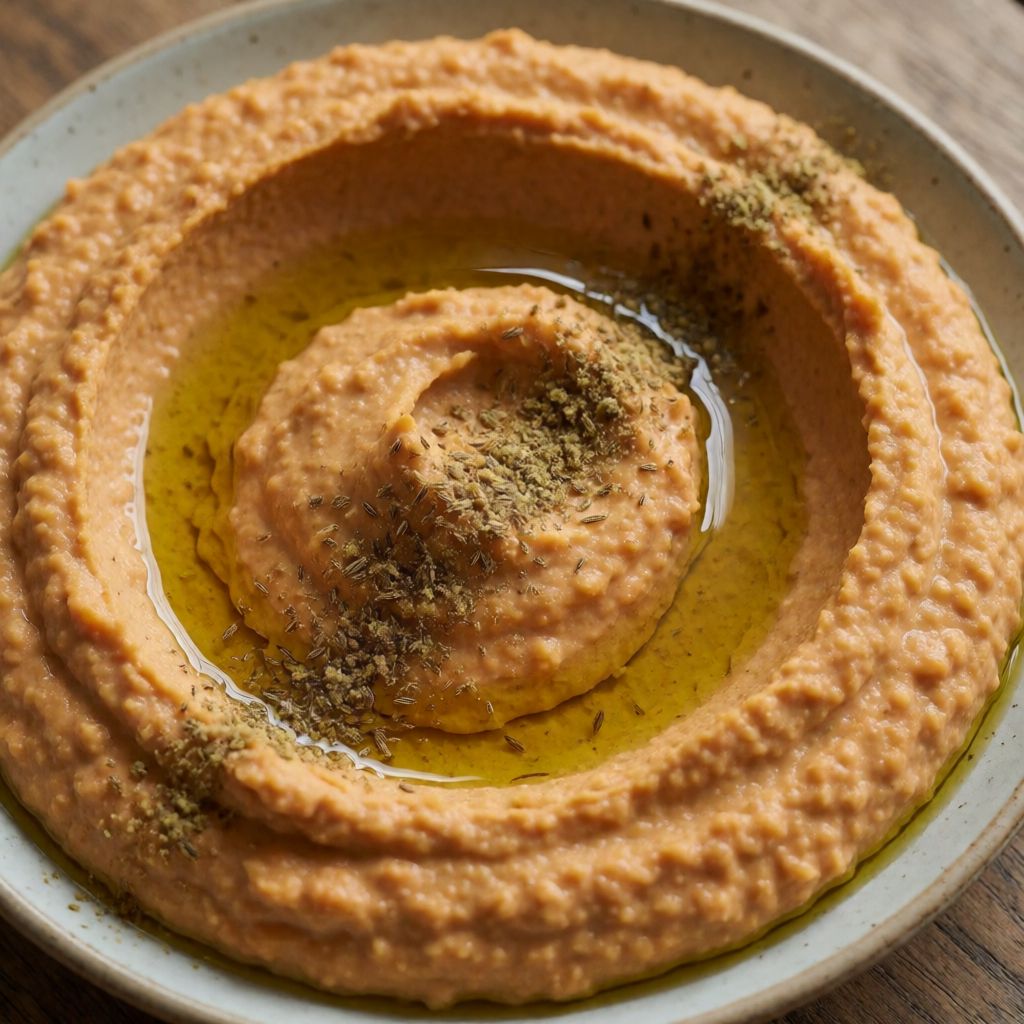
 AI photo
Red Lentil Hummus
A quick, creamy hummus made with red lentils, tahini and lemon.
Labels are worked out automatically from the ingredients and can be wrong. Check the packaging if it matters to you.
Ingredients
- 100 ml Red Lentils
- 2 clove Garlic
- 1 tbsp Tahini
- 2 tsp Cumin ground
- 1 tsp Ground Coriander
- 0.5 pcs Lemon juice only
- 3 tbsp Olive Oil
- Salt to taste
- Black Pepper freshly ground, to taste









Steps
Rinse the lentils and cook them for 15 minutes, adding the garlic cloves for the last 5 minutes of cooking.
15 minDrain the lentils well through a sieve.
Blend the lentils, garlic, tahini, cumin and coriander until creamy.
Season with lemon juice, salt and pepper, adding a little olive oil if needed to reach the desired consistency.
Despite the name, this isn't hummus in the old sense — hummus is just the Arabic word for chickpea, and the classic dish is chickpeas, tahini, lemon, garlic. Here chickpeas are swapped for red lentils, and that one swap changes the whole economics of the thing: no overnight soak, no hour at a simmer, fifteen minutes and you're done. That's the entire appeal of red lentils stepping into a chickpea's shoes — speed, for people who didn't plan their dinner the night before.
What decides if this works isn't the blending, it's everything before the blending: how far the lentils actually break down in the pot, and how well you get the water out of them afterwards. Lentils that are merely "tender" still have a stubborn little core of starch holding its shape — blend those and you get a grainy paste, not a cream. And water left clinging after draining turns a good paste thin and gluey, no matter how much tahini you throw at it.
Some say lentils don't need watching, they're too quick to go wrong — no, because quick doesn't mean careless. A hard, rolling boil cooks them unevenly: some grains collapse to mush, others keep their bite. Keep it at a bare simmer, small bubbles just breaking the surface, not a boil you can hear from the next room. That's what gets every grain collapsed at the same rate, ready to go smooth in the blender rather than fighting you.
Red lentils are split and hulled — the outer coat is gone before you ever open the packet, which is exactly why they cook in fifteen minutes and fall apart so readily. Whole lentils, brown or green, keep their skin and their shape far longer; don't substitute them here expecting the same timing, you'll get a chunkier result that needs much longer at the pot. 100ml of red lentils is roughly 80g — in a kitchen that weighs everything in grams anyway, trust the scale over the jug.
Tahini is sesame ground down to a paste, pure fat and nuttiness, doing the job butter does in mash — carrying flavour and smoothing texture at once. Without it, use any seed or nut butter with a similar oil content and a similarly neutral-to-nutty taste, unsalted and unsweetened: sunflower seed butter works well, almond butter at a push. The result will taste a little different. That's not a failure, it's a different dish wearing the same name.
Ground cumin and ground coriander lose their aroma within weeks of grinding, not years — if yours have sat in the cupboard since the last roast dinner, they're mostly just colour by now. If you can, buy the whole seeds, toast them dry in a hot pan until they smell nutty, then grind just what you need. The whole point of adding them is the smell; stale ground spice gives you none of it.
Lemon juice and salt go in only at the end, after blending, never into the cooking water — acid slows the softening of pulses, so lentils cooked in acidic water stay stubbornly firmer for longer, the opposite of what you want from a fifteen-minute cook. Seasoning at the end also means you're tasting the paste as it actually is, not guessing ahead of time. The olive oil at the end does two jobs at once: it loosens the texture and it adds its own flavour and shine. Any oil with no smell of its own would thin the paste just as well, but since olive oil is doing double duty here, don't swap it out unless you have to.
Patience matters more than it looks like it should for a fifteen-minute dish. The lentils can look soft on the surface at ten minutes while the centre is still faintly starchy, and a paste made from that will never go fully smooth, however long you run the blender. Fifteen minutes is a floor, not a target — look for lentils that have lost their edges and nearly dissolved on their own, not ones that have simply gone pale.