
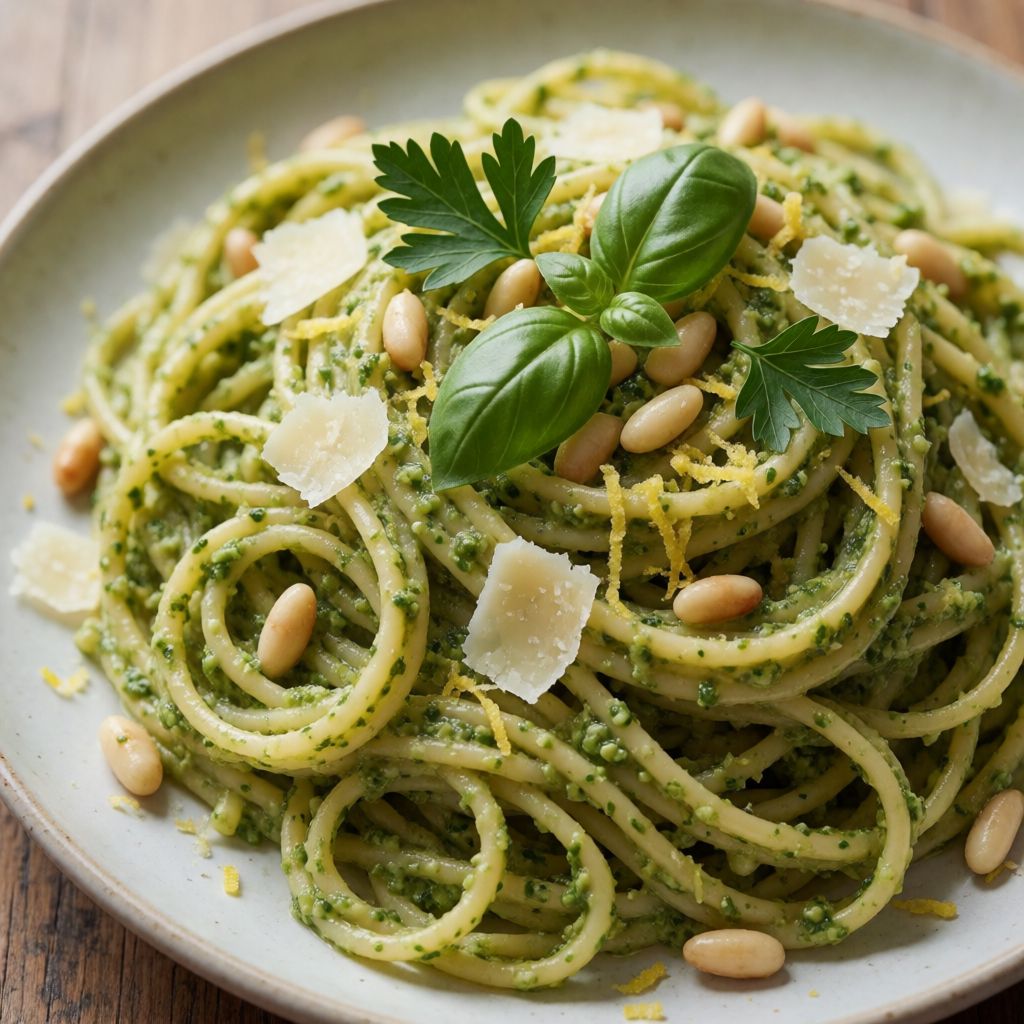
 AI photo
Lemon Pesto Pasta
A bright, zesty pesto made with lemon, pine nuts and Parmesan, tossed with spaghetti.
Labels are worked out automatically from the ingredients and can be wrong. Check the packaging if it matters to you.
Ingredients
- 2 pcs lemon zest
- 100 g lemon juice
- 50 g pine nuts
- 100 g Parmesan
- 6-7 pcs basil leaves
- 1 bunch parsley
- 100 ml olive oil
- salt to taste
- black pepper to taste









Steps
Wash the lemons thoroughly under running water; choose unwaxed lemons if possible.
2 minRemove the zest from the lemons, avoiding the bitter white pith.
3 minSqueeze the lemons to get the required amount of juice.
3 minPour the lemon juice into a blender, add the pine nuts, olive oil and Parmesan.
2 minAdd the chopped basil, parsley, lemon zest, salt and black pepper to taste.
2 minBlend until smooth but not too thick; add a little more olive oil or a spoonful of water if needed.
2 minCook the spaghetti until al dente, drain and toss with the freshly made pesto.
10 minMix well, adding a little of the pasta cooking water if needed.
1 minAdd a little ground black pepper, plate up and garnish with slices of lemon zest.
1 min
Pesto is a cold sauce built on the idea that heat kills green and kills brightness. Genovese pesto is basil, pine nuts, parmesan, garlic, oil — ground, not cooked, so the chlorophyll stays sharp and the oil stays fresh-tasting. This version swaps out garlic's bite for lemon's acid, and leans on parsley to carry the green when basil alone would go muddy and dark. The result is less a cousin of the Ligurian original and more a lemon-herb butter sauce dressed up in pesto's clothes — nothing wrong with that, it just means you should stop expecting basil to be the main flavour.
What decides whether this works is balance between fat, acid and salt, and nothing else. 100ml of oil against 100g of lemon juice is a lot of acid — that's roughly two-thirds of a lemon's worth of sharpness for every spoon of oil, so the parmesan's salt has to hold the middle or the sauce reads as sour rather than bright. Taste before you add all the juice; lemons vary wildly in acidity depending on size and season, and "2 lemons" is not a fixed quantity.
Some say pesto must be made in a mortar and pestle, hence the name — no, because that's etymology, not religion. A blender heats the mixture slightly through friction and can bruise the basil, turning it from green to khaki within minutes if you over-blend. Pulse in short bursts rather than running it continuously; you're aiming for a rough, pourable paste, not a purée, and stopping early costs you nothing.
Lemon zest only, never the pith — the yellow layer holds the aromatic oils, the white layer underneath is pure bitterness with nothing to offer. A fine grater or a sharp peeler used shallow does this; if you go deep you'll taste it as a bitter note you can't explain later, and you won't be able to fix it by adding more sugar or salt, because bitterness doesn't dissolve away. Unwaxed lemons matter here because you're eating the skin, not just the juice — supermarket wax is food-safe but it's also a coating you don't need in your sauce. If you can only get waxed ones, a hot-water scrub with a bit of washing-up liquid, rinsed well, does the job.
Pine nuts are there for fat and a mild, buttery crunch that toasting would improve — if you have five spare minutes, dry-toast them in a pan until they go from pale to light gold and smell nutty, because raw pine nuts taste mostly of nothing. If pine nuts aren't in the cupboard, walnuts or blanched almonds work as substitutes on the same logic: a fat-rich nut with a mild flavour that won't fight the lemon. Cashews work too, for the same reason. What won't work is anything strongly flavoured — pistachios will insist on being the star of a dish that's supposed to be about citrus.
Parmesan here does two jobs at once: salt and body. It's the ingredient holding the whole sauce together against 100g of lemon juice, so don't skimp on it to save money — a weak parmesan or a block that's gone rubbery in the fridge won't grate finely and won't melt into the sauce properly, it'll sit as gritty lumps. Grana Padano is the honest substitute if parmesan's price puts you off; it's made the same way, slightly milder, and nobody at your table will stage a protest.
Basil and parsley together solve a problem basil has on its own: basil leaves bruise and darken fast once cut, especially against acid, so a pesto made of basil alone often turns from bright green to brownish within the hour. Parsley doesn't have this problem — it holds its colour — so it's doing structural work here, not just bulking out the bunch. If you're out of parsley, use more basil and accept the sauce will darken a little sooner; it's not dangerous, just less pretty on the plate.
Olive oil should have no flavour of its own strong enough to compete with lemon — an extra virgin with a peppery, grassy finish is traditional and fine, but if all you've got is a basic "light" olive oil from the supermarket shelf, that's actually not a failure here, since the lemon is doing the flavour work anyway. What you shouldn't reach for is anything with its own strong personality — sesame oil, walnut oil — because this sauce has exactly enough competing flavours already.
Salt gets added twice in effect: once directly, once through the parmesan, and once more through the pasta water you'll stir in at the end. Taste before that final addition, not after — it's much easier to loosen a sauce that's slightly too salty with more pasta water than to rescue one that's already thin and bland.