
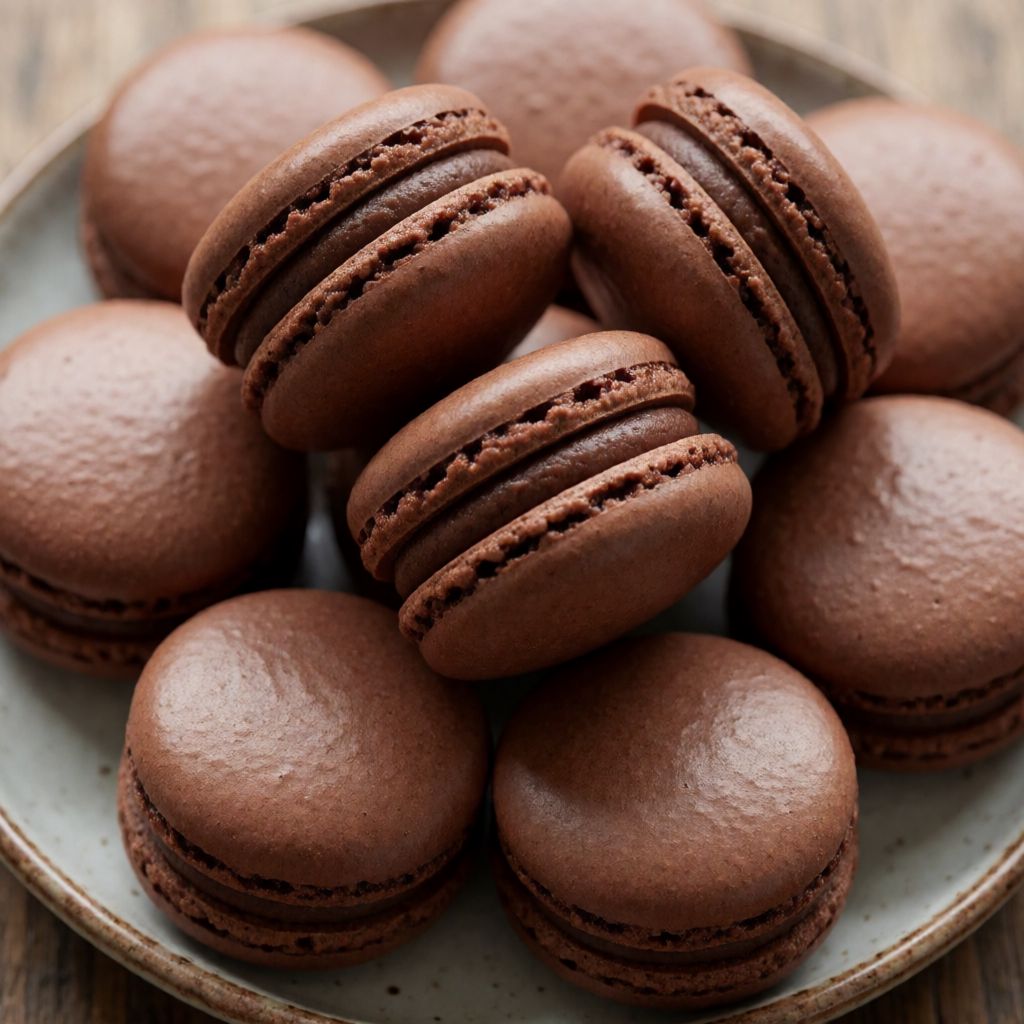
 AI photo
Macarons
Cocoa and coloured macarons filled with a raspberry buttercream.
Labels are worked out automatically from the ingredients and can be wrong. Check the packaging if it matters to you.
Ingredients
Cocoa macarons
- 150 g Ground almonds
- 20 g Cocoa powder
- 125 g Icing sugar
- 110 g Egg whites
- 35 g Water
- 150 g Caster sugar


Coloured macarons
- 150 g Ground almonds
- 150 g Icing sugar
- 110 g Egg whites
- 1 pinch Food colouring paste
- 35 g Water
- 150 g Caster sugar
Raspberry buttercream
- 100 ml Salted caramel sauce
- 100 g Caster sugar
- 50 ml Raspberries
- 125 g Butter room temperature
- 1 pcs Egg yolk
- 0.5 tsp Freeze-dried raspberry powder powder


Steps
Sift the ground almonds and put them in a mini chopper with the cocoa, icing sugar and half of the egg whites; blend until smooth and thick.
Put the water and sugar in a pan, bring to the boil and cook until the sugar dissolves and the temperature reaches 118°C.
Whisk the second half of the egg whites to stiff peaks and gradually pour in the sugar syrup, whisking to a smooth, glossy meringue. Gently fold the meringue into the almond mixture.
Spoon the mixture into a piping bag and pipe 3 cm rounds onto baking paper. Leave the shells to dry at room temperature for 45 minutes.
45 minTransfer to a baking tray and bake in an oven preheated to 160°C (fan) for about 10 minutes.
10 minLeave to cool on the baking paper on a wire rack; only remove from the paper once fully cooled.
Sift the ground almonds and put them in a mini chopper with the icing sugar and half of the egg whites; blend until smooth and thick.
Put the water and sugar in a pan, bring to the boil and cook until the sugar dissolves and the temperature reaches 118°C.
Whisk the second half of the egg whites to stiff peaks and gradually pour in the sugar syrup, then add the food colouring. Gently fold the meringue into the almond mixture.
Spoon the mixture into a piping bag and pipe 3 cm rounds onto baking paper. Leave the shells to dry at room temperature for 45 minutes.
45 minTransfer to a baking tray and bake in an oven preheated to 160°C (fan) for about 10 minutes.
10 minLeave to cool on the baking paper on a wire rack; only remove from the paper once fully cooled.
Put the sugar and raspberry juice in a pan, bring to the boil and cook uncovered.
A macaron is a meringue arguing with an almond paste, and the whole recipe is just rules for making sure the meringue wins without flattening the almond, or the almond winning without drowning the meringue. That tug is why people treat them as fiddly — they're not fiddly, they're just unforgiving of shortcuts, because there's no flour here to hide a mistake. No gluten, no structure to fall back on. Everything rests on egg white protein holding air, and sugar syrup setting that protein in place before it has a chance to collapse.
Two shells, two colours, one filling split two ways — a cocoa shell and a plain one coloured with paste, sandwiched with salted caramel on one side and a raspberry buttercream on the other. It reads as two different macarons but it's one method practised twice, which is the sensible way to learn it: you make the mistake once, you fix it the second time.
What decides whether this works is not the piping, it's the resting. Thirty, forty-five minutes uncovered on the counter, until the surface of the piped round stops being wet and shiny and turns into something you can touch without it sticking to your finger — that's the "skin." Some say you can skip it if your oven's good. No — the skin is what gives you the "foot," that frilly skirt at the base. Without a dry skin, the steam inside has nowhere to push except straight up through wet batter, and it cracks the top instead of lifting a foot underneath. Dry skin first, foot comes free.
Ground almonds and icing sugar, blitzed together with half your egg whites into a thick paste, is doing one job: making sure no sugar crystal or almond lump survives to tear a hole in the shell's surface later. Sieve the almonds before this — not for show, for the same reason, any gritty bit becomes a weak point the air pushes through when it bakes. If your almonds are coarse or a touch oily (cheap pre-ground almonds often are), that's fine for crumbles, wrong here; buy the fine blanched kind if you can, or grind your own in short pulses and sieve out what won't pass.
The syrup brought to 118°C is the part people fear and the part that actually forgives you most. What's happening: you're cooking sugar to a concentration where, poured hot into whisked egg white, it instantly scalds and sets the protein structure mid-whip — that's what gives a macaron meringue its gloss and its stability, versus a plain whisked meringue which is softer and collapses faster. No thermometer, no panic: at that stage syrup dropped into cold water forms a soft ball you can roll between fingers, still pliable, not hard. That old test still works when your thermometer's battery doesn't.
Folding the meringue into the almond paste — this is where most trays go wrong, and it's not about counting strokes, whatever anyone tells you. You're looking for a ribbon: lift the spatula, the batter falls back into itself and the ridge disappears into the surface within several seconds, not instantly, not sitting there stiff. Underfold and you get lumpy, domed shells with no shine. Overfold and the batter runs thin, spreads past your 3cm circle before it skins, and you lose the foot entirely because there's no structure left to hold shape while it bakes. This is feel, not time — thirty folds for one person's wrist is forty for another's.
Baking at 160°C fan for about ten minutes is a lower bound, not a target — pull one off the paper at ten minutes and look underneath: if it lifts clean, sturdy, with a dry foot visible around the rim, you're there; if it tears or the inside's still wet-looking through a crack, give it another minute or two. Ovens lie about their own number constantly, especially small domestic ones with hot spots — rotate the tray halfway if yours runs uneven, which most do.
Cooling fully on the paper before peeling isn't fussiness either — warm shells are still setting their internal structure, and a shell lifted too early tears its base off, stuck to the paper, because the inside hasn't finished drying into that slightly chewy, not-wet crumb you want. Patience here costs you nothing but ten more minutes of not touching them, which is the hardest ingredient in this whole recipe.
For the fillings: salted caramel needs nothing from me you don't already know — sugar cooked to a deep amber before the cream goes in, salt to cut the sweetness that would otherwise be relentless against an already-sweet shell. The raspberry buttercream is butter creamed with yolk and a reduced raspberry-sugar syrup plus freeze-dried raspberry powder for colour and punch without adding wet juice that would split the butter — if you can't get freeze-dried raspberry powder, a spoon of good raspberry jam reduced down works, though you lose some of that sharp true-fruit hit. Any neutral food colouring paste works for the shells — gel or paste, not liquid, which adds water you don't want anywhere near this batter; a few drops too much liquid colouring and you've thinned your ribbon stage without meaning to.
This recipe makes eighty halves, so forty finished macarons if you sandwich evenly — plenty for a gathering, or a tin that outlasts a week of tea breaks if you keep them in the fridge and let them come back to room temperature before eating, which also, incidentally, is when the filling and shell marry properly and stop tasting like two separate things sitting next to each other.