
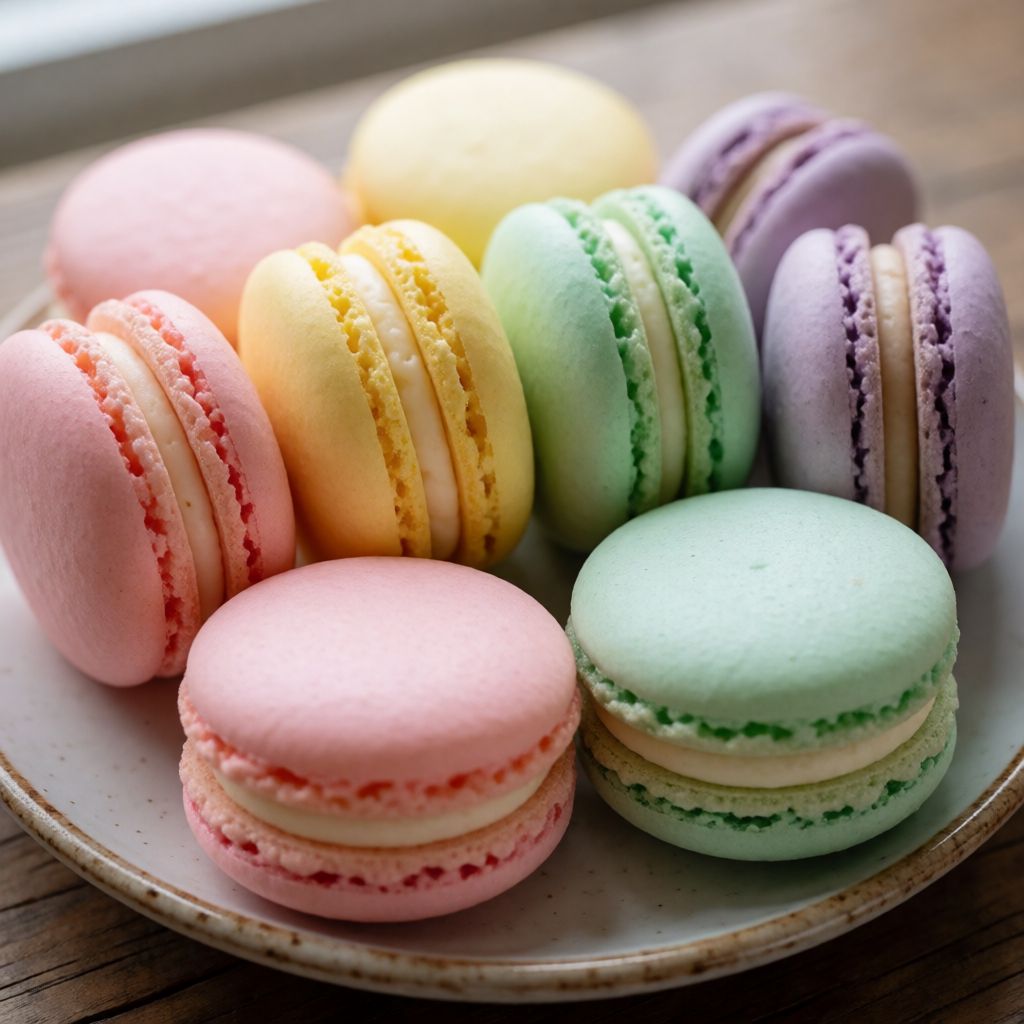
 AI photo
Macarons
Classic French-style macaron shells filled with Nutella.
Labels are worked out automatically from the ingredients and can be wrong. Check the packaging if it matters to you.
Ingredients
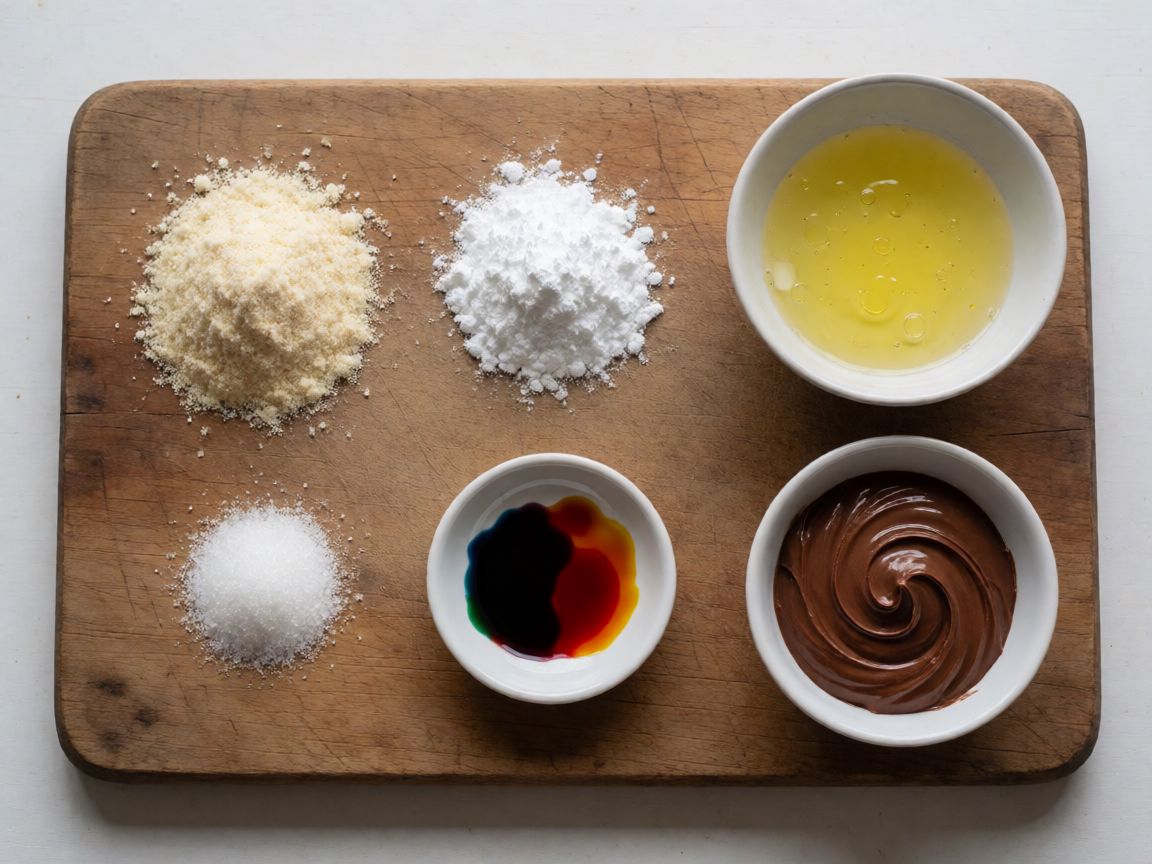
- 100 g Ground almonds
- 100 g Icing sugar
- 80 g Egg whites
- 100 g Caster sugar
- 15 ml Water
- Food colouring to taste
- Nutella to taste







Steps
In a bowl mix the ground almonds, icing sugar and egg whites, stir with a spatula, then knead by hand into a dense paste.
In a saucepan bring the sugar and water to the boil and cook the syrup to 118-121°C.
Whisk the egg whites to a foam, pouring in the hot syrup in a thin stream, until cooled.
Add the food colouring and continue whisking with a mixer.
Combine the whites with the almond-sugar paste, folding until smooth.
Transfer the batter to a piping bag and pipe small rounds onto baking paper.
Smooth any unevenness with the back of a spoon.
Leave at room temperature to form a skin.
20 minBake at 160°C with fan/convection.
10 minOpen the oven door slightly and let sit.
3 minRemove and leave the macarons to cool completely.
Fill half of the macarons with Nutella and cover with the other half.
Macarons are a chemistry demonstration dressed up as a biscuit. Two almond-sugar paste shells, one Italian meringue to bind and lift them, a skin dried on the outside so the inside has somewhere to go when the oven hits it, and a "foot" — that frilled skirt at the base — that either appears or doesn't, and tells you everything about whether you got the mechanism right.
What decides success isn't the piping, it's the egg whites. Macaronage — folding the meringue into the almond paste — has to go just far enough that the batter slumps into a smooth round blob when you lift the spatula, not so far that it turns to soup. Undermixed, it sits in stiff peaks and bakes with a cracked, lumpy top. Overmixed, it spreads thin and footless. There's no timer for this; you watch the ribbon fall off the spatula and judge the fall, not the clock.
Some say macarons fail because of humidity in the room, full stop, end of story — no, that's only half true. Humidity slows the skin from forming, and a wet, tacky skin is what actually cracks in the oven, because steam trying to escape through a weak membrane tears it open instead of pushing the batter up cleanly through the foot. The room matters because it changes drying time, not because macarons are cursed by weather.
Ground almonds and icing sugar, kneaded with raw egg white into a dense paste, form the structural half of the shell — this is what gives the macaron its body and that slightly chewy, almost marzipan-like interior once baked. Buy almonds ground fine, almost flour-fine; coarse ones leave bumps you can't pipe smooth and the shell cracks along those seams. If you can only find coarser ground almonds, a quick turn in a food processor with some of the icing sugar (the icing sugar keeps the oil from turning it into paste) will even it out. There's no real substitute for almonds here without changing what the dish is — this isn't a recipe that bends to "whatever you've got."
The caster sugar and water syrup cooked to 118-121°C is the Italian meringue's backbone. That range matters because it's the soft-ball stage: below it, the syrup is too thin and won't stabilise the foam; above it, it starts turning brittle and you risk cooking the egg white into scrambled threads the moment it hits the whisk. A sugar thermometer earns its cupboard space on this one recipe alone — guessing by eye on a British hob, where burner output varies wildly from one ring to the next, is how people end up with weeping, flat shells.
Food colouring goes in at the meringue stage, while it's still warm and loose, because a gel or powder colouring disperses evenly through liquid foam far better than it would once folded into stiff paste — fewer streaks, less overmixing to even it out. Liquid colouring, by contrast, adds water you don't want; if that's all you have, use it sparingly and expect to extend the drying time slightly.
The 20-minute rest to form a skin, before anything goes near heat, is not decoration time — it's the step that prevents the crack. A dry, slightly matte surface that doesn't stick to a fingertip means the top has set enough to hold firm while the inside still rises and pushes out that characteristic foot at the base. Touch it before baking; if it's tacky, give it longer. A British kitchen in winter, heating on, air dry — this can go faster than a damp summer flat with the windows shut, so trust the finger test over the clock.
Baking at 160°C with fan is deliberately gentle and even — convection circulates heat round each shell equally so they rise together rather than one side of the tray catching before the other, which fan ovens do better than most domestic fan-assisted cookers on static settings. If your oven runs hot or has known hot spots (most do), rotate the tray partway rather than trust the dial. Propping the door for those last three minutes lets residual heat finish the inside without the surface drying out or browning — macarons should stay pale, not biscuit-coloured; browning means the sugar's caramelising and the texture will turn brittle rather than that soft, faintly chewy give.
Cooling completely before filling isn't fussiness either — a warm shell is still soft enough to crush or absorb moisture from the filling and go soggy. Nutella as the filling is the easy, forgiving route: it won't split or weep the way a buttercream can if your kitchen's warm, and it needs no further cooking or chilling. A ganache or jam would work the same way structurally — anything thick enough to sit between two shells without soaking into them — but Nutella's the one requiring nothing from you except a spoon. Five servings here means roughly ten to twelve filled macarons depending on how small you pipe them; they're rich enough that nobody needs three.