
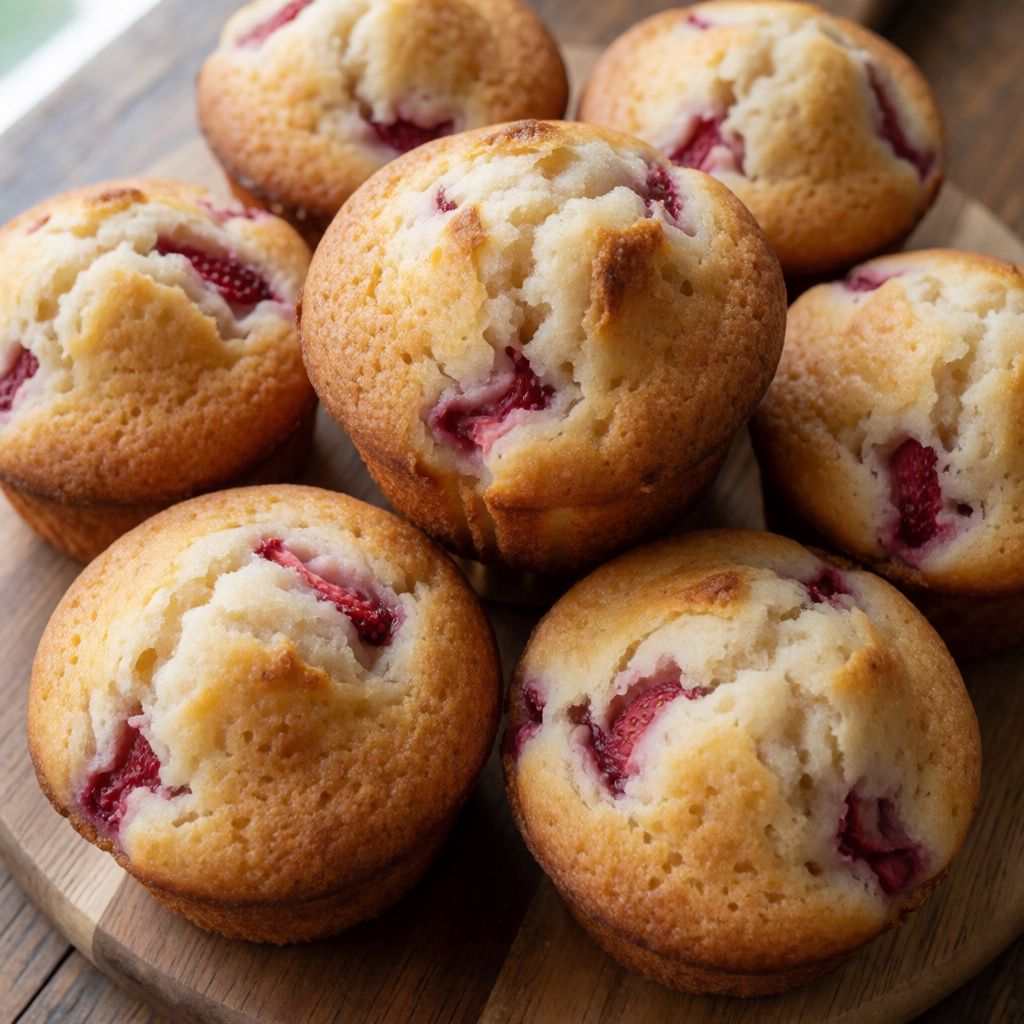
 AI photo
Strawberry Muffins
Soft strawberry muffins made with ricotta and almond flour.
Labels are worked out automatically from the ingredients and can be wrong. Check the packaging if it matters to you.
Ingredients
- 250 g Ricotta
- 150 g Caster sugar
- 1 pcs Egg
- 200 g Plain flour
- 100 g Almond flour
- 100 g Strawberries
- 50 ml Milk
- 15 g Baking powder
- Icing sugar to taste









Steps
Wash and dry the strawberries, hull them and cut into small pieces.
In a separate bowl, sift the flour and add the almond flour, caster sugar and ricotta; mix well.
Add the egg, then pour in the milk in a thin stream, mixing again.
Fold in the baking powder and strawberries, mixing until you get a smooth, even batter.
Using a ladle, divide the batter among muffin cases, filling each about two-thirds full.
Bake in a preheated oven at 180°C for 25 minutes.
25 minRemove from the oven, leave to cool, and dust with icing sugar before serving.
These are not cupcakes dressed up with fruit. The ricotta is doing the job butter usually does — it's the fat, and most of the moisture, in one spoonable lump. That's why the batter looks heavier and wetter than an ordinary muffin mix before it ever meets a strawberry. What decides whether this works is whether that ricotta is dry enough to bind, not swim.
Second thing that decides it: the oven has to be hot and steady at 180°C before the tray goes in, not still climbing while the door's shut. Baking powder reacts twice — once when it meets liquid, once when it meets heat — and that second kick is what lifts the dome. Twenty-five minutes is a lower bound, not a deadline: push a skewer into the centre, and it should come back with no wet batter clinging to it. If it does, give it a few more minutes rather than trusting the clock.
Third: two-thirds full in the case, no more. Some say you fill muffin cases nearly to the rim because "they don't rise that much" — they do here, because almond flour carries fat but no gluten, so there's nothing in the structure to hold the crumb back once the baking powder fires. Overfill, and the batter climbs over the paper, scorches on the tray edge, and the top collapses sideways instead of setting into a dome.
Ricotta is the whole architecture of this cake, so choose it on sight, not by the label. You want the kind that holds its shape on a spoon, not the kind that pools whey the second you open the tub — that extra water has nowhere to go but into your batter, and it's what leaves the middle of the muffin gummy no matter how long you leave it in. If yours looks wet, tip it into a sieve for ten minutes and let the whey drain off first. Italian bakers built a whole shelf of cakes around ricotta for a plain reason, not a romantic one — it was the cheap, plentiful leftover of proper cheese-making, the curd strained from the whey after the real cheese was taken. Nothing sacred, just using what the dairy had spare. If you've none, a well-drained cottage cheese blitzed smooth, or mascarpone loosened with a spoon of yoghurt, does the same job: soft curd, little free liquid.
Almond flour isn't here for flavour, though you'll taste a trace of it. It's fat without gluten — it keeps the crumb short the way butter does in a sponge, instead of letting the plain flour build long strands that turn the cake chewy and bread-like. No almond flour in the cupboard? Use more plain flour in its place, but expect something denser, closer to a scone than a muffin — not wrong, just a different animal.
The egg binds; it doesn't lift. One is enough, because the ricotta already supplies the moisture a muffin would normally take from oil or melted butter — a second egg would toughen the crumb rather than richen it. The milk goes in after, in a thin stream while you keep mixing, because tipping it in all at once against egg and ricotta risks splitting the batter into lumps and liquid instead of one smooth mass, and lumps don't dissolve back out once the flour's folded through.
Fifteen grams of baking powder against three hundred grams of flour is heavy-handed by the standard of an ordinary cake, and that's the point — it's compensating for the dead weight of the ricotta, which carries no whipped-in air the way sugar-and-butter would. Fold it in last, and don't let the batter sit once it's mixed. The reaction starts the moment the powder meets wet, and every minute it waits on the worktop before the oven is lift you won't get back. That's the one place patience works against you here — everywhere else this batter is forgiving, but between mixing and the oven, move with intent.
Strawberries go in cut small and properly dried, because wet fruit folded straight into batter bleeds juice and sinks, leaving a damp streak at the bottom of the baked muffin rather than fruit scattered through it. Any firm berry behaves the same way, so if strawberries are thin and pale out of season, swap on the same logic — cut small, pat dry, fold in last, don't apologise for it.
Icing sugar at the end is cosmetic, not structural, and it only works dusted on once the muffins are properly cool. On a warm muffin it melts into a thin wet gloss instead of sitting as visible dust, which rather defeats the point of bothering with it at all.