
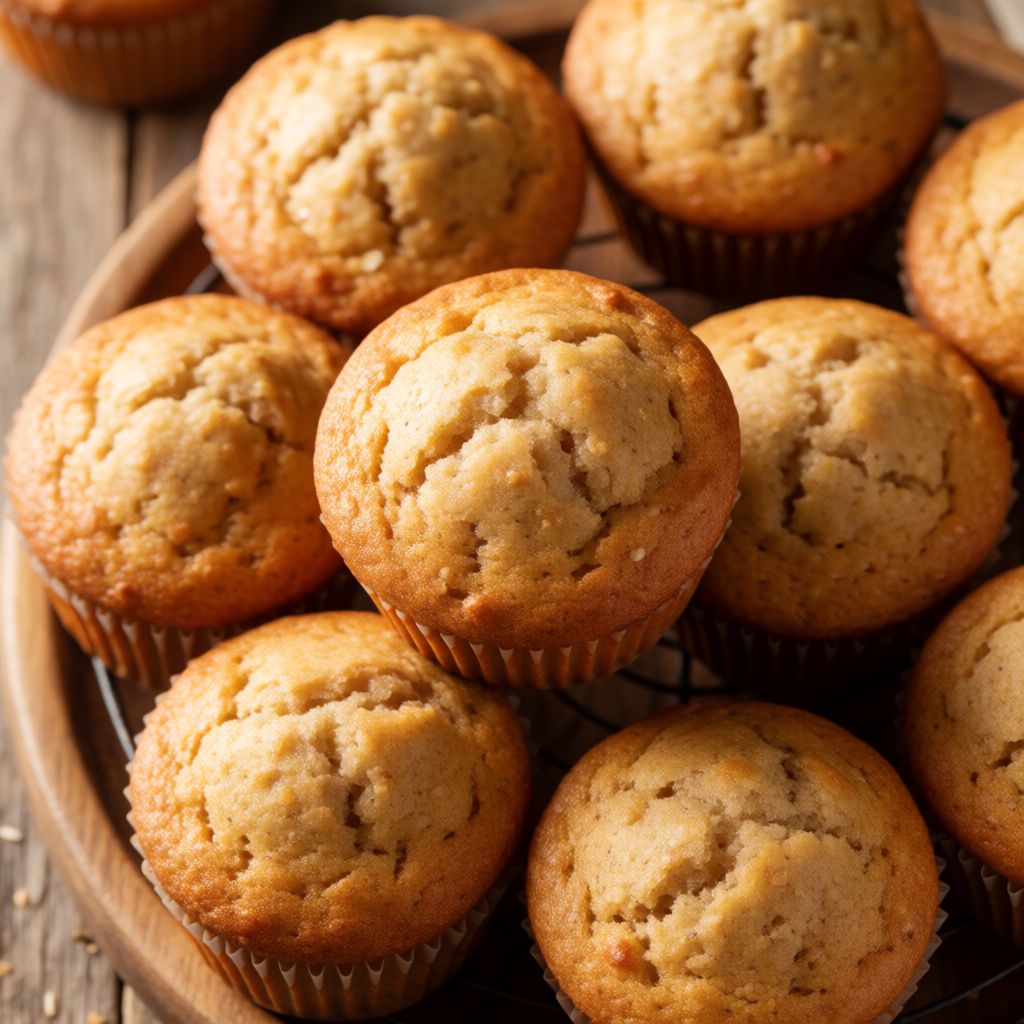
 AI photo
Oat Bran Muffins
Soft, lightly spiced oat bran muffins, sweetened with honey and brown sugar.
Labels are worked out automatically from the ingredients and can be wrong. Check the packaging if it matters to you.
Ingredients
- 150 g Plain flour
- 50 g Potato starch
- 100 g Oat bran
- 100 g Honey
- 50 g Brown sugar
- 150 ml Milk at room temperature
- 1 pcs Egg
- 2 tbsp Vegetable oil
- 5 tbsp Rolled oats
- 1 tsp Cinnamon
- 8 g Baking powder with a few drops of vanilla extract
- Icing sugar to taste










Steps
Sift the flour and potato starch into a large bowl, add the brown sugar, baking powder, cinnamon and oat bran, and mix.
In a separate bowl, whisk the egg with the room-temperature milk until smooth. Add the vegetable oil and honey, and whisk again.
Gradually pour the liquid mixture into the dry ingredients, stirring thoroughly with a spoon until the batter is smooth.
Divide the batter among the holes of a muffin tin using two teaspoons.
Sprinkle the tops of the muffins with rolled oats.
Preheat the oven to 200°C and wait a few minutes for it to heat through.
Bake the muffins for about 20 minutes, until golden and well risen.
20 minLet the muffins cool slightly, then dust with icing sugar.
What was changed
Baking powder replaces vanilla-flavoured baking powder, as it is not sold in local shops; plain baking powder with a little vanilla extract is used instead.
These aren't cupcakes pretending to be virtuous — oat bran muffins are a genuinely different animal, dense and a bit nubbly, built around the fact that oat bran doesn't behave like flour. It has almost no gluten of its own, so it can't trap the air and rise the way plain flour does on its own. That's why potato starch is sitting in there with it: starch keeps the crumb tender and prevents the bran from turning the whole thing into something you'd call "hearty" in the worst sense — dry, crumbly, falling apart in your hand.
What decides whether this works is not the mixing, it's the restraint in the mixing. You fold a wet mix into a dry one, and the second the flour's wetted, gluten starts forming strands. Overwork it and you get muffins with tunnels running through them and a tough, chewy top — the texture of a bread roll, not a muffin. Stir until you can't see dry patches and stop. A few lumps are not a mistake, they're insurance.
Doneness here isn't really about the clock, though the recipe gives you twenty minutes as a floor, not a target. Look for the rise — a proper dome, not a flat puck — and a colour that's gone from pale batter-yellow to a warm gold at the edges and on the oat-sprinkled top. Press the centre lightly: it should spring back rather than leave a dent. A domestic oven runs hot in patches, so rotate the tray halfway if your oven has a side that scorches — you'll know which side if you've baked in it before.
The flour-to-starch ratio is the backbone. Plain flour gives structure through gluten; potato starch dilutes that gluten slightly and brings a silkier, less chewy bite — it's the same trick behind a lot of Eastern European baking, where starch stretches flour and softens crumb at the same time. If you haven't got potato starch, cornflour does the same starchy job, though it's a touch blander; don't swap in more flour instead, you'll lose the tenderness the starch was there for.
Oat bran is the point of the whole recipe, not a garnish. It absorbs liquid slowly and keeps absorbing it even after baking, which is why these muffins stay moist for a day or two rather than drying out like a plain sponge muffin does. If you can only find rolled oats and not bran, pulse them briefly in a blender — bran is really just the coarse outer layer, ground finer than a whole oat but rougher than flour. Don't substitute oat flour; it behaves too much like ordinary flour and you lose the texture entirely.
Honey and brown sugar split the sweetening job because they do different things. Honey brings moisture — it's hygroscopic, it pulls water in and holds it, which is part of why these muffins don't go stale fast. Brown sugar brings a dry sweetness and a faint molasses note, plus it helps the tops catch colour in the oven through caramelisation. If you swap all the honey for sugar, add a splash more milk or oil, or the batter will be too stiff and the muffins will bake drier.
The egg and milk, whisked first and brought to room temperature deliberately, are there to stop a specific failure: cold milk and cold egg hitting oil makes the oil seize into little beads instead of blending smoothly, and you end up with greasy pockets in the finished muffin instead of an even crumb. Room temperature isn't fussiness, it's just giving the fat a fair chance to emulsify.
Vegetable oil is chosen over butter because oil stays liquid and coats the oat bran evenly, keeping the crumb soft; butter solidifies as it cools and can make a bran-heavy batter feel drier once it's out of the oven. Use any oil with no smell of its own — sunflower, rapeseed, a light vegetable oil — anything that won't compete with the cinnamon and honey. Olive oil will work in a pinch but it brings its own flavour, so use it only if you don't mind that.
Baking powder with a few drops of vanilla is doing two separate jobs that happen to share a spoon: the baking powder is the only thing giving lift here, since the bran and starch can't do it themselves, so don't skimp on it or measure it stale — it loses potency sitting in a cupboard for months. The vanilla is purely for smell, nothing structural, so if you haven't got extract, a pinch of vanilla sugar in with the brown sugar does the same gentle job.
On a British hob and oven: 200°C fan-assisted will run hotter than a non-fan oven at the same number, so if you've only got a fan oven, drop it by about 15–20°C to land in the same place — the recipe's 200°C assumes you'll judge by the dome and the gold colour anyway, not blindly trust the dial. A muffin tin with paper cases makes life easier if you don't want to scrub batter out of tin wells later; no shame in it, that's just kitchen economics, not tradition.
Patience here is short but real — not the hours of a stew, but the discipline of stopping stirring early and the discipline of letting the muffins sit a few minutes before dusting with icing sugar. Dust them hot and the sugar melts into a wet streak instead of sitting as a fine white layer; that's the whole reason step eight tells you to wait.