
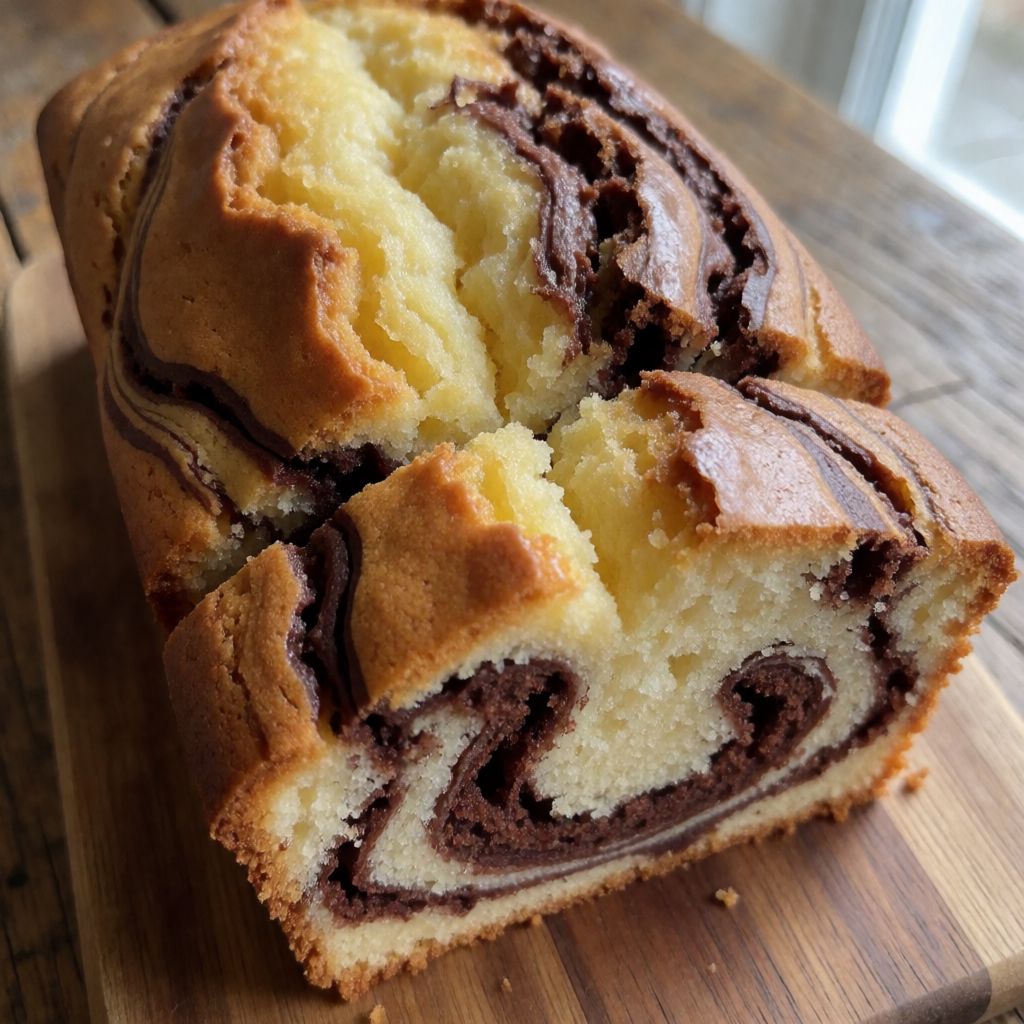
 AI photo
Marble Cake
A classic marble cake with vanilla, orange zest and dark chocolate, swirled into one pretty loaf.
Labels are worked out automatically from the ingredients and can be wrong. Check the packaging if it matters to you.
Ingredients
- 1 pcs vanilla pod
- 200 g sugar
- 1 pcs orange zest
- 200 g butter soft, room temperature
- 4 pcs eggs
- 200 g plain flour
- 2 tsp baking powder
- 1 pinch salt
- 75 g dark chocolate
- 50 g hazelnuts roughly chopped








Steps
Split the vanilla pod lengthways, carefully scrape out the seeds with a knife and add them to the sugar.
Beat the sugar, vanilla, orange zest and butter until light and fluffy, then beat in the eggs one at a time.
Mix the flour, baking powder and salt, sift into the batter and mix well.
Melt the chocolate in a bowl over a pan of simmering water on low heat and add a third of the plain batter to the bowl with the chocolate.
Carefully pour the chocolate batter into the bowl with the plain batter and just fold together with a spatula, making one figure of eight.
Pour the batter into a greased tin about 10 x 25 cm, lined with baking parchment.
Bake the cake in a preheated fan oven at 175°C for about 45 minutes.
45 minKeep an eye on the cake and check with a wooden skewer in the centre to make sure it is cooked through.
Remove the cake from the oven and let it cool.
A marble cake is two batters that never properly meet — a plain one, and a chocolate one — swirled just enough to leave streaks, not a brown cake with spots. The whole trick lives in that one figure-of-eight fold: too little and you get a plain cake with a chocolate blob, too much and you get an evenly brown cake with no marble at all, just cocoa-tinted sponge.
What decides whether it works is restraint in two places: beating the butter and sugar until it's genuinely pale and fluffy — not just mixed — because that's where the air for the rise comes from, not from the baking powder alone; and then deliberately under-mixing the two batters together at the end, which feels wrong the first time you do it, because everything in baking up to that point has told you to combine thoroughly.
Some say you need a kazan-deep tin or a fancy marble mould for the pattern to show. No — a loaf tin does the job, because the pattern comes from the fold, not the vessel. A standard British 2lb loaf tin (roughly 21 x 11 cm) is close enough to the stated 10 x 25 cm; the cake will just sit a bit taller and may want a few extra minutes.
This is a teatime cake, not a showpiece — dense, buttery, citrus-scented, with bitter dark chocolate running through it rather than sitting on top. Good with the milky tea you'd already be having; it keeps well past the day it's baked, which plain Victoria-style sponges don't, because the butter content and the chocolate keep it from drying out as fast.
The vanilla pod and orange zest aren't decoration, they're there to fight the one real flaw of a cake this buttery: it can taste flat, all fat and sugar and little else. Scraping seeds into the sugar rather than the batter matters because sugar is abrasive — rubbing the seeds through it breaks the pod's little black flecks apart and spreads the flavour evenly, instead of leaving clumps that end up as bitter specks in one bite and nothing in the next. No vanilla pod at hand? A teaspoon of good vanilla extract added with the eggs does the job, just stirred in rather than rubbed into sugar, since there's nothing to rub.
Butter has to be properly soft — pliable, not greasy, not melting — because the beating stage is physical, not chemical. You're forcing tiny air bubbles into fat, and cold butter won't hold them; it just breaks and goes grainy instead of pale. That trapped air, together with the baking powder, is what keeps a cake this dense with butter from turning into a brick. Any unsalted butter with a clean taste works; margarine will get you a cake, but a duller one, because margarine carries water and additives butter doesn't, and that changes both the crumb and the flavour.
Eggs go in one at a time for the same reason you don't dump flour into hot oil — a sudden shock makes things split. Butter-sugar foam holds a little egg at a time; add all four eggs together and the water in them can curdle the fat emulsion before the flour arrives to stabilise it. If that happens, it isn't ruined — the cake just loses some of its lightness. Room-temperature eggs make the risk smaller, because cold eggs chill the butter back toward firmness exactly when you need it soft.
Flour, baking powder and salt are sifted together rather than added separately, which has nothing to do with lightening flour — modern flour doesn't need that — and everything to do with distributing the baking powder evenly, so you don't get one dense patch and one over-risen patch in the finished loaf. The salt is not for salting; it's there because sugar without any salt tastes sweeter in a flat, one-note way, and a pinch sharpens everything else.
The chocolate is melted gently over simmering water, not direct heat, because dark chocolate scorches and turns grainy above roughly body temperature plus a little — once it seizes, no amount of stirring brings back the shine or the flavour. Taking a third of the plain batter into the chocolate bowl does two things: it loosens the melted chocolate so it folds in without sinking in one stubborn lump, and it keeps the ratio of chocolate batter to plain roughly one-to-two, which is why you get streaks rather than a fifty-fifty checkerboard. The hazelnuts, folded in or scattered depending on taste, are there for the one thing a soft, dense batter can't give you: something to bite against. Any raw nut you can roughly chop works — almonds, walnuts — the point is texture, not a particular nut.
On checking doneness: a skewer in the middle is the only honest test here, because the chocolate streaks will look dark and "underdone" by eye long after the cake is actually cooked — colour lies, texture doesn't. Go in at the stated time, not before, and treat it as the earliest you check, not the moment you pull it out. Fan ovens run a touch fiercer than they claim; if yours runs hot, start checking a little early rather than trusting the clock blindly. And give it the full cool before slicing — cutting a hot cake tears the crumb and you lose the marbling at the very moment you want to see it.