
 AI photo
Marshmallow Cookies
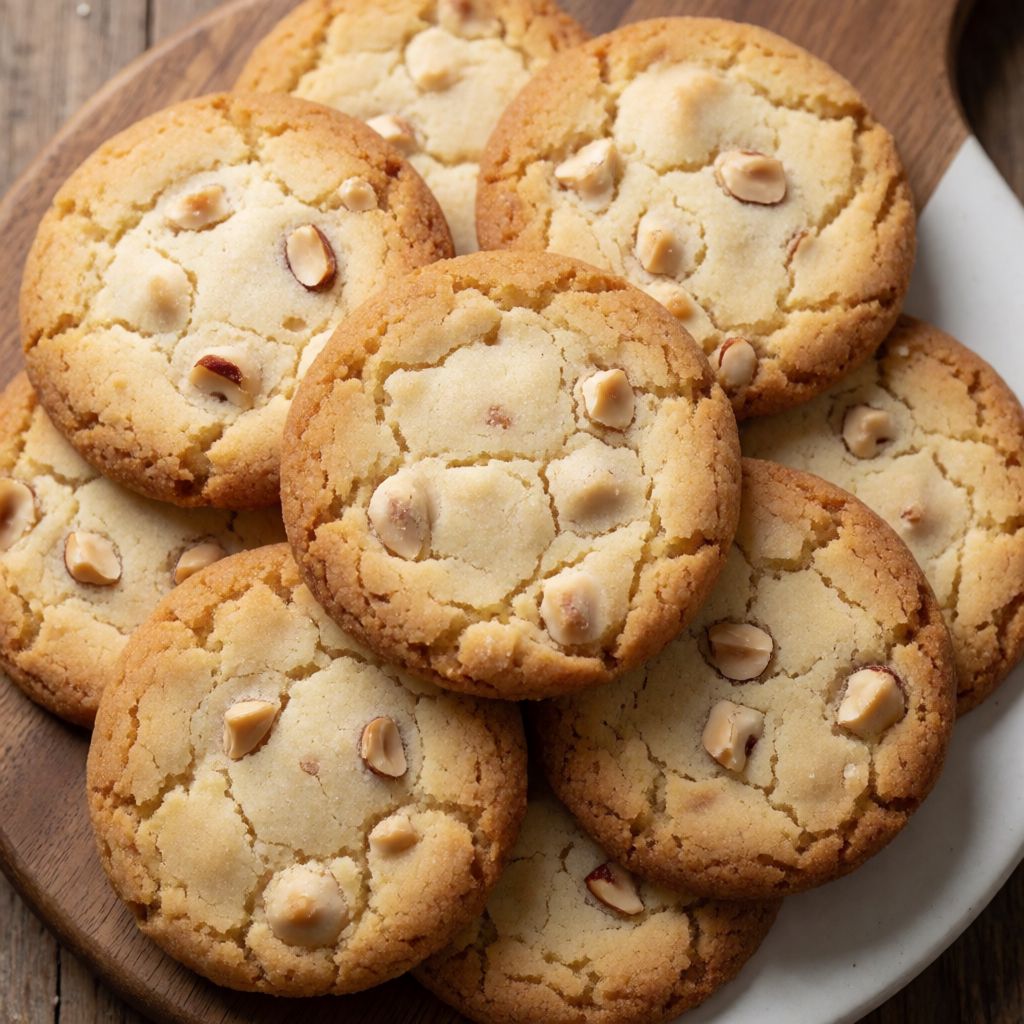
Chewy hazelnut and chocolate cookies studded with mini marshmallows.
Labels are worked out automatically from the ingredients and can be wrong. Check the packaging if it matters to you.
Ingredients
- 100 g Hazelnuts roughly chopped
- 150 g Butter room temperature
- 130 g Caster sugar
- 100 g Brown sugar
- 2 pcs Eggs
- 220 g Plain flour
- 0.5 tsp Vanilla sugar
- 0.5 tsp Baking powder
- 1 pinch Salt
- 100 g Dark chocolate roughly chopped
- 75 g Milk chocolate roughly chopped
- 40 g Marshmallows mini








Steps
Preheat the oven to 175°C (fan) and spread the hazelnuts on a tray while it heats.
Take the nuts out once the skins turn brittle and start to crack; rub them in a clean tea towel to remove the skins, then roughly chop. Set aside for later.
Beat the butter, caster sugar and brown sugar together.
Add the eggs one at a time, beating to a smooth mixture after each egg.
Mix the flour, vanilla sugar, baking powder and salt, sift into the batter and mix well.
Add the chocolate, hazelnuts and marshmallows and mix thoroughly into the dough.
Shape the dough into balls and place on two trays lined with baking paper, pressing lightly. Leave enough space between them as they spread while baking.
Bake in the preheated oven at 175°C (fan) for 13-15 minutes, until the cookies are golden but still a little soft in the middle.
14 minLet the freshly baked cookies cool slightly on the tray before transferring to a wire rack to cool completely.
A cookie that is really two doughs pretending to be one: a brown-sugar butter base that wants to spread thin and crisp, loaded with enough hazelnuts, chocolate and marshmallow that it never quite manages it. What decides whether this works is restraint at the oven door — pull them while the middle still looks underdone, because a cookie carries on cooking on the hot tray for a good minute after you take it out. Wait for "golden all over" and you'll get a biscuit, not a cookie.
The brown sugar is doing more than sweetening. It's hygroscopic — it holds water — so it keeps the centre soft while the edges, with less moisture to lose, firm up and brown. Swap all the brown sugar for caster and you lose that chewy middle; the biscuit goes uniform and dry. This is the same mechanism that makes a flapjack chewy rather than crunchy, just smaller and in company.
The marshmallow is the odd one in: 40g against 150g of butter and 230g of sugar is not there to be tasted as marshmallow. It melts, bubbles, and sets into little pockets of chew around the chocolate — texture, not flavour. Some say you can leave it out and nothing changes. No — you lose the one unpredictable bite in an otherwise even cookie, the thing that makes someone stop mid-sentence over their tea.
Butter at room temperature, not melted, not fridge-cold — you're after a butter that holds air when beaten with the sugars, not one that just goes slick. Cold butter won't trap the air bubbles that give the cookie its lift at the edges; melted butter gives you a flat, oily puddle because the structure collapses before the flour's had a chance to set. If your kitchen is cold, fifteen minutes out of the fridge, cut into pieces, does the job faster than leaving a whole block sitting there.
Caster sugar and brown sugar together, not one or the other, because they're not interchangeable despite both being "sugar". Caster dissolves fast and gives you the crisp edge; brown, with its molasses content, gives you moisture and that deeper, almost toffee note, plus the chew discussed above. If you only have dark brown sugar in the cupboard, use it — the flavour goes a shade more treacly, no disaster. White sugar alone and you've made a different, drier biscuit.
Eggs, added one at a time: this isn't fussiness, it's about emulsion. Butter and egg don't naturally want to mix — add both eggs in one go to a cold-ish butter-sugar mix and you risk it splitting, going curdled and grainy instead of smooth, because the water in the egg can't disperse fast enough through all that fat at once. One egg, beaten in properly, then the second, keeps it stable.
Flour, plain, 220g, is simply the scaffold — gluten enough to hold the dough together, not so much you're building bread. Baking powder, half a teaspoon, is modest on purpose: this is a cookie that spreads and chews, not one that puffs. More raising agent and you'd get a cakey dome instead of the flatter, crackled top you want. Vanilla sugar is there for aroma lifted by heat — if you haven't got it, a drop of vanilla extract added with the eggs does the same work; don't skip it thinking sugar is sugar, vanilla sugar is carrying scent, not sweetness.
Dark and milk chocolate together, roughly chopped rather than chips, because chips are moulded to resist melting — they're built for cookies that want neat round dots. Chopped chocolate melts unevenly, bleeds a little into the dough, leaves streaks and pools. That's the point here: you want some bitterness from the dark against the sweetness of everything else, so don't swap it all for milk chocolate or the cookie tips over into just-sweet with no edge to it. Any chocolate over about 60% cocoa will do for the dark; any eating chocolate for the milk.
On spacing and the two trays: the dough spreads as the butter melts and the sugars loosen, so cookies placed close will merge into one slab with no crisp perimeter — a known amateur mistake that has nothing to do with the recipe and everything to do with impatience to use one tray. Give each ball real space, more than seems necessary at the raw stage.
Sixteen cookies from this amount, enough for a full round of tea in a house that doesn't stand on ceremony — one each with the first cup, one more with the second. The soft-centre window is short, maybe a minute either side of fourteen, so don't wander off; a kitchen timer here is not neurotic, it's the only way to catch that line between "still a little pale and soft" and "set and dry," and that line is the whole recipe.