
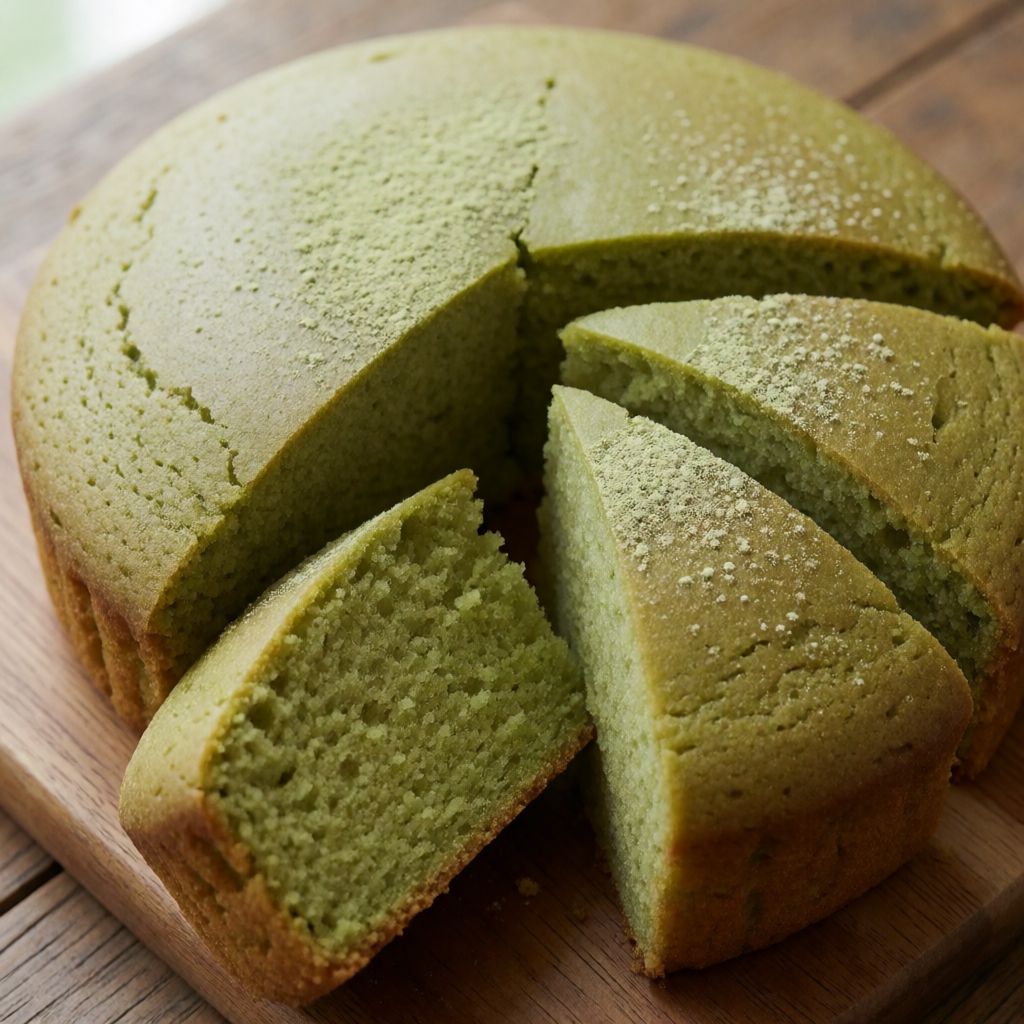
 AI photo
Matcha Tea Cake
A light, buttery cake tinted and flavoured with matcha tea, finished with a dusting of icing sugar and matcha.
Labels are worked out automatically from the ingredients and can be wrong. Check the packaging if it matters to you.
Ingredients
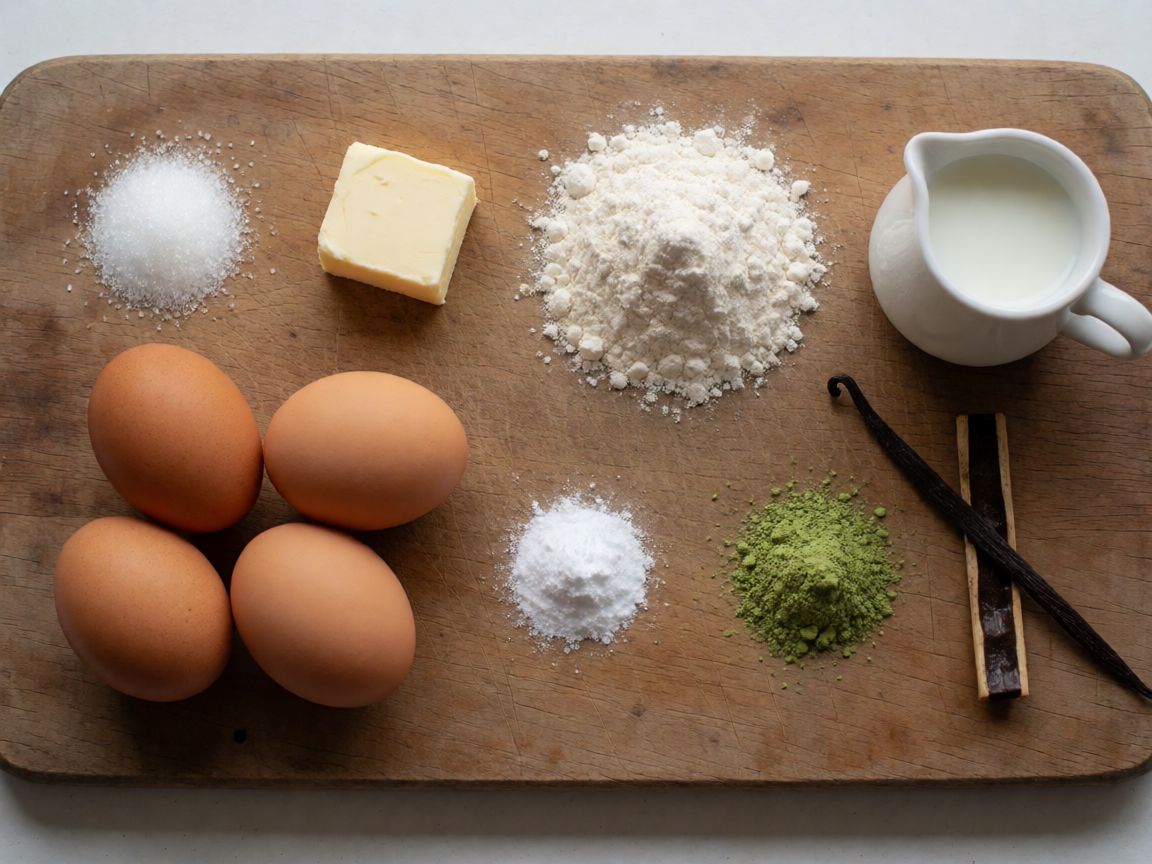
- 250 g Caster sugar
- 250 g Butter
- 250 g Plain flour
- 4 pcs Eggs
- 16 g Baking powder
- 2 tsp Matcha
- 2 tbsp Milk
- 0.5 pcs Vanilla pod
- Icing sugar to taste








Steps
Take the eggs and butter out of the fridge and let them come to room temperature.
30 minIn a large bowl, combine the sugar and the butter, cut into pieces, and beat until smooth and creamy.
Split the vanilla pod in half, scrape out the seeds with the tip of a knife and add them to the batter.
Add the four whole eggs and beat again with a mixer until the mixture is light, fluffy and voluminous.
Gradually add the sifted flour, folding it in with circular, top-to-bottom motions.
Add the sifted baking powder and mix until you have a smooth, lump-free batter.
Gently warm the milk in a small saucepan. In a small bowl, mix two teaspoons of matcha with the warm milk into a thick, smooth paste.
Add the matcha-milk mixture to the batter and stir until evenly pale green.
Lightly butter a round 22 cm tin or line it with dampened, well-wrung baking paper.
Pour the batter into the tin and smooth the top with a spatula.
Bake in a preheated oven at 170°C (static/conventional) for 60 minutes.
60 minCheck with a wooden skewer — it should come out dry; remove the cake from the oven and let it cool slightly.
Carefully remove the cake from the tin and transfer it to a wire rack to cool completely.
Before serving, dust the top of the cake with a mix of icing sugar and matcha.
This is a pound cake wearing a kimono. Equal weights of butter, sugar and flour — the old French quatre-quarts ratio, invented by bakers who couldn't be bothered weighing, because one egg weighs roughly what one portion of butter, sugar or flour weighs, so you just matched everything to the eggs — and then matcha stirred in to turn it green and give it that faint grassy bitterness against the sweetness. It's a cake built on a ratio, not a recipe, which is why it forgives you almost everywhere except one place: creaming the butter and sugar.
That first beating isn't decoration. You're not just mixing, you're trapping air in thousands of tiny pockets around sugar crystals and fat. Every one of those pockets is a future pocket of steam and expanding gas that lifts the crumb. Skip it, or do it cold, and your baking powder is working alone — it'll get you some lift, but a dense, close one, not the open, soft crumb a pound cake is meant to have. Room-temperature butter isn't fussiness. Cold butter won't hold air; it just shears into lumps. Some say you can cheat it by melting the butter instead — no, because melted fat can't trap anything, it's already given up its structure.
The oven number, 170°C static, matters more than it looks. Fan ovens push hot air hard across the surface and will catch the outside of a tall, dense batter like this before the centre's had a chance to set — so if yours is fan-only, drop it by about 20 degrees as a rule of thumb, not a guess, and check the skewer earlier rather than trust the clock. Sixty minutes is the lower bound here, not the answer. A pound-cake ratio like this is heavy and wet relative to a sponge, so it needs the long, gentle bake to cook through without a dry crust forming on top first. The skewer test exists precisely because ovens lie — every one runs a little hot or cold, and a cake this dense can look done on top and still be batter two centimetres down.
Butter: you want one with no strong character of its own beyond "butter" — nothing cultured or heavily salted, because its job is structure and a background richness, not flavour competition with the matcha. Unsalted is the safer default; if you've only got salted, that's fine, just don't add extra salt elsewhere, there isn't any in this recipe to begin with.
Sugar: caster, specifically, because the fine grain dissolves into the butter during creaming instead of sitting there as grit. Granulated will work in a pinch but you'll beat for longer and still feel the odd crystal on your tongue — not a disaster, just a texture tell.
Eggs: room temperature isn't a ritual, it's about emulsion. Cold eggs hitting warm creamed butter can make the mixture split — curdle, basically — because fat and water-based egg don't want to mix easily when there's a temperature shock involved. If it does split a little, don't panic, a spoonful of the flour beaten in will usually bring it back together; the flour's starch acts as a buffer between the fat and the water.
Flour: plain, not self-raising, because you're controlling the rise yourself with measured baking powder — self-raising already has its own amount baked in and you'd end up either flat or over-risen and craggy on top. Sift it; this cake has no other leavening help beyond the powder and the air you beat in, so lumps of flour are lumps that never fully hydrate and leave streaks in the crumb.
Baking powder: 16g against 250g flour is a generous but not reckless ratio — enough to lift a dense batter, not so much that it tastes metallic or makes the top collapse after it's over-expanded. If yours has sat in the cupboard since last Christmas, test it in a cup of warm water first — it should fizz energetically. Flat fizz means flat cake.
Matcha: culinary-grade matcha, not the ceremonial stuff meant for drinking straight — ceremonial grade is expensive and delicate in flavour, which gets lost once you bake it; culinary grade is made for exactly this, holding its colour and slightly grassy bitterness through heat. If you can't get matcha at all, you haven't really got a substitute that keeps the name — a strong-brewed, finely ground green tea can approximate the colour and bitterness but won't have the same smoothness, since matcha is the whole leaf ground fine, not an infusion.
Vanilla: the pod gives you both flavour and those little black flecks that tell you it's real vanilla, not an essence from a bottle. No pod, use a good teaspoon of vanilla extract — not "flavouring", which is usually vanillin made in a lab and tastes thinner and more one-note.
Tin: 22cm is wide enough and shallow enough for a 170°C oven to reach the centre in that hour without the edges drying out first — go smaller and the middle stays wet when the outside's already dark; go bigger and it'll bake faster than the time given, so start checking it sooner. Damp, wrung-out paper moulds into the corners of the tin better than dry paper, which just fights you and springs back.
And patience — real patience, not the thirty seconds before you reach for a knife — matters twice here. Once while the cake cools on a rack before you unmould it fully, because a warm pound cake is still structurally soft and will tear or sink in the middle if you rush it out of the tin. And once again before that first beating, letting butter actually come up to room temperature rather than microwaving it halfway there, which softens the outside and leaves a cold core that won't cream properly at all.