
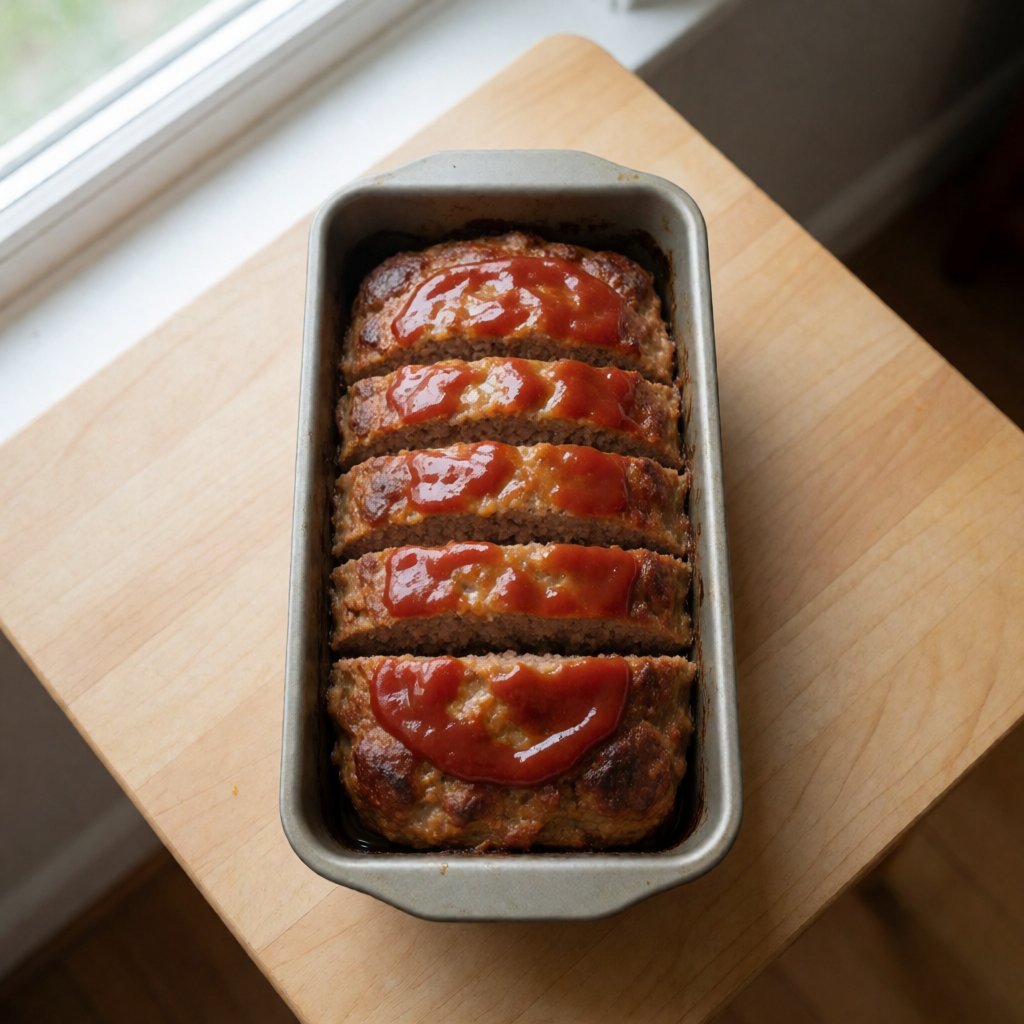
 AI photo
Meatloaf
A simple home-style meatloaf of minced beef and pork, baked until tender and finished with a ketchup glaze.
Labels are worked out automatically from the ingredients and can be wrong. Check the packaging if it matters to you.
Ingredients
- 500 g Beef and pork mince
- 0.5 pcs Onion finely chopped
- 1 pcs Egg
- 40 g Breadcrumbs
- 50 ml Milk
- 2 tbsp Ketchup
- 1 pinch Salt to taste
- 1 pinch Black pepper to taste








Steps
Mix everything except the ketchup thoroughly.
Press the mixture firmly into a greased tin, then spread ketchup over the top.
Place the tin in the oven at 200°C and bake for 45 minutes, until the centre reaches 71°C.
45 minRemove the tin from the oven and let it rest for 10 minutes.
10 min
What was changed
We've used Beef and pork mince in place of veal and pork mince, since British shoppers more commonly buy beef and pork mince for a meatloaf like this.
A meatloaf isn't a roast that shrank in the wash. It's held together by its own glue — egg, bread, milk — and that glue is what decides whether you get a loaf you can slice clean or a crumbling mess that falls apart on the fork. Mince alone has no structure; cook it loose and it just separates into grains. The bread and milk soak into a paste (cooks call it a panade), swell, and wrap themselves around the meat fibres so the egg has something to grip and set when the heat hits it. Mix it thin and lazy, and you get dry clumps in a wet puddle. Mix it properly, and the whole thing behaves like one piece of meat instead of five hundred grams of mince pretending to be one.
Some say you should pack the mixture into the tin as hard as you can, like you're building a brick, because a denser loaf slices better. No — pack it hard enough to force out the air pockets, no more. Air trapped in loose mince turns to steam in the oven, and steam looks for a way out, which is exactly how you get a cracked top and a loaf that sags apart when you lift a slice. Press it in firmly, evenly, corner to corner, and stop. You're not compressing meat, you're removing air.
The beef-and-pork mix matters more than people give it credit for. Pure beef mince, especially the lean stuff sold in most British supermarkets, has almost no fat to keep it moist once it's baked for 45 minutes at 200°C — all that liquid just runs off. Pork brings the fat back in, rendering slowly and basting the loaf from the inside instead of pooling at the bottom of the tin. If you only have beef, buy it at 15-20% fat rather than the "extra lean" pack, or the loaf will taste like cardboard with good intentions.
Onion, finely chopped and raw, goes in for two reasons that have nothing to do with flavour alone. It bulks the mince out cheaply — this is an old trick, stretching expensive meat with vegetables, going back to when mince itself was the budget cut and a whole joint was a Sunday-only extravagance. And as it bakes, it releases its own moisture into the loaf, which helps the panade do its job. Chop it fine — big pieces stay crunchy and raw-tasting inside a loaf that's otherwise fully cooked, which reads as a mistake even though nothing's actually wrong with it.
The egg is the one ingredient doing a single, non-negotiable job: it coagulates under heat and locks the structure in place. Leave it out and you have a very good meat porridge that falls apart the second you try to slice it. There's no real substitute here if you want slices rather than scoops — this is one of the few places where the ingredient is the mechanism.
Breadcrumbs and milk together are the panade, and the criterion for substitution is simple: you need a starch that can absorb liquid and swell, sitting inside a liquid with enough body to be worth absorbing. Forty grams of dried breadcrumbs plus fifty millilitres of milk is one version of that; stale bread torn into pieces and left to go soft in the milk does the same job, sometimes better, because fresh crumb from a loaf you tore yourself holds more structure than the dried shop stuff. Milk specifically — not water — because its fat and protein get absorbed into the mince and stay there, instead of just diluting it. Stock works at a pinch, for the same reason: it's liquid with something in it besides water.
Ketchup on top isn't decoration. It's sugar and acid and tomato, and at 200°C the sugar catches and darkens into a glaze — the nearest thing this dish has to the gravy on a roast. If you don't have ketchup, anything with that same sweet-acid balance works: brown sauce, which is arguably more native to a British table than ketchup is, does the job just as well and gives a sharper, more vinegary top instead of a sweet one. Salt and pepper go in to taste, but season the mix before you shape it, not after — once it's packed into the tin and baking, there's no stirring it through again.
Grease the tin properly, and don't skip it for the sake of saving on butter. This loaf has nothing but its own fat to release it, and a loaf torn apart trying to get it out of the tin is a worse loss than the smear of fat you were trying to save.
·