
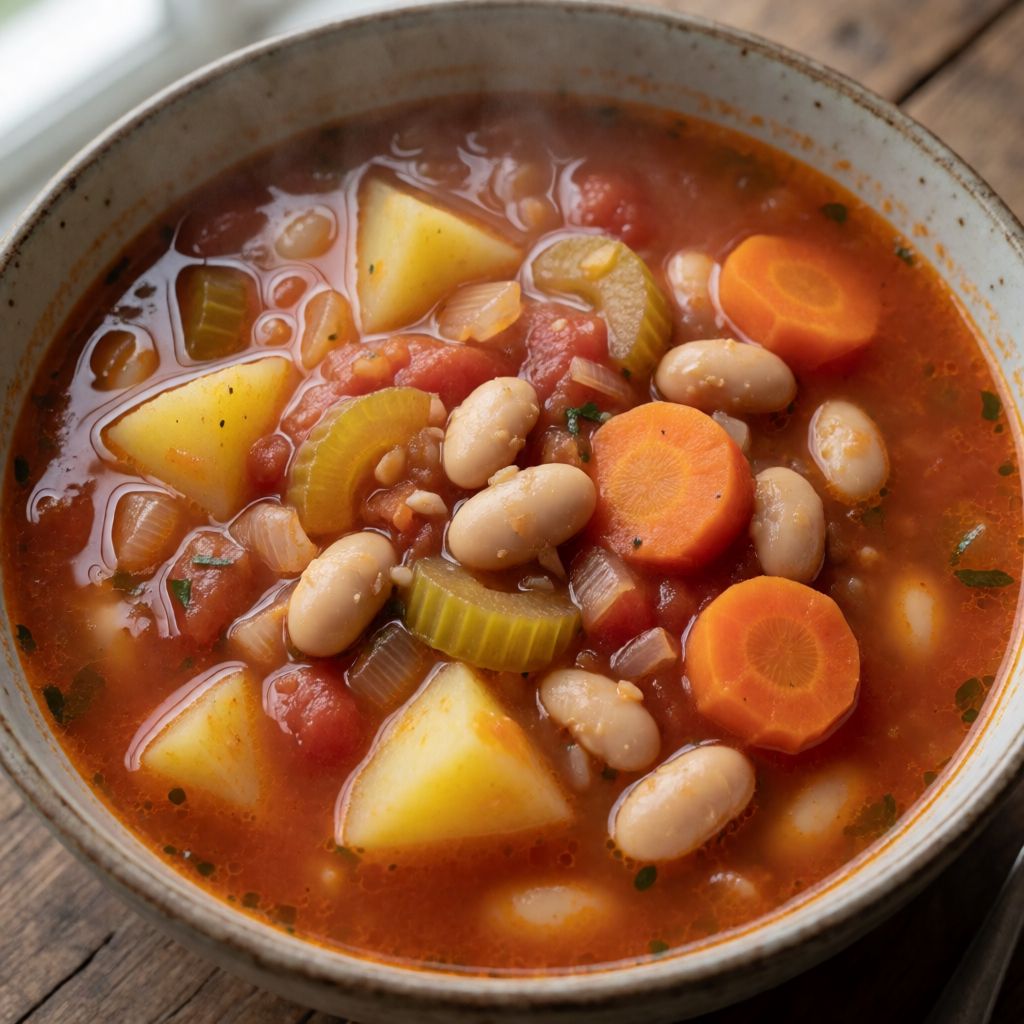
 AI photo
Vegetable Minestrone
A hearty vegetable minestrone, finished smooth or chunky and served with Parmesan.
Labels are worked out automatically from the ingredients and can be wrong. Check the packaging if it matters to you.
Ingredients









Steps
Wash all the vegetables and cut them into large pieces: peel the potatoes, shell the beans and peas, and finely chop the parsley.
Heat the olive oil in a pot and gently fry the celery, garlic, carrot and onion over a low heat.
When the onion turns golden, add the vegetables and parsley, and cook over a high heat, stirring often.
5 minAdd the potatoes and pour in enough water to cover the vegetables.
Season with salt, bring to the boil, then simmer gently until the vegetables are tender.
45 minServe as is, or blend to a smooth soup; serve in deep bowls with Parmesan, pepper or oil to taste.
Minestrone isn't a recipe so much as a method for using up a vegetable drawer before it goes soft and sad. The name just means "big soup" — it was peasant food built from whatever stood between the family and nothing, and that's still the real spirit of it: the carrot and courgette listed here are a suggestion, not a contract. What decides whether this works isn't which vegetables you pick but the order you cook them in, and whether you let each stage actually finish before rushing the next.
The whole thing hinges on one quiet step people skip: softening the garlic, onion, celery and carrot slowly before anything else goes in. This isn't decoration — it's the base flavour of the entire pot, and it only forms properly in fat over low heat, never in water. Some say you can just chuck everything in a pot of water together and boil it — no, because then the onion never gets past raw and sulphurous, and that sulphur sits in the soup for the whole hour, not just the first five minutes. The gold the onion turns to — not brown, not translucent, a warm yellow-gold — is the sign the harshness has cooked out and sweetness has come up to replace it. That's the one moment in this dish you actually watch for, not time.
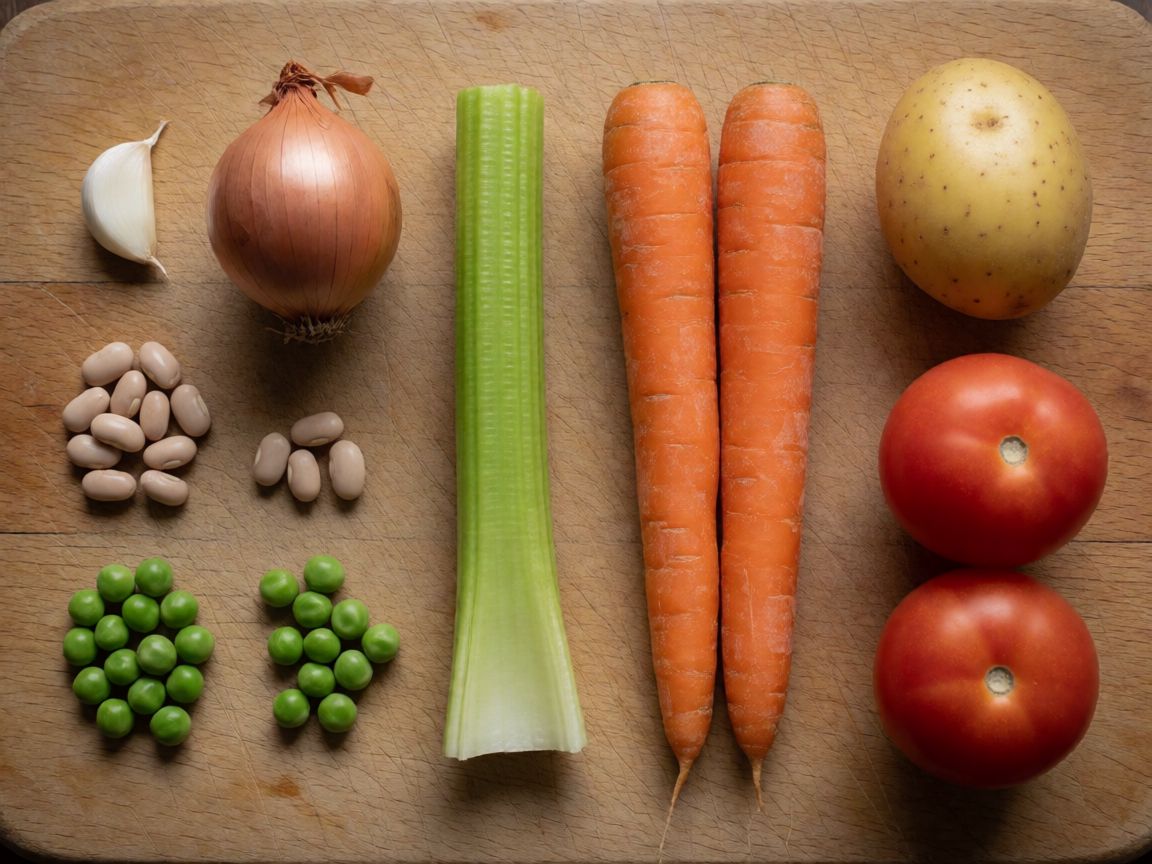
The vegetable list is really two separate jobs. Garlic, onion, celery and carrot are the base — their sole purpose is to melt into background flavour, so they go in first and go in finely enough to disappear. Potato, courgette, broccoli, beans, peas, tomato and spinach are the body — what you actually bite into — so they go in later, in rough, honest pieces, because if you cut them too small they'll collapse into mush by the time the potato is done. Any firm root vegetable can stand in for carrot or potato; any leafy green that wilts fast — chard, cabbage leaves — can stand in for spinach, which is added at the very end or barely cooked at all, since spinach needs seconds, not minutes, and overcooking it just turns it to dark slime and bitterness.
Olive oil here is doing a specific job: carrying flavour from the aromatics into the fat without burning, at a heat gentle enough that you can still hold a hand near the pan comfortably. The rule for substituting it isn't "use vegetable oil" — it's "use any oil with no smell of its own that can take gentle heat without smoking," which rules out anything already strongly flavoured, like unrefined sesame oil, but lets in sunflower or a neutral rapeseed, both easy to find in a UK supermarket and arguably more traditional here than imported olive oil ever was for most households.
Celery is often the vegetable people skip, assuming it's filler — it isn't. It carries a savoury, almost salty background note that holds the base together the way MSG does in other cuisines; leave it out and the soup tastes thinner even with the same salt. If you genuinely don't have it, a tablespoon of finely chopped celery leaves or even the leafy tops of fennel will do something similar — don't just omit and hope.
The tomatoes go in with the "hard-fry" vegetables rather than at the base stage, because their job is different: they want to break down fast under high heat and give up their juice and acidity into the mix, not melt slowly like the onion. If fresh tomatoes are watery and flavourless — which is most of the year in this country — a tin of chopped tomatoes does the same job better, and nobody serious about soup should feel bad reaching for it; tradition in Italian kitchens used whatever was ripe that week, not whatever looked nice in a photograph.
Water is just water — "as needed" means enough to cover the vegetables by a thumb's width, no more, because minestrone is meant to be thick with vegetable rather than swimming in broth. If you want more depth than plain water gives, a light vegetable or chicken stock works, but don't reach for anything heavily salted or you'll lose control of the seasoning before the soup's even finished reducing.
Parmesan at the end isn't tradition for its own sake — it's an economic habit, the rind end of a wheel too hard to eat otherwise, grated over soup so nothing goes to waste. Any firm, salty hard cheese does the same job if Parmesan isn't to hand; the point is salt, fat and a little sharpness on top of a soup that's otherwise all vegetable sweetness.