
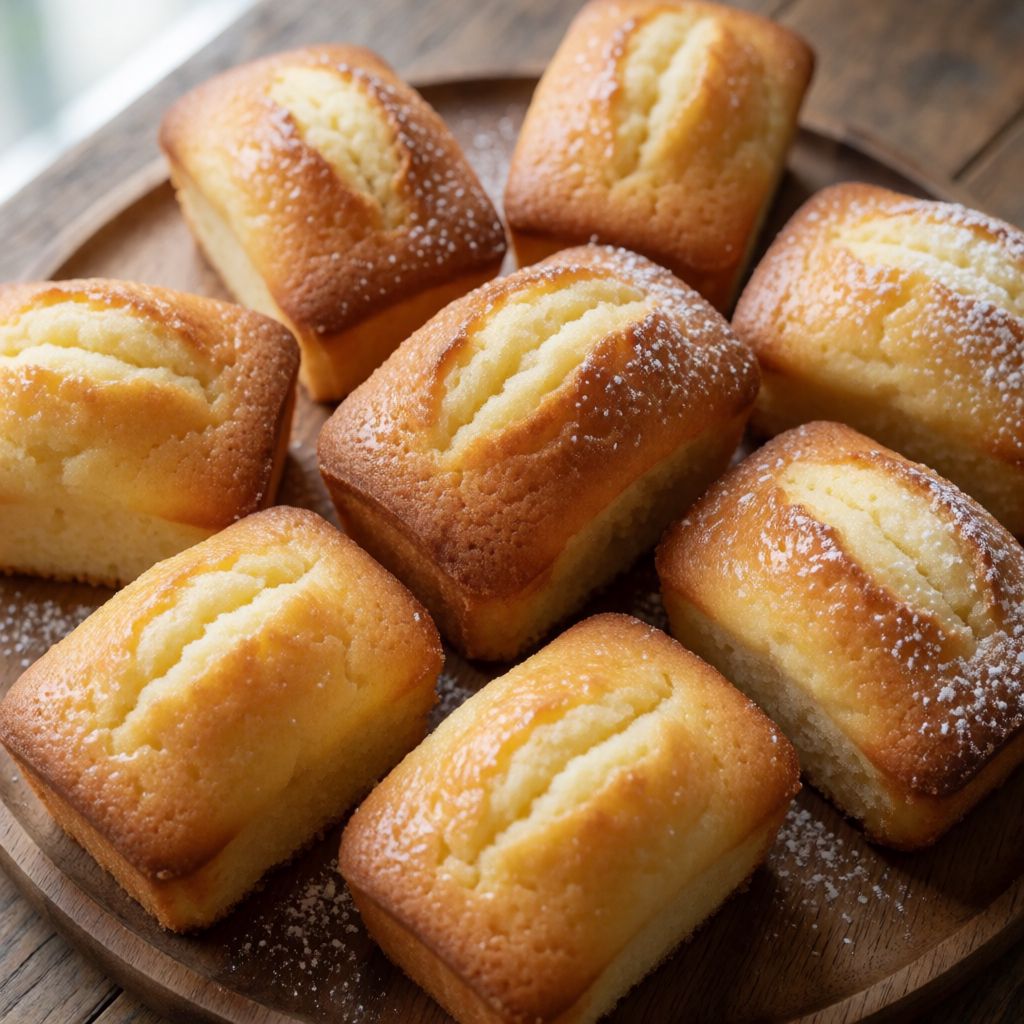
 AI photo
Mini Yoghurt Loaf Cakes
Soft mini yoghurt loaf cakes flavoured with lemon zest, baked until golden and light.
Labels are worked out automatically from the ingredients and can be wrong. Check the packaging if it matters to you.
Ingredients
- 160 g Plain flour
- 40 g Potato starch
- 150 g Sugar
- 3 pcs Eggs
- 200 g Apricot yoghurt
- 100 g Sunflower oil
- 10 g Baking powder
- 1 pcs Lemon zest zest of 1 lemon
- 1 pinch Salt









Steps
Whisk the eggs, sugar and salt with a mixer for 5 minutes until light, pale and foamy.
5 minAdd the yoghurt and oil in a thin stream while continuing to mix the batter. Flavour with the lemon zest.
Sift the flour together with the potato starch and baking powder and gently fold into the batter.
Butter and flour mini loaf cake tins and fill them to three-quarters full.
Bake in an oven preheated to 180°C without fan.
20 minCheck for doneness with a toothpick before removing from the oven.
Let the loaf cakes cool on a wire rack before serving.
What was changed
The oven temperature was set to , the nearest step for UK ovens.
This is a sponge, not a bread — a cake built on whisked egg foam, with yoghurt and oil there to keep it from drying out by Tuesday. Four small loaves, one portion each, the kind of thing you grab with tea rather than slice at a table and argue over who gets the end piece.
The rise here is two mechanisms doing two different jobs, not one ingredient doing magic. Five minutes of whisking eggs with sugar and salt beats air into the egg protein and builds a scaffold — pale, thick, holding its own shape for a second when you lift the beater. That scaffold is your real raising agent. Baking powder only tops it up in the oven; it cannot build air out of nothing. Some say you can skip the long whisk and let the baking powder carry the whole cake — no, because without that foam first, the crumb comes out flat and faintly rubbery, eggy in a way nobody asked for.
Adding the yoghurt and oil in a thin stream while the mixer keeps turning isn't fussiness, it's how you work fat and liquid into air without popping the bubbles you just spent five minutes making. Tip it all in at once and you'll feel the batter suddenly go loose and watery — that's the foam collapsing under the weight before it's had a chance to be absorbed.
Flour on its own would give you a cake with real chew — right for bread, wrong here. Potato starch has no gluten at all, so mixing it in dilutes the protein that would otherwise tighten into strands as it bakes. That's the actual difference between a crumb that's merely soft and one that's properly tender. No potato starch to hand — cornflour or rice starch does the same job, the criterion is simply a pure starch with nothing else mixed into it.
Eggs are the structure here, sugar does two jobs at once — sweetness, but also stabilising the foam so it holds while you're still pouring in everything else. Salt in a cake isn't there to taste salty; it wakes up flavour that sugar alone flattens into one note. A pinch, not a seasoning — more than that and you'd notice it, which means you've used too much.
Apricot yoghurt is doing cheap, reliable flavouring work — fruit without peeling, cooking, or worrying whether it's ripe. Only plain yoghurt in the fridge — stir in a spoon of apricot jam, or any smooth jam, and you've rebuilt the same effect for less fuss. The zest is there for the oil in the peel, not acid, which is why you want zest and not juice — juice would pick a fight with the baking powder instead of just perfuming the batter.
Oil instead of butter is why these loaves are still soft the day after. Butter sets solid as it cools, and a cake baked with it stiffens right along with it. Oil stays liquid at any temperature you'd realistically store a cake at, so the crumb stays soft long after it's left the oven. The rule for picking one is simple: any oil with no smell of its own — sunflower, rapeseed, a light vegetable oil. Not olive oil here; it has an opinion, and it disagrees with the lemon. Ten grams of baking powder for this amount of flour is a fair, slightly generous dose, because the bake is short and the rise has to happen fast — there's no time for a slow one. Sift it in with the flour and starch rather than stirring it through afterwards; uneven distribution is exactly how you get one bitter little pocket in an otherwise sweet mouthful.
Mini loaf tins change more than the look of the thing. More surface for the same amount of batter means a faster bake and a bigger share of crust to crumb than you'd get from one large loaf — that's the real reason twenty minutes is enough here, where a full-size loaf would want closer to an hour. No fan is deliberate too: moving air crusts the outside before the centre has set, and these loaves are small enough that a hard skin forming early stops them rising properly underneath. If your oven only runs with a fan, pull the dial back a touch from the number given and go by the loaf, not the display — ovens lie about the temperature more than people admit.
The toothpick test matters because a skewer that comes out wet means the starch inside hasn't finished setting, and the loaf will sink on itself once it's out of the tin. Cool it on anything that lifts the tin off the worktop and lets air move underneath — a rack if you have one, a couple of chopsticks laid across a plate if you don't. Set it flat on a plate with no gap and the steam coming off the base has nowhere to go; you'll find a damp, dense line right where the cake met the surface. This whole family of cake — flour, sugar, egg, a pot of yoghurt, oil — comes down from French kitchens where the empty yoghurt pot was the measuring cup, long before most homes owned scales: one pot of sugar, a pot and a half of flour, half a pot of oil, all by volume. Worth knowing, because it explains why the recipe is forgiving — it was built for someone guessing with a pot in hand, not for anyone chasing a decimal point.