
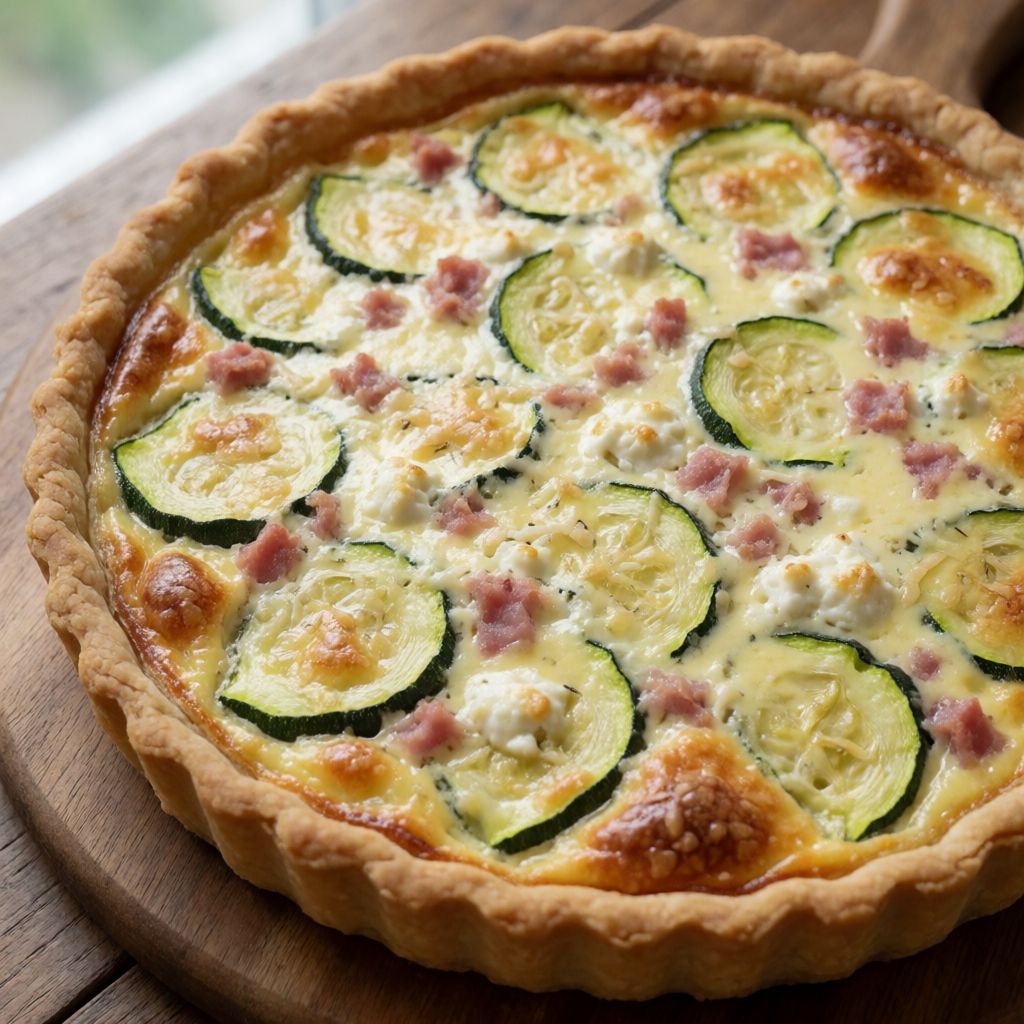
 AI photo
Courgette and Ricotta Quiche
A comforting courgette and ricotta quiche with ham and Parmesan, baked until golden in crisp puff pastry.
Labels are worked out automatically from the ingredients and can be wrong. Check the packaging if it matters to you.
Ingredients










Steps
In a non-stick pan, fry the onion in a little olive oil until golden.
Add the courgettes, cut into thin rounds, season with salt and cook for 10 minutes, adding a little water if needed.
10 minLet the mixture cool, then add the sifted ricotta, chives, eggs, ham and Parmesan, and mix well.
Spread the filling over the puff pastry and smooth it out.
Fold the edges, sprinkle with a handful of Parmesan and bake at 180°C for 30 minutes.
30 min
This is a free-form tart, not a true French quiche — nobody blind-bakes the base here, nobody uses a proper quiche tin with a loose bottom. You build it on a tray, fold the pastry edges up over the filling like a parcel, and let the oven do the rest. Call it a vegetable pie with a continental accent: ricotta and Parmesan for weight and salt, ham for chew, courgette for the body of it. Four people, a light lunch, or a slice alongside the cold cuts on a Sunday when the roast has already had its turn.
What decides whether it works is water — specifically, the courgette's water. A courgette is mostly water held inside cells with thin walls; cut it thin and it still looks solid, but put it raw into a custard and bake it, and it weeps. That weeping has nowhere to go but down, into the pastry, and a pastry base soaked from above never crisps — it goes pale and slightly rubbery no matter how long you leave it in. So you fry the courgette first, uncovered, giving the water somewhere to escape as steam rather than staying trapped for the oven to deal with later. That's not a flavour step dressed up as a technical one — it's the whole reason the base survives.
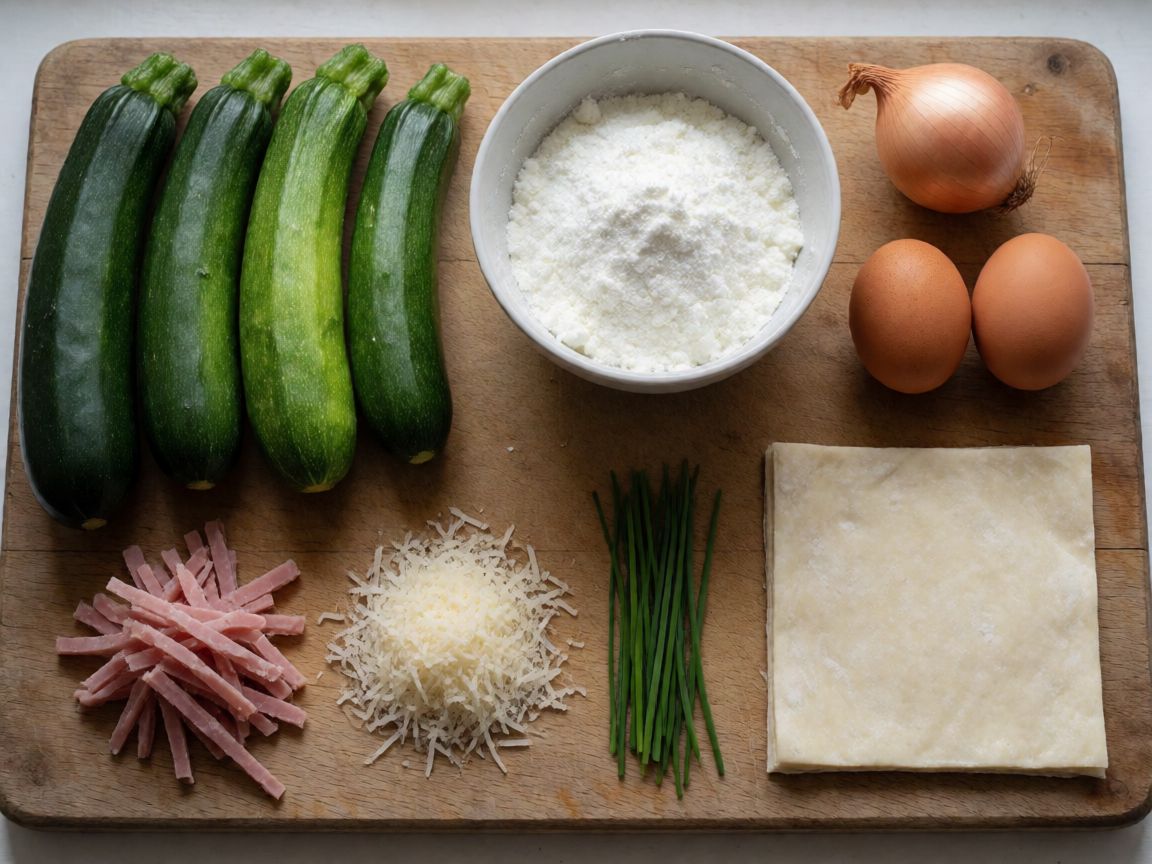
Courgette: pick ones that are firm, glossy-skinned, no soft give when you press them — a limp courgette has already lost moisture and flavour to its own storage, and it's the moisture-logged ones that cause the most weeping in the pan. Small to medium is better than the oversized marrow-shaped ones sold cheap at the end of summer; those are mostly seed cavity and water, nothing to them.
Ricotta, sifted: fresh ricotta drains unevenly and comes out slightly grainy — sifting is just pushing it through a sieve to break those curds into something smooth, so your custard doesn't have little lumps sitting in it later. If you've no ricotta, any mild, soft curd cheese that isn't too wet will do the same binding job — well-drained cottage cheese pressed through a sieve, or a mix of cream cheese loosened with a spoon of yoghurt.
Onion: a small one is right for the quantities here — it's a background note, not a feature. If all you have is a large onion, use half; too much raw onion sweetness fighting the Parmesan's salt throws the balance off.
Eggs: two is enough because the ricotta already gives the filling body — the eggs aren't there to bulk it out, they're there to set it. Egg proteins tighten and bind as they heat, turning a soft cheesy mixture into something that holds a slice. Let the courgette and onion cool properly before you stir the eggs in — mixing eggs into anything still warm from the pan starts cooking them early, in patches, and you get little scrambled threads through your filling instead of a smooth set. That wait costs you nothing but a few minutes, and it's the cheapest insurance in the whole dish.
Ham: salt and a bit of chew against the softness of ricotta and courgette. Any cured, fairly salty meat cut into thin strips works on the same principle — bacon, pancetta, even leftover roast ham from Sunday, which is honestly where a lot of British kitchens will find theirs. For a vegetarian version, skip it and lean harder on the Parmesan, or add something with its own savoury punch — sun-dried tomato, a few olives chopped small.
Parmesan: inside the filling it's salt and depth; on top it's a crust — a hard, low-moisture cheese melts and browns under dry heat instead of just going liquid and sliding off, which is exactly what a wetter cheese would do. Any hard aged cheese behaves the same way — pecorino, grana padano, whatever's cheaper on the shelf that week.
Puff pastry: bought, ready-rolled, from the chiller aisle — and there's no shame in that. Puff pastry is layered by lamination, folding butter and dough dozens of times, which is exactly the kind of fiddly, time-heavy work that industrial bakeries do far better and cheaper than a home kitchen ever will. Buying it isn't cutting a corner; it's recognising which jobs are worth doing yourself and which aren't. Folding the edges up over the filling instead of using a tin is the same logic in miniature — you don't need specialist kit, the pastry itself becomes the wall.
Chives, olive oil: chives are a mild, grassy member of the onion family — if you haven't any, the green tops of a spring onion chopped fine do the same gentle lift. For the oil, you want something with no smell of its own, so it carries the onion's flavour rather than adding a competing one — a light olive oil is fine, sunflower oil too if you'd rather the onion stood alone.