
 AI photo
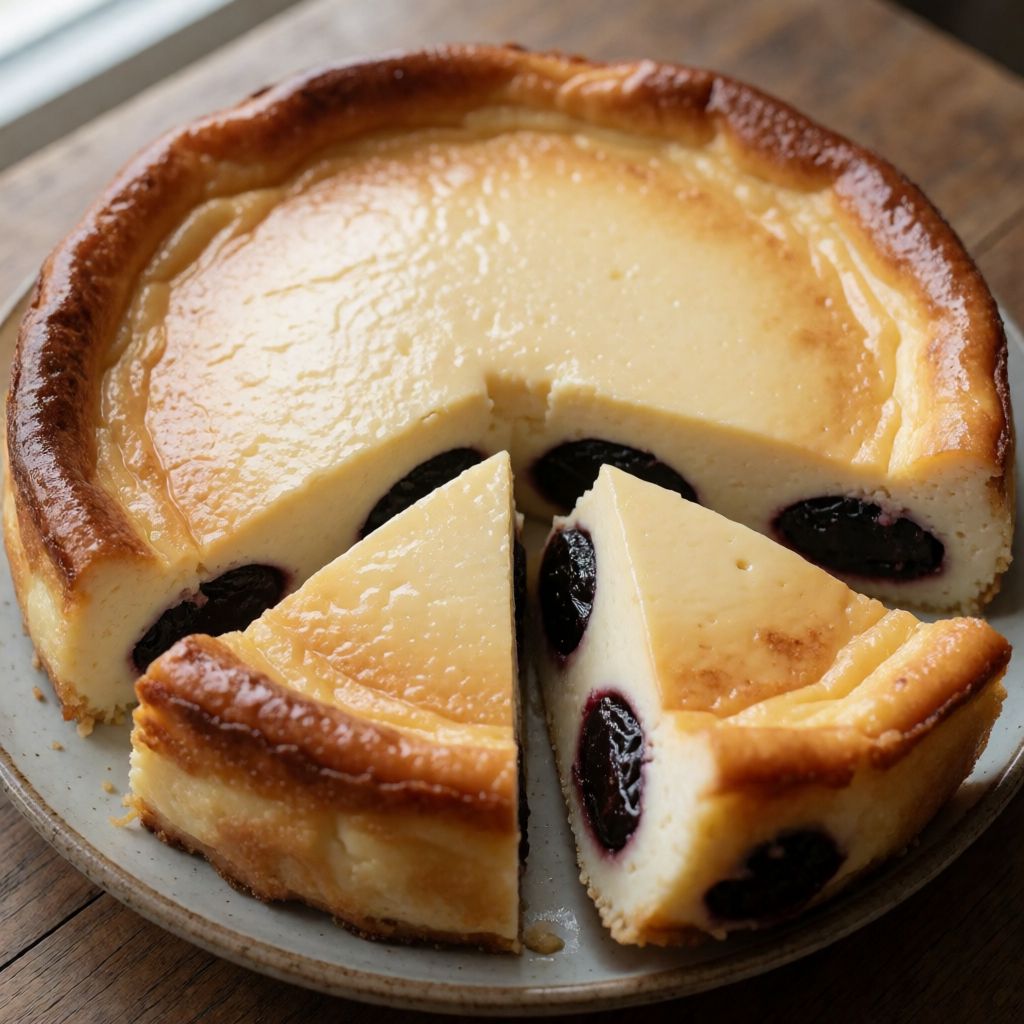
Far Breton with Prunes
A classic French custard cake from Brittany, studded with sweet prunes.
Labels are worked out automatically from the ingredients and can be wrong. Check the packaging if it matters to you.
Ingredients
- 130 g Plain flour
- 150 g Caster sugar
- 4 pcs Eggs
- 250 ml Milk at room temperature
- 20 g Butter melted
- 200 g Prunes
- 2 tsp Icing sugar
- 1 tsp Vanilla extract
- 8 g Baking powder









Steps
In a bowl, mix the dry ingredients: flour, baking powder, sugar and icing sugar.
Add the eggs and beat with an electric mixer until smooth, then pour in the melted butter and the vanilla extract.
Add the room-temperature milk and keep mixing until the batter turns creamy.
Add the prunes — whole or cut into pieces and lightly tossed in flour.
Grease a silicone mould or a 24–26 cm springform pan with butter.
Pour the batter into the mould.
Bake in an oven preheated to 180°C for about 50 minutes.
50 minLet the cake cool, cut into slices and serve.
What was changed
Added Vanilla extract because vanilla icing sugar is not commonly sold in UK shops; plain icing sugar plus a little vanilla extract gives the same flavour.
Far Breton is not a cake, whatever the word "cake" suggests to a British ear trained on Victoria sponge. It's a custard that happens to hold its shape — same family as clafoutis, same logic as a baked flan without the pastry shell underneath it. The ratio tells you everything: 130g flour against 250ml milk and four eggs. That's nowhere near enough flour to build a crumb. It's just enough to keep egg and milk from running once they set.
What decides whether it works is restraint at two points: how much you mix once the flour's in, and how long you leave it in the oven. Mix past "smooth" and you start pulling gluten strands out of that flour, and your custard drifts toward something chewy — the texture you're trying to avoid, not the one you're after. Bake it until a skewer comes out bone dry, the way you'd test a sponge, and you've overshot: the centre should still give a little, like a set jelly, when you nudge the tin.
Room-temperature milk isn't a fussy instruction for its own sake. Melted butter meeting cold milk seizes — the fat re-solidifies into tiny beads, and no amount of mixing afterward brings it back into a smooth batter. That's the one mistake in this recipe you can't fix later, so get the milk out of the fridge early and leave it be.
The prunes get tossed in flour for a reason that has nothing to do with flavour. A batter this thin can't hold heavy fruit in suspension on its own. Skip the flour coat and every prune drops straight to the bottom while it bakes — you end up with a fruit layer and a custard layer stacked on top of each other, not one dessert.
Some say a far is just a thick crêpe batter baked in a dish — no, because a crêpe batter is built to stay thin and pourable forever, and this one is built to set into something you can slice and pick up. The giveaway is the egg count: four eggs to roughly a cup of flour. The eggs are doing the structural work, not the flour. Treat this like pancake batter — thin it further, or decide the baking powder won't matter for something so "light" — and you get a far that never properly holds together once it's cool, closer to a baked omelette than a dessert.
On flour specifically: plain, and for a reason. Plain flour carries less protein than bread flour, so it builds less gluten when beaten. Bread flour here, or simply overworking the plain flour you've got, leaves elastic strands running through what should be a tender custard. If self-raising is all you have, it'll still set, but pull the baking powder right back — you'd otherwise be lifting it twice, and a far that puffs in the oven just collapses on itself as it cools, because nothing inside is strong enough to hold a risen structure once the heat's gone.
Use eggs you'd trust for a Sunday breakfast — freshness matters more than size here, since a tired egg whips thinner and carries less of the structure this dessert leans on. Milk should be whole, for the fat in it: that fat is what lets the melted butter blend into the batter rather than sitting on top as a separate film. Skimmed milk still sets, technically, but you lose the richness that's the whole point of making this instead of a flan made with water. Dairy-free, a full-fat oat drink is the nearest stand-in; avoid anything watery like rice milk, because the custard needs that body to set evenly through.
Butter does two separate jobs: flavour inside the batter, and a thin film on the tin that stops the edges sticking and gives them a faint gold crust where they meet hot metal or silicone directly. Don't swap it for a neutral oil in the batter itself — that's the one dairy note the whole dessert runs on, and it's cheap to keep. For greasing only, any flavourless fat works, since that part of the job is purely mechanical. On the tin itself: most British kitchens have a springform rather than a proper flan ring, and that's a fair substitute, but springform seams leak thin batter more readily than a solid pan. Sit it on a baking tray before it goes in — not a tip from nowhere, but because this batter runs, and scraping burnt sugar off an oven floor afterward is no one's idea of a good Sunday.
Prunes aren't decorative, they're an inherited economy — Brittany had eggs, milk and grain year-round, but fresh fruit only in season, and prunes were what kept through winter when nothing else did. Without prunes, use a dried fruit that holds its shape under heat rather than melting into the batter — dried apricot, cut down, behaves the same way. Keep it coated in flour for the suspension reason already given, and check twice that the fruit is properly stoned.
Every domestic oven lies a little about its own dial, and a fan oven in particular runs hotter at the edges than the number suggests. Fifty minutes is the floor this recipe gives you, not a guarantee — trust the wobble over the clock. And once it's out, leave it alone: the custard keeps firming as it cools, because the egg protein is finishing a job the oven started but can only complete slowly, off the heat. Cut it warm and it slumps; cut it once it's properly cool and it holds a clean edge. That waiting isn't decoration — it's the last stage of the cooking, just happening outside the oven.