
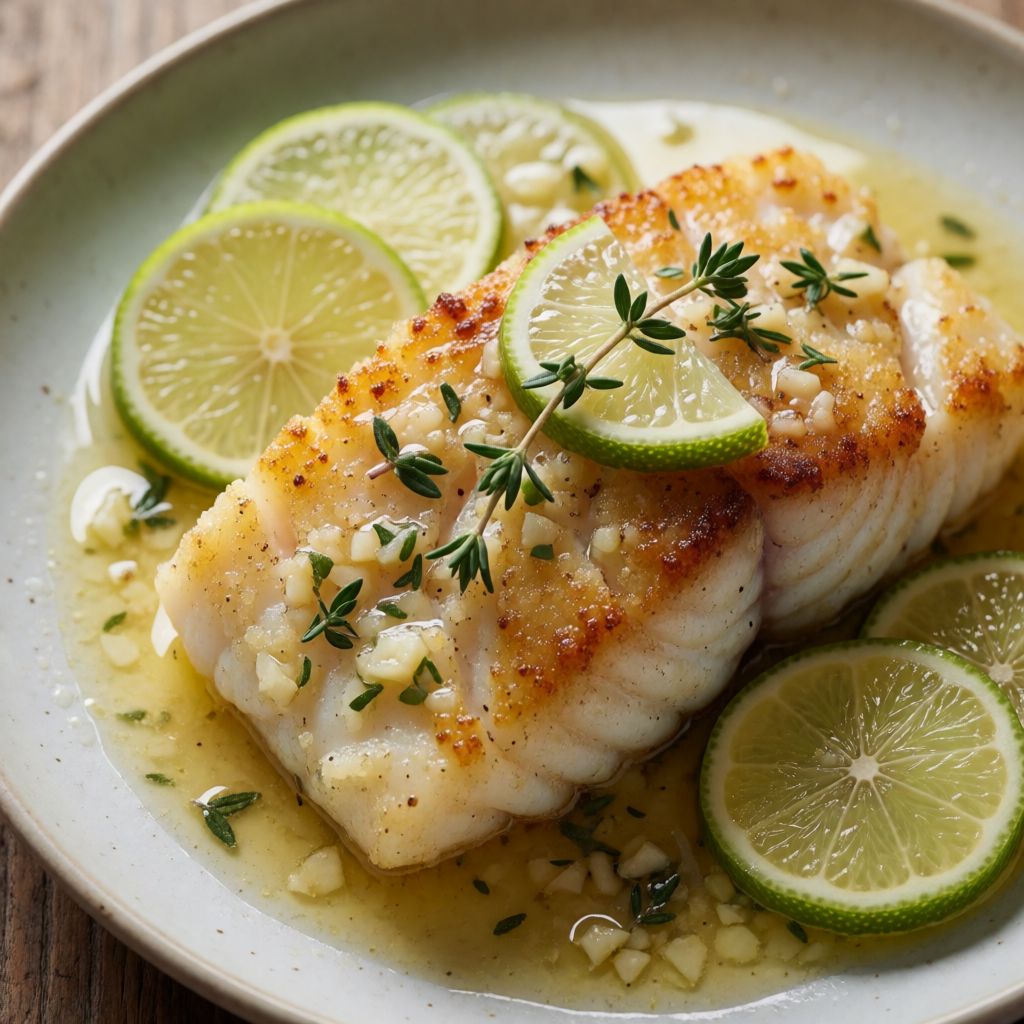
 AI photo
Cod with Lime
Pan-fried cod fillets marinated in lime juice with garlic and thyme, finished in a buttery lime sauce.
Labels are worked out automatically from the ingredients and can be wrong. Check the packaging if it matters to you.
Ingredients
- 800 g Cod
- 2 tbsp Plain Flour
- Lime for juice and serving
- 2 clove Garlic in its skin
- 40 g Butter
- 1 pcs Thyme sprig
- 2 tbsp Olive Oil
- Salt to taste
- White Pepper to taste








Steps
Cut the cod into 3-4 pieces, checking for any bones. Place in a dish and marinate in the juice of half a lime, white pepper and thyme.
120 minRemove the dish from the fridge and drain the marinade. Take out the cod and coat it in flour.
In a frying pan, heat the olive oil, butter and garlic (in its skin) over a low heat.
Add the coated fish and fry over a higher heat for about 2 minutes until golden brown.
2 minTurn the cod over and continue cooking until golden and the internal temperature reaches 63°C.
Season with salt, add the lime juice, cover with a lid and let the flavours combine for a few minutes.
Plate the fillets and garnish with thin slices of lime.
This is a four-minute fish dish that pretends to be more delicate than it is, and most of the real work happens before the pan ever gets hot — in a dish in the fridge, over two hours, with nothing but lime juice and pepper. What decides whether it works is not skill with a spatula. It's whether you treat that marinade as a ceiling and not a target, and whether you let the pan do two different jobs at two different heats instead of one lazy "medium" the whole way through.
Some say: the longer the fish sits in citrus, the more flavour it takes on. No — acid doesn't flavour protein, it cooks it. Lime juice does to cod exactly what heat does, just slower: it unwinds the muscle fibres, turns translucent flesh opaque, firms it up. Leave cod in lime for twenty minutes and you've seasoned it. Leave it for six hours and you've made ceviche by accident, and then fried it, which nobody asked for. Two hours is already near the edge for a fillet this thin — it's there to let the acid reach in a little and to let the thyme perfume sit on the surface, not to tenderise. Don't be tempted to push it "for more flavour" while you go do something else. That's the patience this dish actually needs: not more time, but holding the line on the time it already has.
Cod is the obvious choice here because it's the fish Britain built a frying habit around — cheap, abundant off northern waters for generations, firm enough to survive a hot pan without falling apart. That firmness is the actual criterion, not the name. Any thick, white-fleshed fish that holds its own shape under heat will do the same trick — hake, pollock, halibut if you're feeling flush. Thin, oily, or flaky-raw fish like plaice or mackerel will fall apart in the acid stage before they ever reach the pan, so don't swap blindly.
Lime instead of lemon is a flavour decision more than a technical one — lime is sharper and more floral, lemon rounder and more forgiving. If you've only got lemon in the fruit bowl, use it, but go a touch easier on it; it reads stronger against fish than lime does, gram for gram. Thyme is there for the same reason bay leaf turns up in stews that don't need it structurally — a quiet herbal note under the citrus so the dish doesn't taste like it's just "fish plus juice." Rosemary will stand in, but use half as much; it shouts where thyme murmurs.
The flour coating isn't padding, it's doing chemistry. Fish skin and flesh are too wet and too low in sugar to brown well on their own — flour gives you a dry, starchy surface that the hot fat can actually caramelise, which is the only way you get that gold crust rather than a pale, steamed-looking fillet. Any flour with no taste of its own works on the same principle — rice flour or cornflour if you want it gluten-free, used thin, just enough to dust, not batter.
Oil and butter together solve a problem each one has alone. Oil with no smell of its own — sunflower, groundnut, a neutral light olive oil — can take the higher heat of the actual fry without burning or fighting the fish's own flavour; pure butter alone would brown its milk solids and turn bitter before the fish is even coloured. Butter earns its place for what it adds at the lower, steeping heat and again at the end, where its fat carries the lime juice into something closer to a light sauce than a squeeze of citrus sitting on top of the fish.
Salt goes in at the end, after cooking, and that's not fussiness — salt on raw fish early pulls moisture to the surface by osmosis, and wet fish does not brown, it stews in its own juice under the flour coat. Salt late, and the crust you built stays a crust.
You won't have a kazan lid shaped for a frying pan, and you don't need one — a plate set over the pan, or even a loose tent of foil, does the same job for the few minutes you need to let the butter and lime juice come together and coat the fillets rather than sit apart as oil and acid. That short covered rest is the last bit of patience the dish asks for. Skip it and you've still got cooked fish, just not the dish — the sauce needs those few quiet minutes as much as the marinade needed its two hours.