
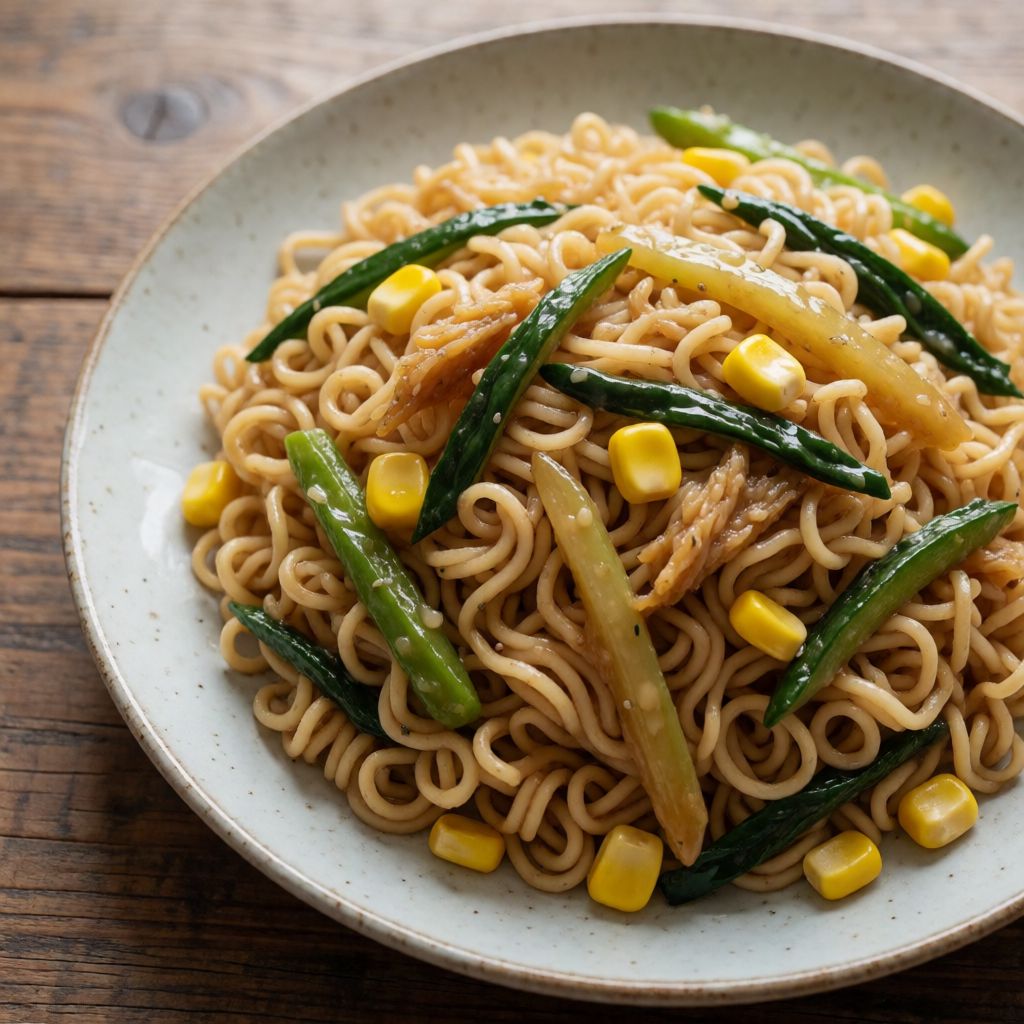
 AI photo
Noodles with Soy Dressing and Vegetables for a Lunchbox
A quick noodle salad with a sweet-soy dressing and crunchy vegetables, perfect for packing into a lunchbox.
Labels are worked out automatically from the ingredients and can be wrong. Check the packaging if it matters to you.
Ingredients
- 100 ml Soy sauce
- 100 ml Sugar
- 1 pcs Lime juiced
- 1 tsp Ginger grated
- 200 g Noodles
- 50 g Corn
- 75 g Pointed cabbage finely shredded
- 75 g Red cabbage finely shredded
- 75 g Spinach
- 75 g Edamame
- 2 pcs Carrot cut into thin strips
- 2 pcs Spring onion finely chopped
- 25 g Sesame seeds










Steps
Mix the soy sauce, sugar, lime juice and ginger in a saucepan and bring to the boil over medium heat, stirring.
5 minCook for 2-3 minutes until the sugar has dissolved and the mixture is smooth.
3 minPour into a clean, scalded jar and leave to cool.
Cook the noodles in lightly salted water according to the pack instructions, ideally 1 minute less than recommended, until soft but still with a little bite.
1 minDrain and rinse the noodles in ice-cold water to stop them cooking further.
2 minToss the cooled noodles with 2-3 spoonfuls of the soy dressing, to taste.
1 minMix the soy noodles, vegetables and sesame seeds in a bowl and pack into lunchboxes straight away, or chill before packing.
2 min
This is a cold-noodle lunchbox dish, and the whole point of it is that it survives four hours in a bag without going sad. That's the brief: not "tasty right now" but "tasty at 1pm after sitting next to your laptop since 8am". Two mechanisms decide whether it works — how you stop the noodles, and how much dressing you add before the vegetables go in.
The sauce is a straightforward sweet-salty syrup: soy, sugar, lime, ginger, boiled until the sugar dissolves and the liquid tightens into something that coats rather than runs. That's it — no magic, just concentration. Sugar in a pan with liquid doesn't "cook", it dissolves and then the water boils off until what's left clings. You're not making caramel, so don't let it go dark or bitter — you want syrup, not toffee.
Noodles are the part people get wrong, and it's not really about minutes. Boil them a touch under what the packet says, then shock them in ice-cold water. Some say rinsing noodles "washes away the flavour" — no, because the flavour hasn't gone on yet; what rinsing does is stop residual heat from carrying on cooking the starch, which is exactly what turns noodles from springy to gluey in a sealed box three hours later. A noodle that's slightly firm at 8am is a noodle that's pleasant at lunchtime; a noodle that's perfectly soft at 8am is paste by lunchtime.
Soy sauce and sugar in a one-to-one measure by volume is a ratio worth knowing on its own, independent of this recipe — salty-sweet-sour-hot (soy, sugar, lime, ginger) is basically the backbone of most East and Southeast Asian dressings, and once you've made it you can scale it for anything cold. Any soy sauce works as long as it's a proper fermented one rather than a thin, salty, caramel-coloured liquid with no depth — light or dark soy both do the job here, dark will just tint things more. Sugar: ordinary white is fine, it just needs to dissolve, nothing structural rides on it.
Lime is for acid and a bit of perfume — if you haven't got one, a lemon does the acid job, cider vinegar does it with less fragrance but doesn't pretend to be citrus, so use a smaller amount and taste. Ginger needs to be fresh and actually grated, not the dried powder — powdered ginger brings heat but none of the bright, slightly soapy top note that makes this taste awake rather than just salty-sweet.
Noodles: the recipe doesn't specify which, and that's the honest answer — wheat noodles, egg noodles, rice noodles will all behave differently in the ice bath, so go by feel rather than a fixed type: you want something that holds its shape cold, not something designed to be eaten hot and soft (fresh egg noodles, for instance, go gummy once chilled).
The vegetables are chosen for crunch that survives hours unrefrigerated in a bag, not for any deeper logic — carrot, pointed cabbage, red cabbage, spring onion are all dense and low in water, which is why they're the ones cut thin or shredded rather than left whole: thin surfaces means they dress and eat easily without needing to be cooked down. Spinach is the odd one out, soft and wet, so it goes in raw and last, right before the lid goes on — if you pack it too early and it sits against warm noodles it wilts and weeps. Edamame and corn are protein and sweetness respectively, and if you've no edamame, any cooked bean that holds its shape — chickpeas, even frozen peas — does the same job: bite and substance so the box isn't just leaves.
Sesame seeds are there for a last bit of crunch and a nutty smell, toasted or not — toast them in a dry pan for ten seconds if you want more of that smell, but don't walk away, they go from pale to burnt fast with nothing in between to warn you.
Patience here isn't about long cooking, it's about letting the sauce cool properly before it meets the noodles, and letting the noodles actually chill rather than just rinsing and hoping — a lukewarm noodle dressed too soon keeps cooking in its own residual heat and you're back to the gluey problem the ice bath was meant to solve. Five minutes of waiting is cheaper than a sad lunch.