
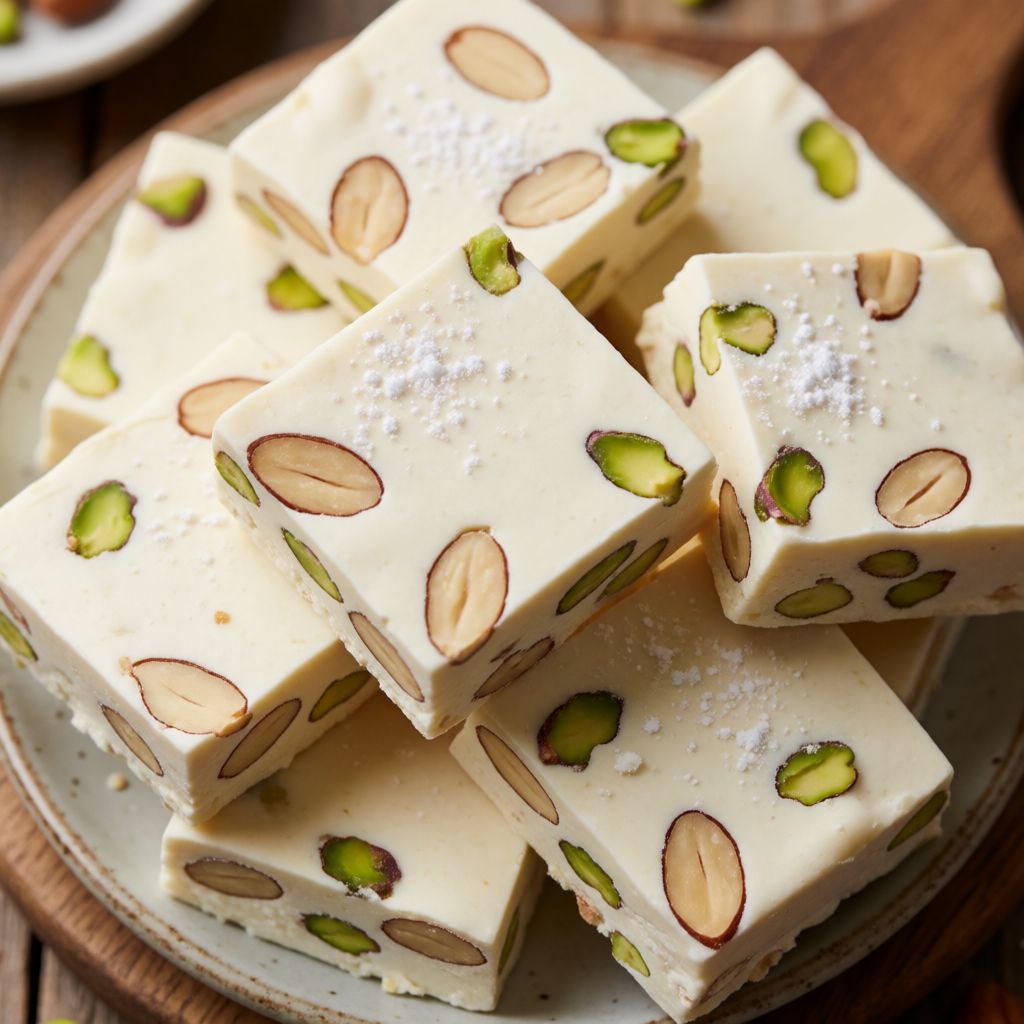
 AI photo
French Nougat
A classic French nougat with almonds and pistachios, bound in a honey and sugar syrup for a chewy, fragrant sweet.
Labels are worked out automatically from the ingredients and can be wrong. Check the packaging if it matters to you.
Ingredients
- 125 g Almonds skinned
- 50 g Pistachios unsalted
- 275 g Sugar
- 150 g Honey
- 125 g Glucose syrup
- 150 g Water
- 2 pcs Egg whites
- 2 tbsp Icing sugar





Steps
Pour boiling water over the almonds twice and peel off the skins. Spread on a baking tray lined with parchment.
10 minBake the almonds and pistachios in an oven preheated to 140°C with fan assistance.
10 minLet the nuts cool on the tray to room temperature (about 20–30 minutes).
25 minPut the sugar, honey, glucose syrup and water in a saucepan and bring to the boil (about 5–7 minutes).
6 minCook until the temperature reaches 148–150°C.
Put the egg whites in a bowl and whisk to stiff peaks (peaks that do not bend, about 3–5 minutes).
4 minSlowly pour the hot sugar syrup into the whisked egg whites, whisking continuously (about 5–10 minutes).
7 minKeep whisking until the mixture is warm and airy (about 35–40°C, around 5–10 minutes).
7 minTip the mixture onto parchment dusted with icing sugar and knead in the nuts until evenly distributed.
5 minTransfer to a container lined with parchment and leave to cool and set until the next day (about 12–24 hours at room temperature).
Cut with a sharp knife into pieces about 2–3 cm in size.
5 min
French nougat is not folk magic, it's a cooked meringue reinforced with nuts — and the only real decision in the whole recipe is how far you push that sugar syrup before it meets the egg white. Push it to 148–150°C and you get hard-crack sugar: snap and chew, not sticky toffee. Stop short and your nougat weeps and never sets; go past and it turns brittle and sugary, more pralin brittle than nougat. A sugar thermometer isn't fussy equipment here, it's the one instrument standing between you and guesswork — the gap between a chewable nougat and a dental hazard is maybe three degrees.
The second decision point is the egg white. It has to be whipped to proper stiff peaks — peaks that stand up and don't flop over — before the hot syrup goes anywhere near it. A soft, underwhipped white has no structure to hold the air the hot syrup is about to pump into it; pour syrup onto a slack foam and you just get sweet scrambled egg soup. So the whisking of the whites and the boiling of the syrup are a race you have to win on the egg-white side first.
Some people flinch at pouring near-boiling sugar onto raw egg white and worry about food safety. No need — that's backwards. The syrup is hotter than any pasteurisation temperature, and the moment it hits the white in a thin stream while you keep whisking, it cooks it on contact. That's the whole mechanism of Italian meringue: you're not folding in raw egg, you're heat-setting it in motion, which is exactly why it holds its shape and gloss long after a plain whipped-egg-white meringue would have collapsed.
Look at what's actually in the bowl and you can see why each thing earns its place. The almonds are blanched not for looks but because the brown skin carries bitter tannins and a papery toughness that ruins the bite — a nougat full of little leathery flecks is a nougat someone rushed. Toasting both almonds and pistachios afterwards at a gentle 140°C with fan is there for two reasons: it develops flavour through browning that raw nuts simply don't have, and it drives off surface moisture so the nuts don't sweat inside the finished nougat and turn it soft and short-lived. If you haven't got pistachios, any unsalted toasted nut that keeps its shape works — hazelnuts, cashews — the job is colour, crunch and fat, not a specific variety.
The sugar and the glucose syrup are doing a double act you won't notice unless something goes wrong. Pure sugar syrup, cooked and cooled on its own, wants to recrystallise — you'd end up with a grainy, sandy nougat instead of a smooth chewy one. Glucose syrup gets in the way of that: its molecules are shaped wrong to join the sugar's crystal lattice, so the syrup stays glassy and smooth instead of seizing up. If you've no glucose syrup in the cupboard, golden syrup does the same disruptive job and is in most British kitchens already — it brings a touch more flavour of its own, which is a fair trade.
Honey is there for both taste and the same crystal-blocking trick, which is partly why old nougat recipes lean on honey rather than sugar alone — before refined cane sugar was cheap and everywhere, honey was the only sweetener that happened to also behave this way, and nougat makers built a technique around what they had, not around a secret. Choose a honey that's mild — a light blossom honey — because anything strongly flavoured, like heather or buckwheat, will fight the almond and pistachio rather than sit behind them.
The water in the syrup is just a carrier to get the sugar to dissolve evenly before it boils off; don't skimp on stirring it in at the start or you'll get sugar scorching on the base of the pan before the rest has even melted. And the icing sugar dusted on the parchment at the end isn't decoration, it's there because warm nougat is tacky enough to weld itself to anything it touches — paper, your hands, the knife. Dust generously, and dust the blade too when you come to cut, or you'll be sawing rather than slicing.
In a flat kitchen without a kazan or a sugar thermometer you've used before, respect the limits: a wide, heavy-based pan stands in fine for the syrup, but watch it closely near the end, because the last ten degrees of a sugar boil happen fast and the pan holds less heat than you think once the water's boiled off. A stand mixer makes whisking in the syrup easier because you need both hands free to pour steadily, but a hand whisk and a second pair of hands — or a very patient one person pouring slow and whisking fast — will get there too. Just don't rush the pour; a thin, steady stream beats dumping it in, every time, because dumping cooks the near side of the egg white instantly and leaves the rest half-raw and lumpy.