
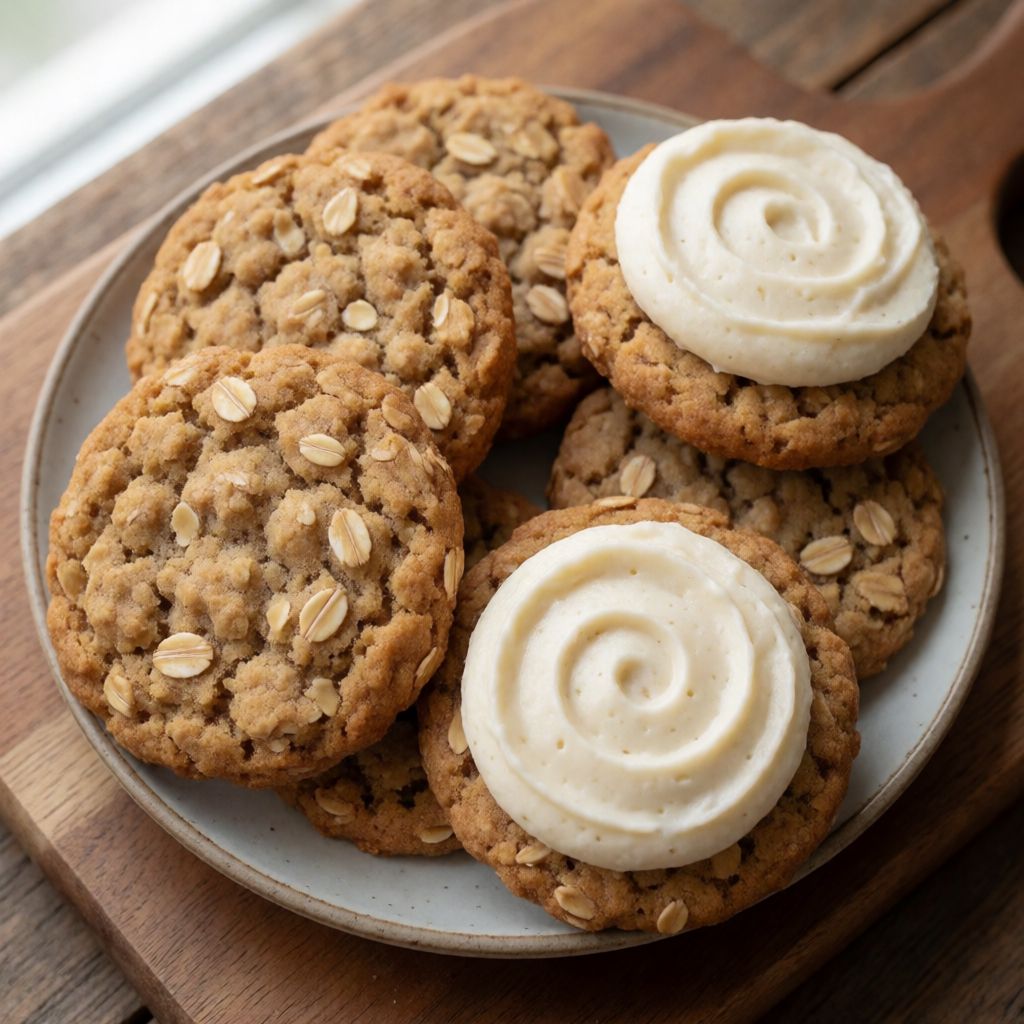
 AI photo
Oatmeal Cookies with Fluffy Butter Cream
Crisp-edged oatmeal cookies sandwiched together with a light, airy vanilla butter cream filling.
Labels are worked out automatically from the ingredients and can be wrong. Check the packaging if it matters to you.
Ingredients
- 90 g Butter
- 125 g Oats fine
- 20 g Plain flour
- 1 tsp Baking powder
- 1 pcs Vanilla pod
- 125 g Sugar
- 1 pcs Egg
- 1 pcs Vanilla pod
- 100 g Sugar
- 50 ml Water
- 125 g Butter at room temperature
- 1 pcs Egg yolk
- 100 g Dark chocolate tempered









Steps
Melt the butter in a saucepan over low heat and take off the heat as soon as it has fully melted.
Mix the oats, flour and baking powder well in a bowl.
Split ½ a vanilla pod, scrape out the seeds and mix them into 125 g sugar. Mix the sugar with the vanilla and 1 egg, then add this to the warm melted butter.
Fold the oat mixture into the butter mixture.
Shape into round balls and place on two baking trays lined with baking paper, 4 cookies per tray, leaving enough space between them as the dough spreads while baking.
Press the balls down slightly and bake in a preheated fan oven at 175°C for 9–12 minutes, until golden at the edges.
Let the cookies cool on the tray.
For the cream: split ½ a vanilla pod, scrape out the seeds and mix them into 100 g sugar.
Put the sugar with vanilla and 50 ml water in a saucepan, bring to the boil and cook uncovered until the sugar has fully dissolved.
Let the syrup cool to room temperature.
Whisk 125 g butter (at room temperature) and 1 egg yolk in a bowl until light and airy, gradually pouring in the cooled syrup and whisking vigorously until the cream is soft, smooth and fluffy.
Brush each cookie with a thin layer of tempered chocolate and let it set.
Sandwich the cookies together with the butter cream.
This is a sandwich cookie, not a biscuit you eat on its own. Two oat rounds, a stripe of tempered chocolate holding the cream to the biscuit, and in between a butter cream that's whipped, not boiled-on-the-stove-and-prayed-over. The whole thing hangs on two separate mechanisms behaving correctly at two separate stages, and if either fails you get a different, worse biscuit.
The cookie itself works because melted butter, not softened, goes into the sugar and egg. Softened butter traps air when creamed, which is what you want for a cake. Here you don't want lift — you want spread and a chewy, slightly dense crumb, the kind that can hold its shape under a weight of cream without crumbling in your hand. Melted butter coats the oats and flour instead of aerating them, so the dough runs a little in the oven before it sets. That's why you leave gaps on the tray: not tidiness, physics. Crowd them and you get one oat sheet instead of eight biscuits.
Doneness here is the edge, not the middle. The centre of an oat cookie always looks underdone when you pull it — it firms up as it cools on the tray, which is also why you don't touch it off the tray early. You're watching the rim turn from pale to gold-going-amber. Pull too late chasing an evenly browned top and the edges go from chewy to snappable, and a snappable cookie can't be sandwiched — it shatters the moment the cream pushes down on it.
The chocolate layer is not decoration, it's a vapour barrier. Oats keep absorbing moisture from anything wet sitting against them, so a cream sandwiched straight onto a bare biscuit goes soggy from the inside within a few hours — by teatime tomorrow you'd have a cookie that bends like the carrot in a stew, which is a good sign in a carrot and a bad one here. A thin, set layer of tempered chocolate seals the surface. Tempered just means the chocolate's been coaxed into stable crystals so it sets with a snap and a shine rather than staying soft and greying over — if you don't have the patience for proper tempering today, melted chocolate stirred in, cooled slightly before brushing, will still hold moisture back, it just won't have the same crack when you bite through.
Butter, melted version: any dairy butter works, salted is fine if you drop any pinch of salt elsewhere in the dough, since salted butter in the UK varies enough between brands that trusting it as your only seasoning is a gamble. What you're after is simply fat that's fully liquid and not still separating — give it a stir off the heat so it doesn't carry on cooking the egg mixture when it meets it.
Oats, fine: this means rolled oats that are on the smaller, thinner side, sometimes sold as "fine" or quick oats, not steel-cut. Steel-cut oats won't soften in the short bake time you've got and you'll be cracking a tooth on them instead of biting cleanly through. If all you've got is standard rolled porridge oats, pulse them briefly in a processor — you're not making flour, just breaking the flakes down so they bind rather than float loose in the dough.
Vanilla pod: you use half a pod twice here, for the dough and for the syrup, which is really one pod split for two jobs — buy one, not two. The reason you scrape the seeds into the sugar rather than the egg or butter is mechanical: sugar is dry and granular, so it grabs the seeds and distributes them instead of letting them clump. No pod in the cupboard — good vanilla extract or paste works, added at the same point, a teaspoon roughly standing in for the seeds of half a pod. What you lose is the visible black fleck in the cream; what you don't lose is the flavour, if the extract's a decent one and not the cheapest bottle on the shelf, which is mostly caramel colouring with a rumour of vanilla in it.
Egg and egg yolk: the whole egg in the dough is there for structure and a bit of lift against all that melted fat; the yolk alone in the cream is there for richness and to help the syrup emulsify into the butter rather than sitting as two separate things that look combined but split apart in your mouth. Keep the white from that yolk back for something else — meringue, an omelette — don't try to use it here, it'll thin the cream and stop it setting fluffy.
Baking powder and the small 20g of flour: this is a biscuit built mostly from oats, so the flour and raising agent are only there to give the structure something to hold onto — too much of either and you've made an oat cake, not a cookie. Some people assume more baking powder means a lighter biscuit; here it just means more spread and a drier crumb, because there's so little flour network for the gas bubbles to get trapped in. Leave the measure as it is.
On the oven: a fan oven at 175°C runs hotter-feeling than a conventional one at the same number because the moving air strips heat into the food faster, which is exactly why this reads as a shorter bake than you'd expect for a cookie — 9 to 12 minutes is a lower bound, not a target, and your particular oven's fan and your tray's position both shift it a minute or two either way. If you're working with a conventional (non-fan) oven, the usual adjustment is roughly 15–20°C hotter, but let the edge colour be the final judge over the dial.
Patience, twice over: once while the syrup cools to room temperature before it meets the butter — rushing this is the single most common reason this cream fails — and once while the chocolate sets fully on the cookie before you spread cream against it. Both are waiting, not working, and both feel like wasted time standing in a small kitchen with nothing to stir. They're not wasted. They're the part of the recipe that happens without your hands.