
 AI photo
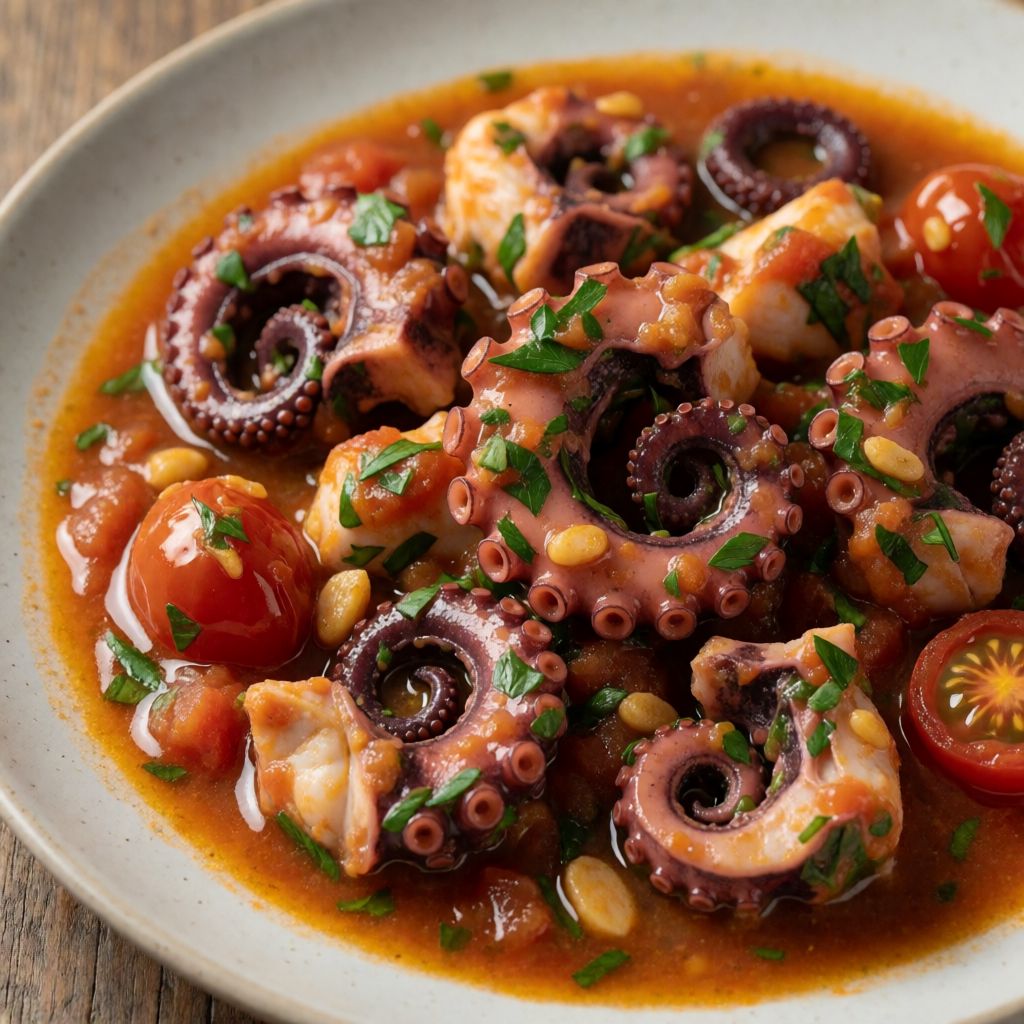
Octopus alla Luciana
A classic Neapolitan octopus stew, slowly simmered in a rich tomato sauce with olives, capers and parsley.
Labels are worked out automatically from the ingredients and can be wrong. Check the packaging if it matters to you.
Ingredients
- 1 kg Octopus
- 1 clove Garlic
- 1 bunch Parsley
- 5-6 pcs Cherry tomatoes
- Olive oil for frying
- 500 ml Tomato passata
- 1 tbsp Capers
- 100 g Gaeta olives
- Salt to taste









Steps
Pour in the olive oil and fry the garlic, cherry tomatoes and parsley.
Add the Gaeta olives and capers, and stir for a few minutes over medium heat.
Pour in the tomato passata and bring to the boil.
Rinse the octopus, especially inside, and pat dry with a kitchen towel.
Lower the whole octopus into the simmering sauce and bring back to the boil.
Reduce the heat to low, cover with a lid and cook for about 1 hour.
60 minTurn the octopus halfway through cooking and add salt to taste.
Garnish with fresh parsley and serve.
What was changed
Tomato passata is used instead of tomato paste, matching the original's passata.
This is octopus braised whole in its own juice and a short tomato sauce, finished with olives and capers — a dish that carries the name of a Naples waterfront, Santa Lucia, where fishermen cooked what the nets brought in cheap. Octopus wasn't a luxury there. It was abundant, awkward to sell whole, and this is what you do with something abundant and awkward: you cook it slow, in one pot, with whatever's salty and sharp in the larder.
What decides whether it works is heat, not time. Some say boil it hard and it'll be ready sooner — no, because heat that high tightens the muscle fibres before the collagen inside them has a chance to melt into gelatine. That's the whole chemistry of an octopus: tough until the connective tissue breaks down, then suddenly, almost rudely, tender. A hard boil locks it in the tough state. A low simmer, lid on, gives the collagen the hour it needs to let go.
So the sauce isn't really a sauce for the octopus — it's the medium the octopus cooks in, low and covered, for about an hour, while it slowly surrenders. You don't time it so much as check it: push a knife tip or a skewer into the thickest part of a tentacle. No resistance, it slides, you're done. If it still fights you, it needs more time, not more heat.
Leaving it whole matters too. Cut it up first and all those exposed surfaces dry out and toughen before the inside softens. Whole, it sits in its own moisture, protected, and only gives up its shape — falls apart gently — once it's properly cooked, which is also roughly how you'll know it's ready even without the knife.
On the octopus itself: don't be precious about buying it frozen. Fresh is not automatically better here — freezing ruptures the muscle fibres with ice crystals, which does a chunk of the tenderising work for you before it's even near the pan. A lot of good cooks freeze octopus on purpose for exactly this reason. One kilogram, whole, gives you four decent mains; stretch it to six as a starter portion with bread to mop the sauce.
Passata is the right base because it's already smooth — it coats the octopus and clings rather than pooling as watery chunks the way tinned whole tomatoes would. If you only have tinned tomatoes, blend them. The criterion is smoothness, not the brand.
Gaeta olives are small, black, wrinkled, brine-cured — firm, with a bitter edge that oil-cured olives lose because oil-curing softens them into something closer to jam. The substitution rule: any firm black brine-cured olive. Kalamata will do. What you don't want is the soft, oily, almost sweet black olive sold for pizza toppings — wrong texture, wrong job.
Capers come packed in salt or brine, and either way they're carrying more sodium than you think. Rinse them before they go in. This is also why the salt in the recipe comes last, to taste, after the olives and capers have already had their say — add it early and you risk a sauce that's seasoned twice over by the time it's reduced.
The garlic, cherry tomatoes and parsley frying at the start are a quick soffritto, not a long one — a few minutes, enough for the garlic to lose its raw bite and the tomatoes to just start collapsing. It's building flavour fast and cheap before the real cooking — the hour under the lid — does the slow work. Keep some parsley back for the end; one bunch doing two jobs, base and garnish, is just good economy, the same economy that built this dish in the first place.
On kit: a wide pan is actually what this recipe wants anyway, not a compromise — the octopus needs to sit low in the sauce, not stand on end in a narrow pot. If your lid doesn't fit well or you haven't got one, a plate set over the pan does the same job: trapping the steam so the sauce simmers rather than reduces too fast and catches on the bottom before the octopus is tender. And have patience with the hour — it's not a step you can shortcut by turning the heat up, because that's the one thing this dish specifically punishes.