
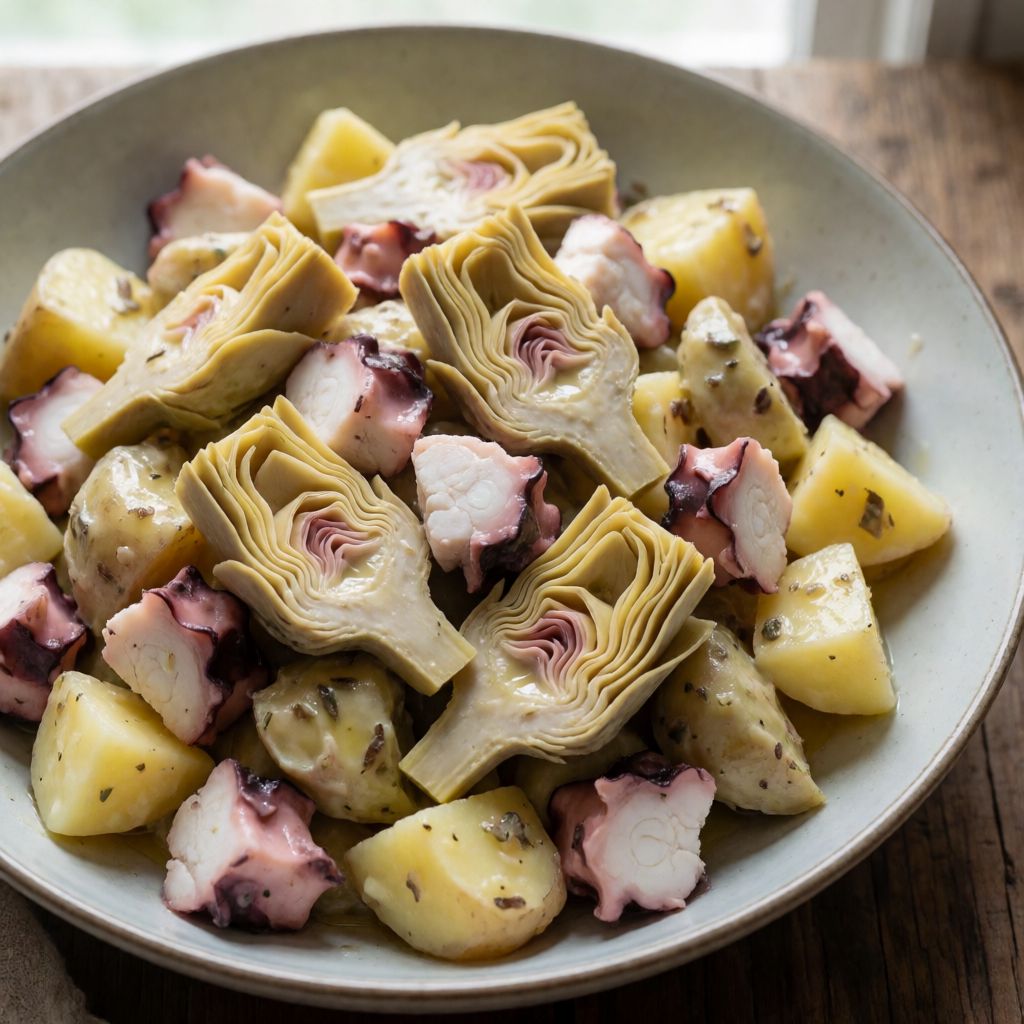
 AI photo
Octopus, Artichoke and Potato Salad
A refreshing salad of tender octopus, artichoke hearts and potato, finished with olive oil, lemon and parsley.
Labels are worked out automatically from the ingredients and can be wrong. Check the packaging if it matters to you.
Ingredients
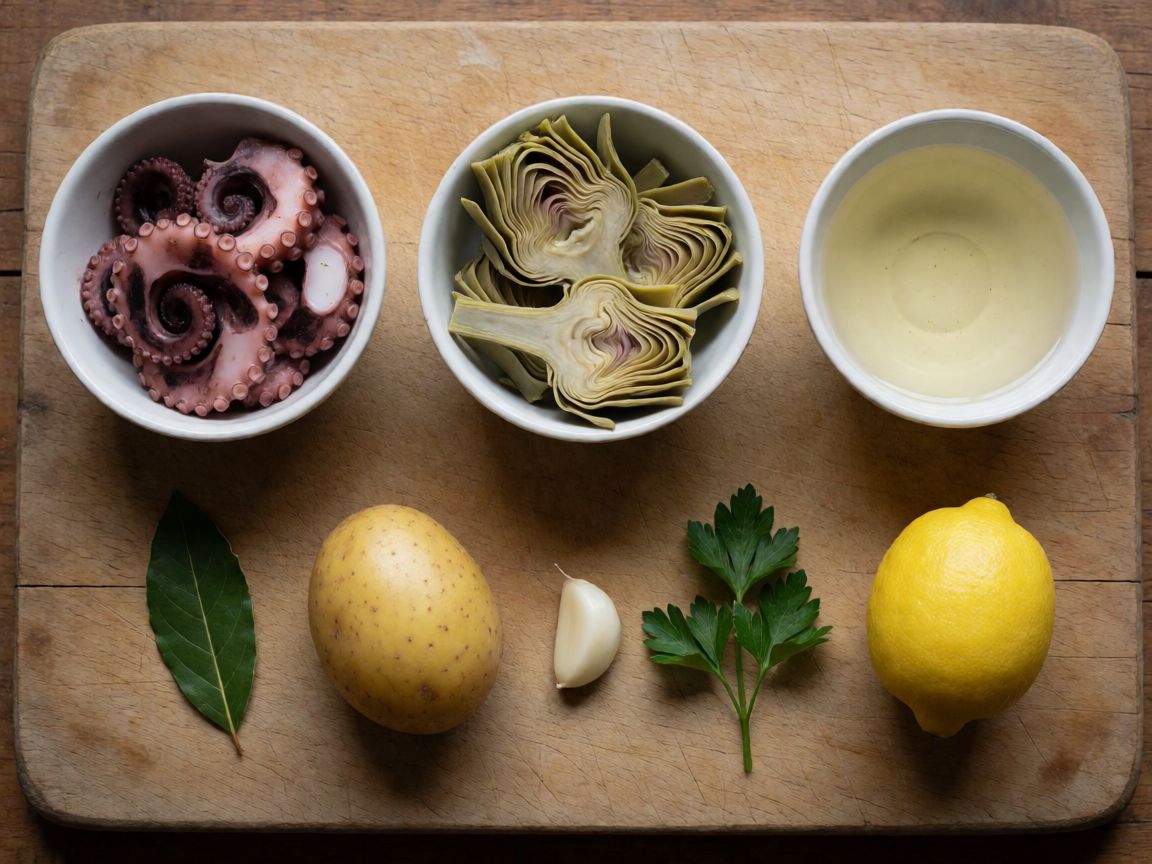
- 800 g Octopus
- 400 g Artichoke hearts
- 1 pcs Bay leaf
- White wine to taste
- 1 pcs Potato
- 1 clove Garlic
- 1 pcs Lemon
- Olive oil to taste
- Salt to taste
- Black pepper to taste
- Parsley to taste










Steps
Boil the octopus in water acidulated with white wine, with salt and a bay leaf. It is done when the thickest part reaches 63°C.
Cut the artichokes into wedges, soak in ice water with lemon, drain in a colander and cook for 8 minutes.
8 minCool the octopus, cut into pieces and place in a bowl together with the drained artichokes and diced potato.
Add finely chopped garlic, ground black pepper and salt to taste, dress with olive oil and lemon juice to taste, and generously sprinkle with chopped parsley.
Serve warm.
This is a warm, not cold, composed salad – octopus, artichoke, potato, lemon and oil – and the whole thing stands or falls on one thing: whether the octopus is tender or rubber. Everything else (artichokes, potato, dressing) is simple enough that it rarely goes wrong. The octopus is where the dish is won or lost.
The recipe gives you a real number — 63°C at the thickest part — and that number is not decoration, it's the mechanism. Below roughly 50°C the connective tissue (collagen) holding the muscle fibres together hasn't started to melt, so the flesh is tough and slippery. Push it too far past 65–70°C and the muscle fibres themselves tighten and squeeze out their water — that's the rubber everyone blames octopus for. Somewhere in between, the collagen turns to something closer to gelatine while the fibres haven't yet seized up. That's the window you're aiming for, and it's narrow. Some say: boil it hard and long, an hour, two hours, 'octopus needs it.' No — that's exactly how you get the rubber you were trying to avoid. Long and gentle beats hard and fast here, every time.
If you don't own a probe thermometer — and most kitchens don't — trust your hands instead. A skewer or the tip of a knife should slide into the thickest tentacle with almost no resistance, the way it slides into a well-roasted potato. The flesh should give slightly under a thumb, like a ripe pear, not spring back like a ball. That's your 63°C without the thermometer.
Octopus: buy it already frozen, or freeze it yourself for a day before cooking, and don't feel you've cut a corner — ice crystals forming inside the flesh physically rupture some of the muscle fibre, which is a genuine head start on tenderness, not a myth. If you've bought it fresh, into the freezer first is a fair move, not a compromise. During cooking, patience is the actual ingredient here: a quiet simmer, not a rolling boil, because a hard boil pushes heat into the flesh faster than the collagen can soften, and you arrive at tough before you arrive at tender.
The white wine in the poaching water isn't there for flavour alone — its acid helps loosen the same connective tissue the heat is working on, and seasons the octopus from outside in while it cooks, the way a marinade would, except here it's doing the job in the pot. If you've no wine open, a splash of vinegar in the water does the acid's job, though you lose the aromatic side of it.
Artichokes go into ice water with lemon the moment they're cut, and this isn't fussiness — a cut artichoke browns within minutes because an enzyme in the flesh reacts with air the second the knife opens it up. The cold slows the enzyme down, the acid in the lemon disrupts it outright. Cook them only until the edge of a wedge gives to a fork — the eight minutes given is a floor, not a verdict, since the size of your wedges will push it either way. If fresh artichokes aren't to be found or aren't in season, jarred ones in brine or oil will do the job, provided you rinse the brine off and accept they're already cooked through, so they only need warming, not boiling.
Potato: choose a waxy one — Jersey Royals, Charlotte, anything that keeps its shape when boiled and diced — rather than a floury roasting potato like a Maris Piper, which is built to collapse into fluff, exactly the thing you don't want sitting next to octopus in a bowl. Boil it whole or in chunks until a knife meets just a little resistance at the centre, then dice once it's cool enough to handle.
Garlic goes in raw and finely chopped rather than cooked, so it stays sharp rather than sweet — if that's too much for you, chop it and let it sit a few minutes in the lemon juice before adding, which takes some of the bite off without cooking it. The olive oil should be one with a flavour of its own, something fruity or grassy, because here the oil isn't a cooking medium hiding in the background — it's doing a third of the dressing's talking, so a flavourless oil would leave the whole thing thin. If olive oil's not what you keep in the cupboard, any good cold-pressed oil with a character to it will stand in; what you want to avoid is the kind of neutral oil that's right for frying and wrong for dressing, because here it needs to taste of something.
The dish itself belongs to coastal kitchens where octopus was cheap — a fisherman's catch nobody fought over — and artichokes grew wild or half-wild nearby in the same season. There's no ceremony behind the combination, just two cheap things that happened to be ready at the same time of year, dressed with what every kitchen there already had: oil, lemon, garlic. Worth remembering before anyone tells you it has to be made a particular way.