
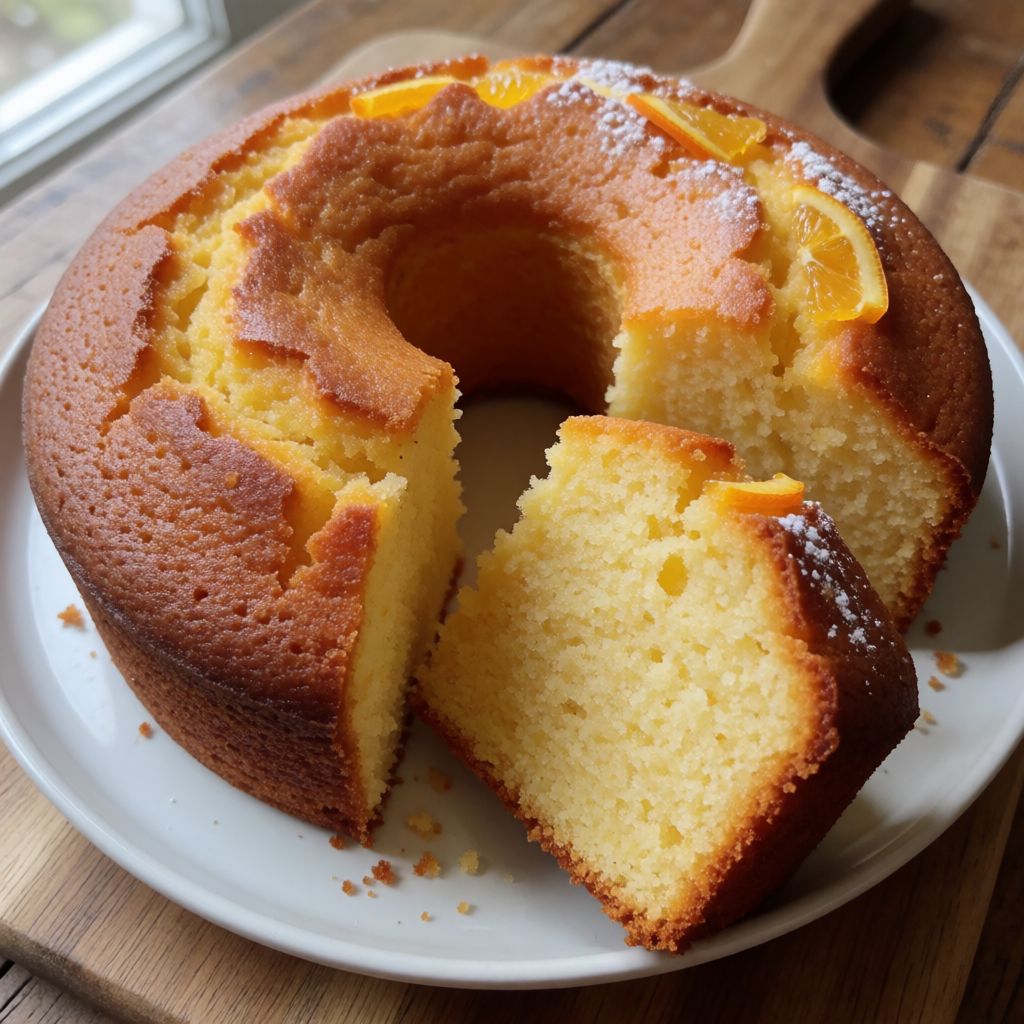
 AI photo
Orange Cake
A soft orange cake, with egg yolks and sugar whipped until fluffy and fresh orange juice folded through the batter.
Labels are worked out automatically from the ingredients and can be wrong. Check the packaging if it matters to you.
Ingredients
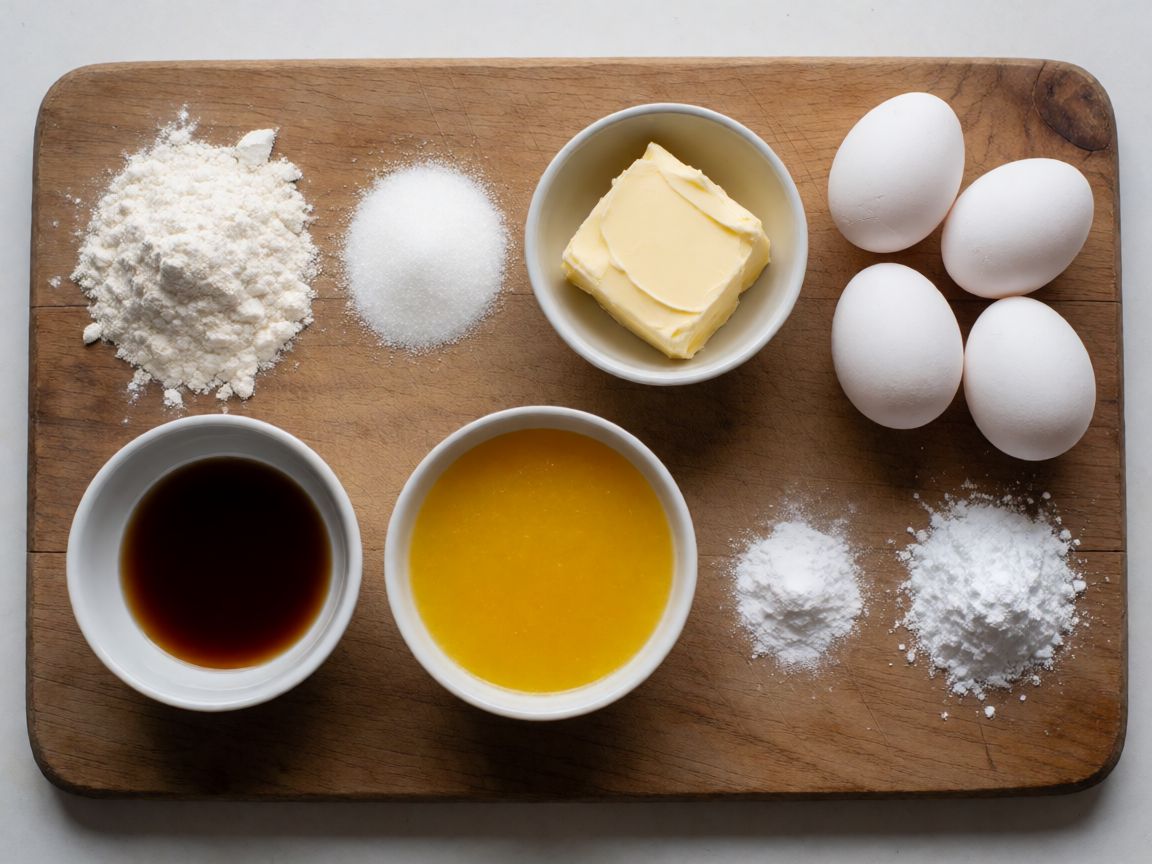
- 300 g Plain flour
- 250 g Caster sugar
- 100 g Butter softened
- 3 pcs Eggs
- 180 ml Orange juice
- 0.5 pcs Vanilla extract or 3 g vanillin
- 16 g Baking powder
- Icing sugar to taste








Steps
In a large bowl, combine the egg yolks, sugar and softened butter and beat until light and fluffy.
Separately, whisk the egg whites to stiff peaks.
Add part of the sifted flour to the yolk mixture and mix thoroughly.
Gradually pour in the orange juice, alternating with the rest of the flour.
Add the baking powder and vanilla extract (or vanillin) and mix well.
Gently fold in the whipped egg whites, stirring with upward strokes.
Pour the batter into a 24 cm tin, greased with butter and dusted with flour.
Bake in a preheated fan oven at 170°C for 30-35 minutes.
33 minCheck with a wooden skewer — it should come out dry.
If you like, fill the cake with orange jam or serve dusted with icing sugar.
This is a sponge, not a pound cake, and the whole method is built around getting air into it twice — once with the butter and sugar, once with the egg whites — and then not losing it when you add the liquid. Whether it works is decided in two places: how long you beat the yolks, sugar and butter, and how gently you fold in the whites afterwards. Everything else is just timing.
Some say you can skip separating the eggs and beat them whole with the sugar — no, because the whites are doing structural work here, not flavour. Whipped to stiff peaks, they're a scaffold of tiny air pockets held up by protein; whole eggs beaten with sugar give you some aeration but a much weaker, looser one, and the orange juice — 180 ml is a lot of liquid for 300 g flour — will slacken the batter further. Without a proper meringue holding it up, the crumb goes dense and a bit wet in the middle, especially near the centre of a 24 cm tin where heat arrives last.
The orange juice itself is doing double duty: moisture and acid. Acid reacts with baking powder's alkaline component a little faster and gives the crumb a slightly finer, more even bubble structure than water would — it's not a magic ingredient, it's a mildly acidic liquid, and lemon juice thinned with water would behave similarly if you're short an orange.
Flour and baking powder are listed as 300 g and 16 g, which is roughly 5% of the flour weight — on the high side for baking powder, which tells you this batter needs real lifting help because it's wetter and heavier (butter, 3 eggs, nearly 200 ml of juice) than a classic whisked sponge. Plain flour is correct here, not self-raising, because you're controlling the rise yourself with a measured amount of baking powder rather than guessing at whatever's pre-mixed into a bag of self-raising. If plain flour with baking powder is what you've got and you're tempted to use self-raising instead, drop the added baking powder to nearly nothing or the cake will dome, crack, and still collapse slightly as it cools — too much lift with not enough structure around it.
The butter needs to be genuinely soft, not melted — melted butter coats the flour's protein and sugar crystals differently and won't hold air the way creamed soft butter does when you beat it with sugar and yolks. Any unsalted butter works; salted will do too, just don't add extra salt elsewhere, there's none in this recipe anyway. If you're using a stand mixer or hand beaters, beat the yolks, sugar and butter until the mixture pales and roughly doubles in volume — that visual change is the cue, not a stopwatch.
Caster sugar is specified rather than granulated because the smaller crystal dissolves into the butter and yolks faster and more completely, giving a smoother batter and fewer undissolved sugar specks that can show up as tiny dense spots in the baked crumb. Granulated will still work if you beat it longer; icing sugar for this part would dissolve too fast and collapse the aeration you're trying to build, so don't substitute it in step one — save icing sugar for dusting at the end, where its only job is a light, sweet finish with no structural role at all.
Eggs at room temperature whip better than cold ones — cold egg white is thicker and resists forming the fine, stable foam you want for folding in. If your eggs came straight from the fridge, a few minutes in a bowl of warm water before you crack them does the job. The vanilla — 0.5 of a pod or 3 g of vanillin — is purely aromatic; it does nothing structural, so swap freely for vanilla extract, a drop of vanilla paste, or even orange zest added to the batter, which would actually reinforce the citrus theme rather than compete with it.
Folding the whites in with upward strokes, as the method says, rather than stirring round and round, matters more than it sounds. Circular stirring shears the air bubbles out of the foam; lifting the batter from underneath and turning it over keeps most of them intact. This is the point where a lot of home bakes lose their lightness — not in the whisking, but in the few seconds right after it, when people get impatient and just mix.
A domestic oven without a window you trust, or one that runs hot in the back corner, means the skewer test in step 9 is your real authority, not the clock. 30–35 minutes is a lower bound based on a 24 cm tin at 170°C fan — a slightly larger tin, a cooler oven, or cold batter straight from a cold kitchen will all push that later, and pulling it early because "it's been half an hour" is how you end up with a wet streak through the middle that looks like underbaking because it is. Let it rest a few minutes in the tin before turning out — straight from the oven it's structurally still a bit fragile, held together as much by trapped steam as by set crumb, and it needs that short settling time the same way a roast needs resting before you carve it.