
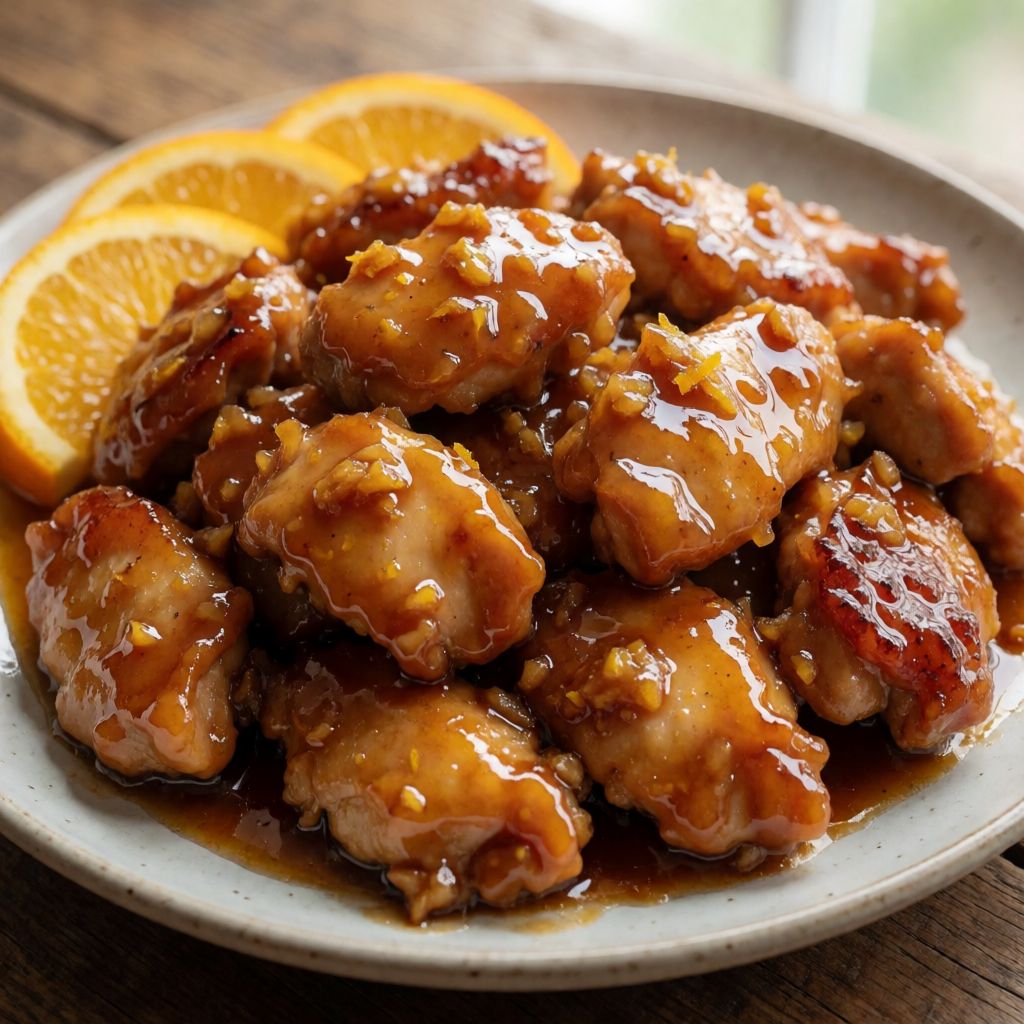
 AI photo
Ginger and Orange Chicken
Juicy chicken breast marinated in ginger, orange and soy, served with sesame rice and wilted spinach.
Labels are worked out automatically from the ingredients and can be wrong. Check the packaging if it matters to you.
Ingredients
- 15 g Ginger finely grated
- 1 pcs Orange juiced
- 3 tbsp Sweet chilli sauce
- 1 tbsp Soy sauce
- 1 pinch Cloves ground
- 1 tsp Cinnamon ground
- 2 tbsp Sesame oil
- 400 g Chicken breast cut into cubes
- 150 g Spinach
- 2 pcs Orange segmented
- 2 pcs Spring onion finely sliced
- 25 g Sesame seeds toasted
- 300 ml Basmati rice
- 1 tbsp Sesame oil
- 25 g Sesame seeds toasted
- pinch Black pepper freshly ground
- l Water lightly salted
- tbsp Sunflower oil a little, for frying















Steps
Marinade: mix the ginger, orange juice, sweet chilli sauce, soy sauce, cloves, cinnamon and sesame oil. Toss the chicken breast in the marinade.
Leave for at least 15 minutes — or longer, for example from morning until evening.
Sesame rice: cook the rice in lightly salted water according to the packet instructions.
Mix the freshly cooked hot rice with the toasted sesame seeds and freshly ground black pepper, add a little sesame oil.
Keep the rice warm in a covered pan.
Ginger and orange chicken: heat a frying pan with a little sunflower oil.
Remove the chicken pieces from the marinade and fry over high heat until golden.
Add the remaining marinade and simmer the chicken strips until fully cooked through.
At the end, add the baby spinach to the chicken in the pan and stir until wilted, then add the orange segments.
To serve: divide the sesame rice and ginger orange chicken between plates or bowls, sprinkle with spring onion and toasted sesame seeds.
This is a stir-fry wearing a marinade as a disguise. The whole dish turns on one decision: do you give the ginger and orange juice time to actually get into the chicken, or do you just coat it and fry five minutes later. Fifteen minutes is the legal minimum, the point past which the acid in the orange juice and the salt in the soy sauce have started to loosen the muscle fibres at the surface. Leave it from breakfast to supper and it goes somewhere else entirely — the ginger's enzymes nibble at the proteins, and the breast meat, which has no fat to protect it, gets a head start against turning to rope in the pan.
What decides whether this works isn't the sauce, it's the heat you fry it on. You want the pan properly hot — hot enough that a piece of chicken dropped in hisses and seizes on contact, because that's what gives you a browned, slightly sticky surface instead of chicken that sweats its marinade back out and boils in it. Some say you should fry chicken gently so it doesn't toughen — no, gentle heat on wet, marinaded meat just means liquid pools in the pan before any colour forms, and then you're simmering from the start, which is a different texture altogether, paler and wetter.
Ginger, grated fine rather than sliced, is there to released its juice into the marinade — sliced ginger just sits there being chewed later, grated ginger disappears and does its work invisibly. If you only have the dried ground stuff, use a pinch, not a spoonful; it's sharper and has none of the citrus top-note fresh ginger brings, so it's a compromise, not a swap.
The orange juice is doing two jobs — acid, to start loosening the chicken, and sugar, which is what lets the pan surface catch and caramelise rather than just braise. A shop-bought carton juice will do the acid job but not the caramelising one nearly as well, because it's often diluted and pasteurised flat. Squeeze your own if you can; it's one orange, not a chore.
Sweet chilli sauce and soy sauce are the backbone flavour — salt and a sweet-hot edge — and between the two of them you could rebuild this marinade from almost anything in a British cupboard: a spoon of honey and a shake of chilli flakes stand in for the sweet chilli sauce well enough, since what you're after is sweetness with a kick, not a brand.
Sesame oil is not for frying — it burns bitter at real heat — it's there raw, for smell. That's the substitution rule worth remembering generally: for frying you want "any oil with no smell of its own", sunflower, rapeseed, whatever's cheap and neutral in a British kitchen; for finishing, the opposite — you want an oil that smells of something, and sesame is that oil here. Don't let the two jobs swap.
Chicken breast cut into cubes rather than left whole is really about surface area — more surface means more marinade contact and more browned edges per mouthful, which is most of the flavour in a dish this quick. If you only had thigh, you'd actually be better off — it forgives overcooking, which breast does not, so if your hob runs cooler than you'd like, thigh is the safer bet, not a downgrade.
The spinach and the toasted sesame seeds are where a bit of patience pays without costing time: toasting sesame seeds in a dry pan for a minute until they go from pale to gold is the difference between seeds that taste of nothing and seeds that taste of themselves — don't skip it to save the thirty seconds, it's the whole point of them being there. And the rice, cooked and then tossed hot with sesame oil and pepper, is doing the same trick as everything else here: a plain base given one extra move right at the end, instead of being left to sit under the chicken as dead weight.