
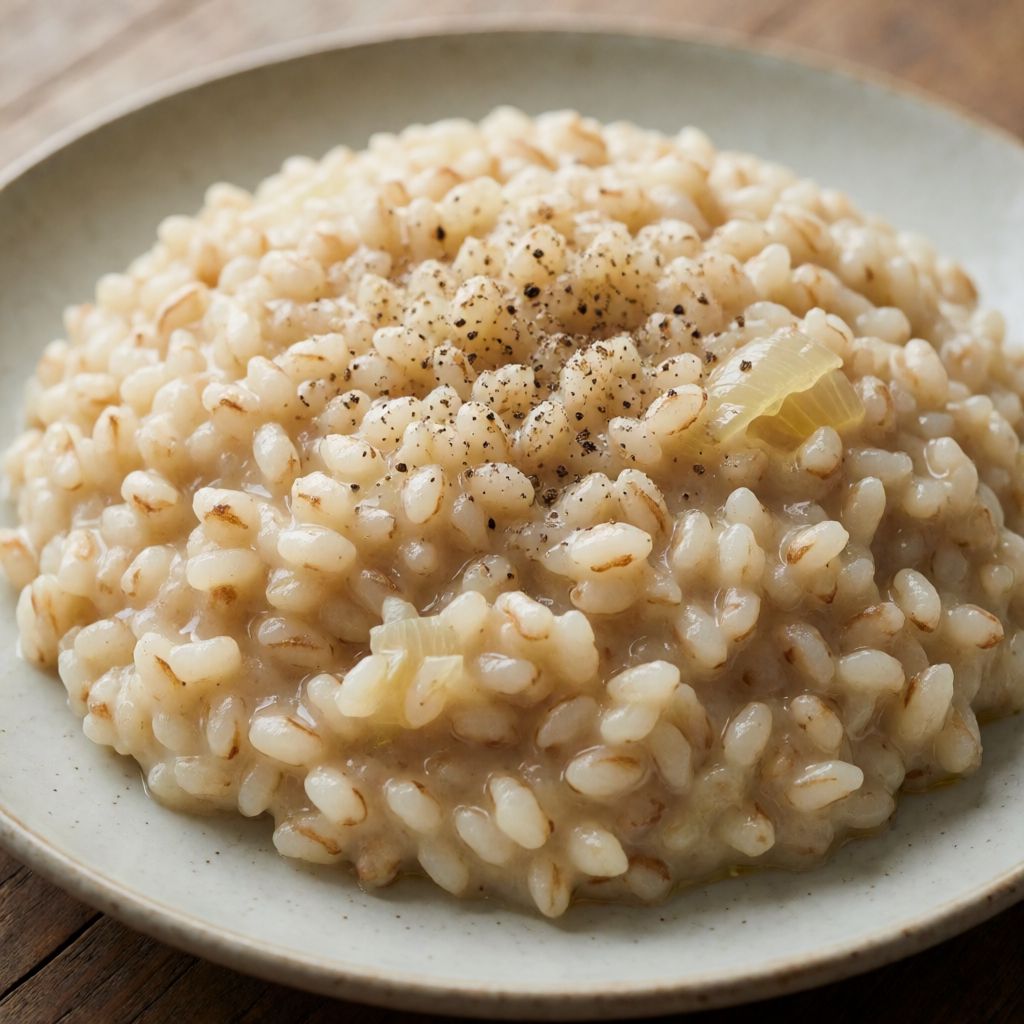
 AI photo
Orzotto: A Creamy Pearl Barley Dish
A creamy risotto-style dish made with pearl barley, finished with Parmesan and butter.
Labels are worked out automatically from the ingredients and can be wrong. Check the packaging if it matters to you.
Ingredients
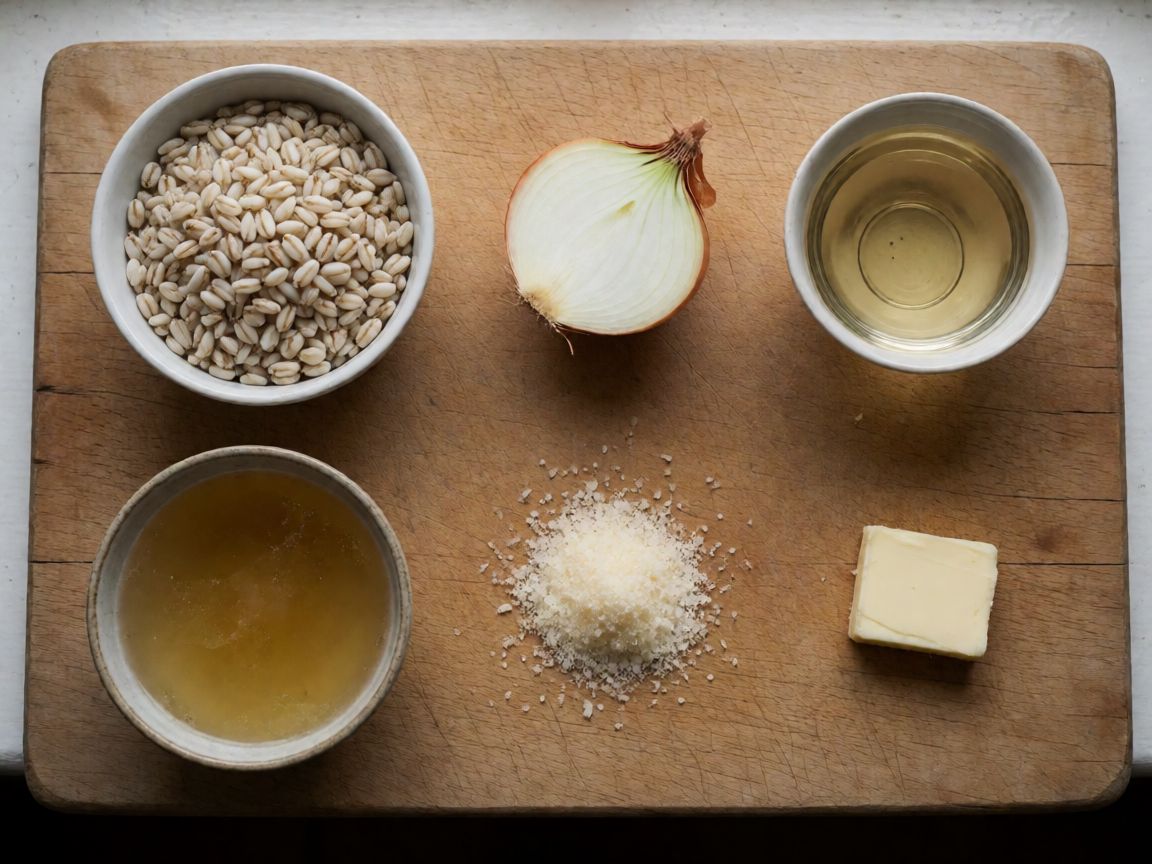
- 300 g Pearl Barley
- 0.5 pcs Onion
- Olive Oil to taste
- Salt to taste
- Black Pepper to taste
- 75 ml Wine
- 1 l Vegetable Stock
- 50 g Parmesan
- 1 pcs Butter a knob









Steps
Finely chop the onion and sauté it over low heat in a saucepan with a little olive oil until soft.
Add the pearl barley, rinsed well beforehand, and toast it over high heat, stirring often.
Pour in the wine and let it evaporate completely.
Begin cooking, gradually adding ladlefuls of hot vegetable stock, until the barley is tender.
30 minRemove the saucepan from the heat and stir vigorously with the butter and Parmesan until creamy.
Orzotto is risotto's trick played on a tougher grain. The whole point of risotto was never the rice — it was a method: toast a starchy grain in fat, then feed it liquid in small doses while you rub it around the pan, and the grain lets its own starch out into the liquid instead of keeping it locked inside. That starch thickens the liquid, and the liquid coats every grain. No cream goes in. The cream is made, not added.
Pearl barley takes to this method but doesn't surrender the way arborio rice does. Barley has had its outer bran layers polished off, same idea as pearled rice, but what's underneath is a denser structure — more protein holding the starch granules together, so they don't all rupture on cue. That's why this takes closer to 45 minutes where a rice risotto might finish in 18. Don't fight it by cranking the heat to hurry it along — you'll just scorch the bottom while the centre of each grain is still raw-hard. Patience here isn't a virtue, it's a requirement of the ingredient.
What decides whether it works is two things: whether the barley got properly toasted before any liquid touched it, and whether you kept feeding it stock in small amounts instead of drowning it once. Toasting over high heat, dry stirring, seals the outside of each grain with a thin layer of fat-set starch — this is what makes the starch come out gradually, ladle by ladle, instead of all in the first five minutes leaving you with gluey liquid and a grain that's still bullet-hard in the middle.
Pearl barley, rinsed well before it goes in: this isn't ritual, it's removing the loose starch dust clinging to the outside from milling and storage. Skip the rinse and that dust gelatinises the instant it hits hot fat, giving you patchy sticking in the pan rather than an even toast. If barley isn't in the cupboard, pearl spelt or farro will take the same method, though both cook a touch faster — start checking for the soft-bend-not-snap bite earlier.
The onion goes in over low heat for a reason that has nothing to do with time and everything to do with sugar. Low heat lets the cell walls break down and the onion go translucent and sweet without the sugars catching and browning. Brown it here and you've built a different flavour than the dish is asking for — fine in other things, wrong in this one, because everything after depends on a mild, sweet base that doesn't compete with the Parmesan at the end.
The toasting step that follows is where most of the work actually happens, even though it looks like nothing — a few minutes of dry grains hissing in hot fat, stirred so they don't catch on one side. This is what sets the starch at the surface of each grain, so it releases slowly later instead of all at once. Skip this and the finished dish goes gluey in the first ten minutes of cooking and starved of texture after that.
Wine, 75 ml, is there for acid, not alcohol — the alcohol is meant to cook off entirely before stock goes anywhere near the pan, otherwise you're left with a raw, sharp edge sitting on top of the dish. Any dry wine does this job; it doesn't need to be good enough to drink. No wine in the house — a small splash of stock with a few drops of vinegar or lemon juice stands in, same acid function, different pedigree.
Stock, a litre, hot, added by the ladle: cold stock shocks the pan back down in temperature every time it's added, which stalls the starch release and stretches the cooking time out unevenly. Keep it hot on the side, in whatever pan is free, and feed it in gradually — this is the ladle-by-ladle part that can't be rushed into one big pour. If it's a Sunday and there's a roast in the oven, the bones and juices from that make a better base than a cube, no extra effort, just timing.
Butter and Parmesan go in off the heat, and that detail matters more than it looks. Stir vigorously while the pan is still hot enough to melt them but no longer over flame — direct heat at this stage splits the fat from the cheese, leaving grease on top instead of the cling you're after. Parmesan brings salt and a hard, dry, aged bite that a young or soft cheese can't; any firm aged cheese with a similarly low moisture content will do, but skip anything that melts stringy. A wide pan rather than a narrow pot gives you more surface contact for even stirring — no kazan needed, your widest frying pan with sides deep enough to hold the stock will do the job a domestic hob can't do any other way.