
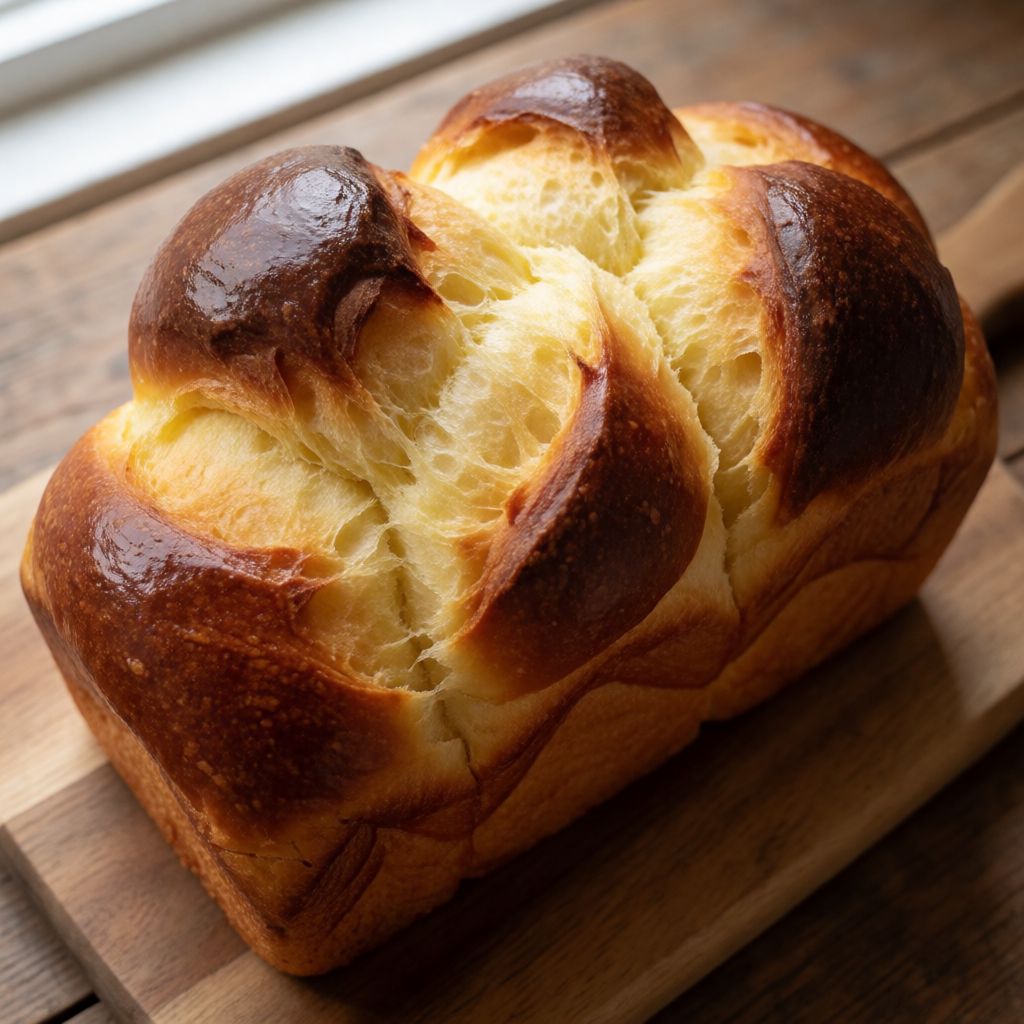
 AI photo
Pain Brioche
A soft, buttery brioche loaf, rich with eggs and a touch of honey.
Labels are worked out automatically from the ingredients and can be wrong. Check the packaging if it matters to you.
Ingredients
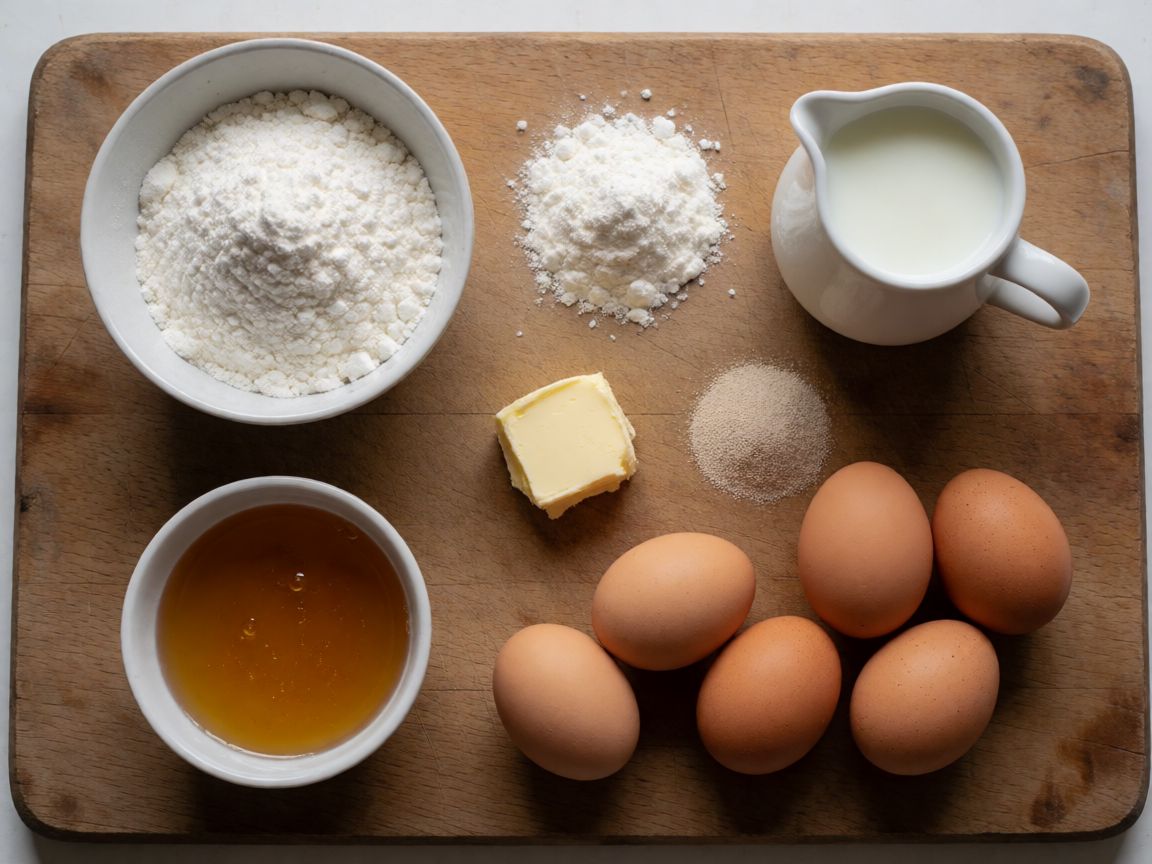
- 200 g Strong white flour
- 150 g Plain flour
- 170 g Butter softened
- 5 g Dried yeast
- 20 ml Milk room temperature
- 5 pcs Eggs
- 5 g Honey runny
- 3 g Salt







Steps
Sift the strong white flour and plain flour into the bowl of a stand mixer.
Add 4 room-temperature eggs, honey and milk, then add the dried yeast.
Knead the dough on the dough setting, gradually adding the softened butter.
10 minAdd the salt near the end of kneading.
Transfer the dough to a bowl, cover with cling film and leave to rise.
120 minButter a loaf tin (30x10 cm) and dust with flour.
Dust the dough with flour and divide into 6 equal balls.
Place the balls in the tin and leave to rise under a damp cloth until they reach the edges.
Beat the remaining egg with 1 tbsp milk.
Brush the dough with the egg and milk mixture using a pastry brush.
Bake the brioche in an oven preheated to 180°C.
28 min
Brioche is bread pretending to be cake, and the pretence works because of one ratio: butter against flour, a lot of it, worked into a dough that still needs gluten to stand up. That's the whole tension of the thing. Too little structure and it collapses into a greasy crumb; too little butter and you've just made a slightly sweet loaf. Here you've got 170 g butter against 350 g flour — close to half — which puts this firmly on the rich end of brioche, the kind that tears into soft strands rather than slices clean.
What decides whether it works isn't the oven, it's the mixer and the fridge-less wait beforehand. Butter at this ratio will not go into a dough by hand in any reasonable time without turning the whole thing into a paste — the fat coats the flour before gluten can form, and you get a dense, greasy result that never rises properly. The stand mixer does something your forearm can't: it develops the gluten network first, then lets butter in slowly enough that the network holds rather than drowns. Add butter too fast, same problem — it slicks the dough and strangles the rise.
The two risings are not decoration. The first one (120 minutes, and that's a floor, not a deadline) builds flavour and the air pockets that give brioche its pull-apart texture; the second — balls packed into the tin until they touch the edges — is what makes it a shaped loaf instead of one solid ball baked into a brick. Skip or rush that second rise and you'll get a loaf with a dense, dry base and only the top inch properly open.
On the flour: strong white (bread) flour plus plain flour, roughly 4:3 here, is a compromise, not a mistake. All strong flour would give you more chew and structure to carry that much butter, which sounds good until you remember brioche isn't meant to be chewy — it's meant to be tender. The plain flour softens the bite. If you've only got strong flour in the cupboard, use it, but expect a slightly firmer crumb — not wrong, just different bread. Don't go the other way and use all plain flour; there won't be enough gluten to hold the butter and the loaf will slump in the tin rather than rise over the edge.
Butter has to be softened, not melted, and this matters for the same reason as the mixer: melted butter is a liquid fat that slides between gluten strands and weakens them before they've formed; softened butter (room temperature, yielding under a finger, not shiny) can be worked in gradually and actually gets held by the dough. If you're short on time, don't microwave it — cube it and let the room do the work, or you'll undo the whole point of the slow addition.
Dried yeast at 5 g against 350 g flour is a modest amount, deliberately so — a rich, buttery dough rises slower than a lean one, because fat coats the gluten and insulates it a little from the yeast's own gas production. Pile in more yeast to "speed things up" and you get a sour, over-proofed taste before the structure's caught up — patience is the actual ingredient here, not extra leavening. If you only have fresh yeast, use roughly double the weight and crumble it into the milk rather than the flour.
Eggs do two jobs: four go into the dough for richness, colour and some structure (egg proteins set during baking and help the crumb hold its shape once it cools), and the fifth is purely for the glaze — beaten with milk for shine and that deep golden crust. Don't skip the glaze thinking it's cosmetic: an unglazed brioche crust dries out faster and looks flat rather than burnished. If you're out of eggs for the glaze, milk alone browns less but still works.
Honey here is a small addition — 5 g, barely a teaspoon — doing a quiet job of feeding the yeast a touch and rounding off bitterness, not sweetening the loaf outright. Sugar works the same way if that's what's in the cupboard; there's no magic in honey specifically.
A British loaf tin at 30x10 cm is on the long, narrow side for six dough balls — that's fine, it's exactly why you pack them in and wait for them to touch the edges before baking: that contact is what fuses them into one loaf with the characteristic lobed top, rather than six separate buns that happen to share a tin. At 180°C the sugars in the crust (from the egg wash, the honey, the milk solids in the butter) brown steadily without racing ahead of the inside cooking — go hotter and you'll get a dark crust over a doughy middle, because a dough this rich needs real time for heat to travel to the centre. 28 minutes is your floor: trust the colour — a deep, even gold, not pale, not scorched — over the clock, and if the top's getting too dark before the crumb's set, lay foil loosely over it rather than pulling the loaf early.