
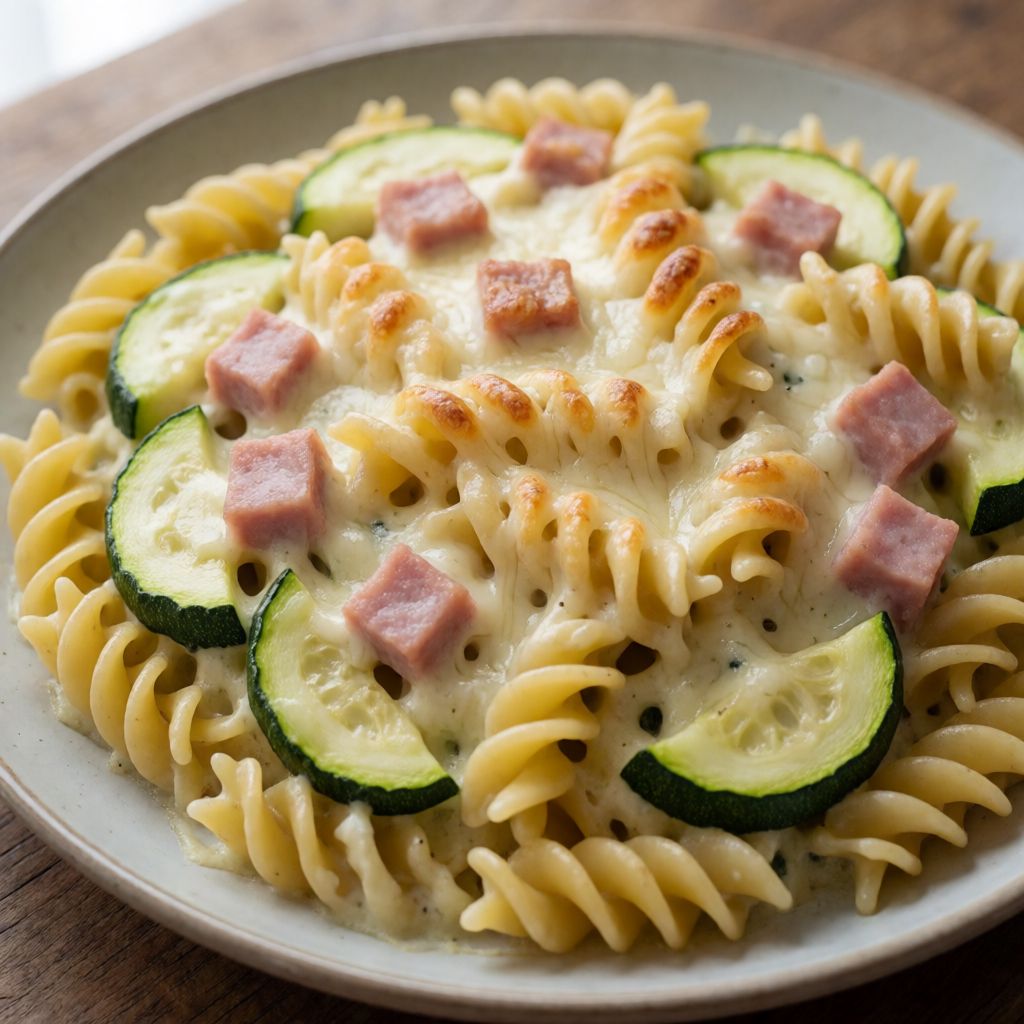
 AI photo
Creamy Baked Pasta with Courgette and Ham
A creamy baked pasta with courgette, ham and melted cheese, finished in the oven until golden.
Labels are worked out automatically from the ingredients and can be wrong. Check the packaging if it matters to you.
Ingredients
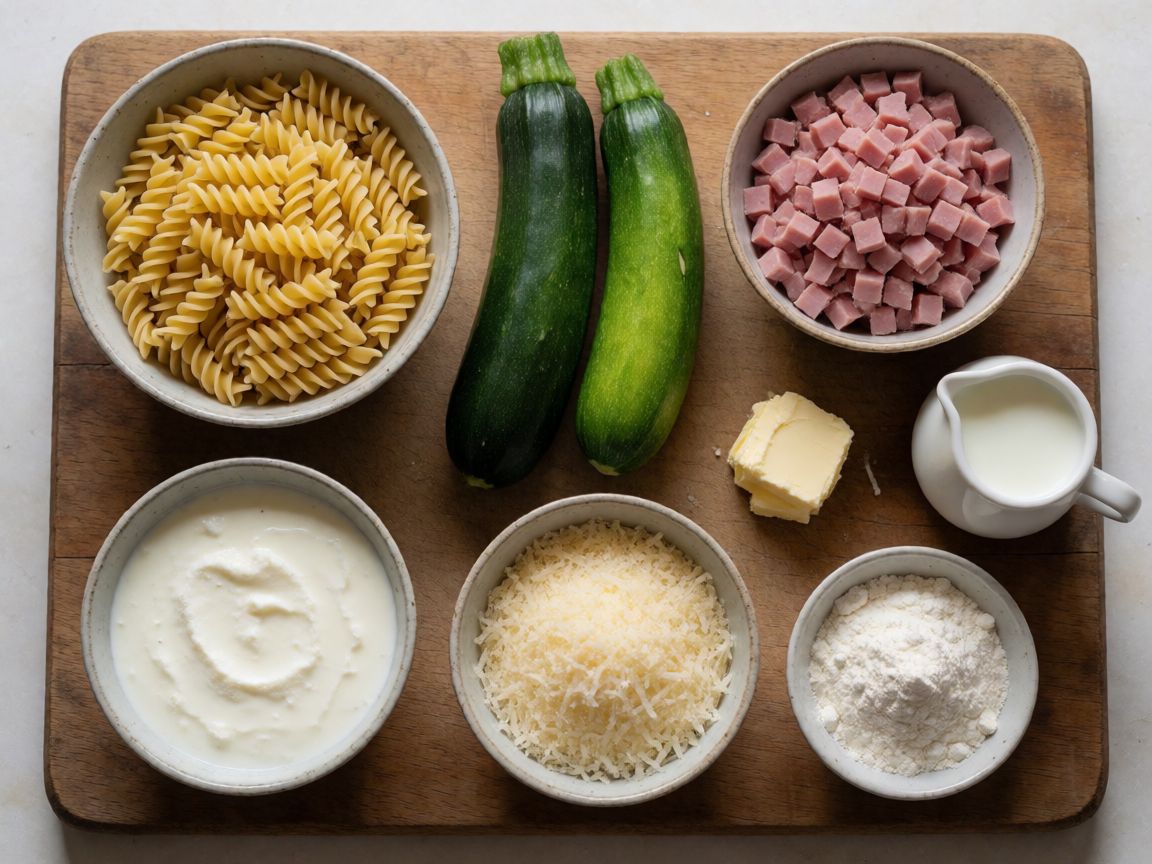
- 350 g Fusilli
- 2 pcs Courgette
- 100 g Ham
- 150 g Fior di Latte
- Olive oil to taste
- Salt to taste
- Black pepper to taste
- 50 g Parmesan
- 500 ml Milk
- 50 g Butter
- 25 g Plain flour
- Nutmeg to taste











Steps
Melt the butter in a saucepan, add the flour and whisk quickly.
Pour in the milk, add salt, black pepper and nutmeg, and cook over medium heat, stirring constantly, until the sauce thickens.
Wash, dry and trim the courgettes, then cut into cubes. Cut the fior di latte and ham into cubes as well.
Bring a large pot of lightly salted water to the boil.
Heat a little olive oil in a wide pan, add the courgettes and sauté for a few minutes.
Season with salt to taste and add the ham.
Cook the pasta.
Drain the pasta while still firm to the bite and toss it with the courgette and ham mixture.
Cover the bottom of a baking dish with 1-2 tablespoons of béchamel. Add half the pasta, the fior di latte cubes, a couple more spoons of béchamel and a handful of grated Parmesan.
Add the rest of the pasta and spread the remaining béchamel over the top.
Sprinkle Parmesan on top and bake at 200°C for about 30 minutes.
30 minRemove from the oven, let the pasta rest for a few minutes, then serve.
This is pasta cooked twice — once in water, once in the oven — and the whole point of baking it a second time is to let a skin form on top while the inside stays wet. Without béchamel glueing it together, baked pasta is just dry fusilli with a crust. With it, you get a dish that holds its shape when you cut a square out of it but still runs a little at the edges. That's the test: a slice that stands, not a slick that pools.
What decides whether it works is restraint at two points. First, the courgette has to lose its raw crunch but keep its shape — sauté it hot and fast, in oil, not simmer it in its own water. A courgette left too long in the pan weeps, and that liquid has nowhere to go once it's under pasta and sauce — it just waters down your béchamel from underneath. Second, the pasta goes into the oven undercooked, properly undercooked, because it keeps cooking in the béchamel's heat for another half hour. Boil it to "done" first and you'll pull out mush.
Some say you need a lid or foil over the dish to stop it drying out. No — that traps steam and you get a pale, soft top with no texture, which defeats the reason you're baking it at all. The cheese and Parmesan on top are there to brown and crisp; cover that and you've just made a stew in a tray.
Four people, one wide baking dish, about 35 x 25cm or whatever roasting tin normally holds your Sunday potatoes — that size, not a deep casserole, because depth is the enemy here. You want surface area for the crust.
The béchamel is not decoration, it's structural — flour and butter cooked together (a roux) coats the milk's proteins so they don't just sit as thin liquid; they thicken into something that clings to pasta instead of running off it. Whisk the flour into the butter the moment it melts, before it browns, because browned butter changes the whole flavour of the sauce and you don't want caramel notes fighting with nutmeg. Pour the milk in gradually if you've never made it before, and keep stirring — lumps happen when flour sits in one spot and cooks into a clump before the liquid reaches it, not because béchamel is temperamental.
Courgette: buy the smaller, firmer ones. Large courgettes are mostly water and seed, which is exactly the enemy of a baked dish. If courgette's out of season or you can't find decent ones, swap in leek or mushroom — something that can be sautéed dry rather than something watery like tomato, which would turn this into a different dish entirely.
Fior di latte is a fresh mozzarella, made for melting without going rubbery — it's cut into cubes here so it stays as pockets of pulled, stretchy cheese rather than a uniform layer. If you can't get it, a block mozzarella from the supermarket chiller works, just pat it dry first — fior di latte is sold in its own whey and carries less water than the blocks sitting in brine. Don't reach for pre-shredded "mozzarella" bags meant for pizza — they're coated to stop clumping, which also stops them melting properly.
Ham here is just salt and savour laid through the dish — any dry-cured or cooked ham you'd put in a sandwich does the job. Parmesan is for the crust and the salt it carries through the sauce; a hard British cheddar grates and melts differently; it'll work but it changes the dish's character, pulling it toward cauliflower-cheese territory rather than Italian baked pasta. Use a parmesan-style hard cheese if that's what's in the fridge, but don't skip grating your own — the pre-grated stuff is dried and doesn't melt the same way.
Nutmeg in béchamel isn't tradition for tradition's sake — it's there because milk sauces are flat without something sharp cutting through the fat, and nutmeg does it without becoming a flavour of its own the way chilli or garlic would. Use it sparingly; a few scrapes of a whole nutmeg go further than you'd think, and the pre-ground stuff loses potency fast once the jar's open.
Fusilli's shape matters more than people assume — its ridges and curls hold béchamel in a way smooth pasta like penne lisce doesn't. If you only have penne, use the ridged kind (rigate), not the smooth one, or you'll find sauce sitting under the pasta rather than clinging to it.
The oven at 200°C is hot enough to brown the top in the time it takes the inside to finish cooking through — any hotter domestic oven and you risk a burnt crust over a cold centre, because home ovens run uneven and that heat has to travel through a dish, not just across a surface. Thirty minutes is the lower mark — watch for the top going from pale and shiny to freckled gold, with the sauce visibly bubbling at the edges of the dish, not just trust the timer.
And give it those few minutes resting out of the oven before you cut into it. Straight from the heat, the béchamel's still loose and everything slides when you try to serve a slice. A short rest lets it firm up just enough to hold its shape on the plate — patience here isn't optional, it's the difference between a neat square and a puddle.