
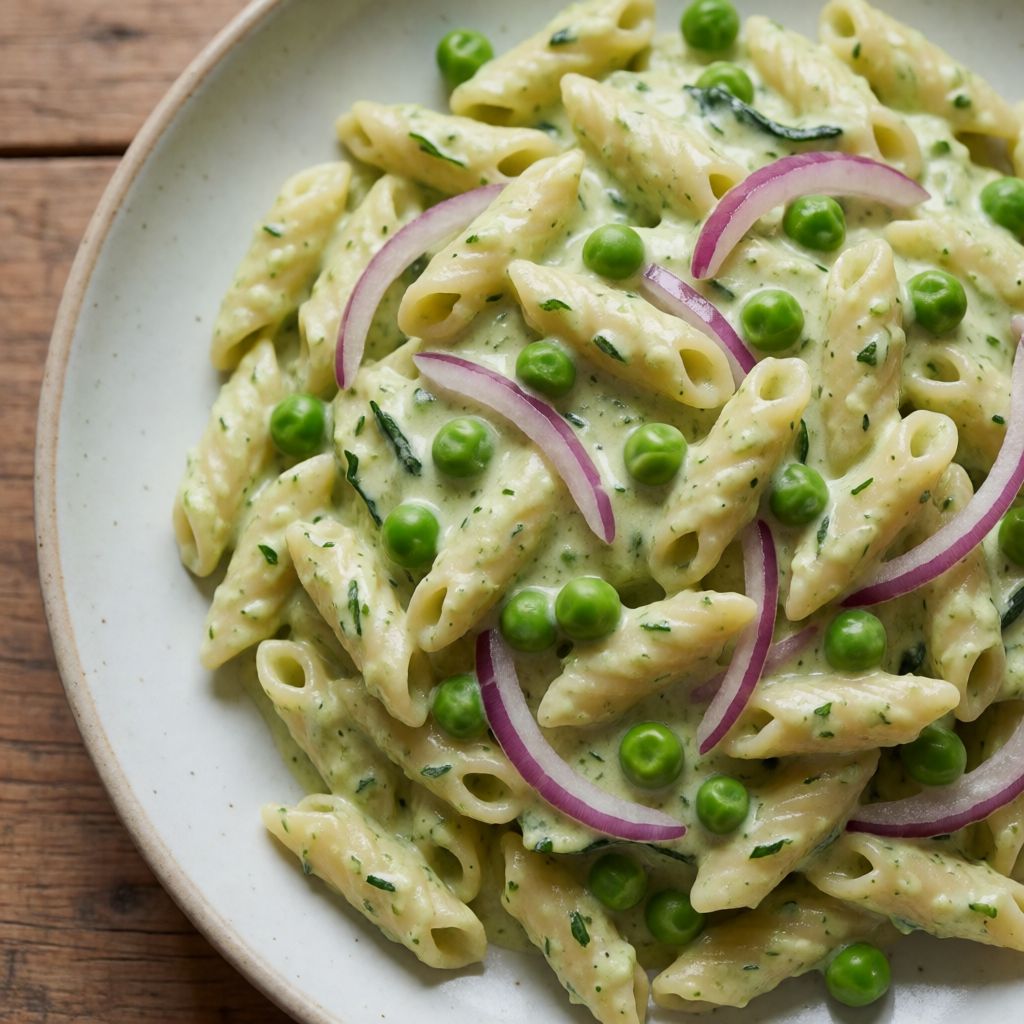
 AI photo
Creamy Courgette and Mint Pasta
A creamy, fragrant pasta with courgette and mint, tossed in a light yoghurt sauce.
Labels are worked out automatically from the ingredients and can be wrong. Check the packaging if it matters to you.
Ingredients
- 500 g Trofie
- 2 pcs Courgettes
- 50 g Peas
- 20 g Red onion
- Olive oil to taste
- Salt to taste
- Black pepper to taste
- 60 g Greek yoghurt
- Pine nuts to taste
- 3-4 pcs Mint leaves


Steps
Bring a large pot of salted water to the boil.
In a frying pan, heat a little olive oil, add the chopped red onion together with the sliced courgettes and sauté.
Cook the courgettes over high heat for a few minutes, stirring occasionally.
Add the peas, and season with salt and pepper to taste.
Keep cooking until the vegetables are very soft.
12 minCook the trofie in salted water.
Transfer the vegetables to a blender and let them cool.
Add the mint to the vegetables.
Blitz for a few seconds, then add the Greek yoghurt.
Blitz again until the ingredients come together into a smooth mixture.
Drain the pasta al dente, tip it into a bowl and toss with the sauce.
Mix well, adding a little pasta cooking water if needed.
Serve, garnished with mint leaves and pine nuts.
This is a sauce built on a trick: you cook courgette and peas down until they give up being vegetables and become a paste, then you let yoghurt stand in for cream. No reduction of actual cream, no roux, no butter — the body of the sauce comes from the vegetable's own water boiling off and its pectin breaking down. That's what "very soft" means in step 5. Not tender like a side dish. Collapsed. If a slice of courgette still has a bit of snap in the middle, your blender will give you a gritty green smoothie instead of silk, and no amount of yoghurt fixes that afterward.
Some say courgette is a watery vegetable with nothing to offer a sauce — no, because that water is exactly the point. You're not trying to keep it crisp-tender the way you would for a stir-fry; you're using high heat to drive the water out fast, so what's left behind is concentrated flesh, not a soup. That's also why the pan stays uncovered and the heat stays high: a lid traps steam, steams the courgette instead of browning its edges, and you lose the faint caramel note that stops this dish from tasting like boiled marrow.
The yoghurt is doing the job cream usually does, but it is not cream, and it does not like a hot pan. That's why the vegetables get blitzed, then cooled, before the yoghurt goes in — add it hot and it splits, turns grainy, throws water. You're making a cold emulsion by hand in a blender, not a cooked sauce, and the order of operations exists purely to keep the yoghurt from curdling under residual heat.
Courgette: pick ones that feel heavy for their size and firm end to end — a soft, spongy one has already started turning watery and bitter inside, and in a sauce that's hiding nowhere. Any firm, mild summer squash works the same way; the recipe doesn't depend on courgette specifically, it depends on a vegetable that's mostly water and goes meltingly soft under heat without turning sweet. That rules out something starchy like potato.
Peas here are not a vegetable you're trying to keep bright and whole — they're going in the blender too, so frozen peas are not a compromise, they're arguably the better choice: picked and frozen within hours, often sweeter than "fresh" peas that have sat travelling for days. Don't thaw them first; they'll cook through in the same few minutes as the courgette.
Red onion against white or yellow: it's milder raw and sweeter cooked, which matters because nothing here is simmered long enough to mellow a sharper onion properly. Twenty grams is not much — this is background, not a base you're building a stock on. If you only have a yellow onion, use less of it; its bite is stronger per gram.
Olive oil needs no particular virtue here beyond not being flavourless — you want a little of its fruitiness to survive into the sauce, since there's no butter, no stock, nothing else carrying fat-soluble flavour. Any neutral oil would work mechanically but would leave the sauce tasting thinner.
Greek yoghurt specifically, not regular yoghurt, because it's strained — less water, thicker body, so it folds into a vegetable purée without loosening it back into soup. If you only have ordinary yoghurt, you'll need less pasta water later, since you're already starting wetter. This is also where the saved pasta water earns its place: not habit, but a tool — starchy, salty, and warm, it lets you loosen a sauce that's gone too tight after the pasta's absorbed some of it, without diluting the flavour the way a splash of tap water would.
Pine nuts and mint leaves go on at the end, raw, because their job is contrast — a bit of crunch and oil against a soft sauce, a cold green note against something that's just come off blended warm vegetables. Toast the pine nuts in a dry pan for a minute if you want their flavour to actually register; raw from the bag they're mostly texture. No pine nuts in the cupboard — toasted flaked almonds do the same job, crunch and a little fat, nothing more is required of them.
As for timing: the 12 minutes for the vegetables is a floor, not a target — you're watching for the courgette to go from pale green and faintly translucent to properly slumped, with the peas no longer tight little spheres. The pasta pot and the vegetable pan run alongside each other, not in sequence, which is the only way this fits into half an hour on a domestic hob with two rings — one for a wide pan of boiling salted water, one for the sauté. On a kazan or a professional burner you'd reduce the vegetables faster and harder; on a flat's hob, give it the extra minute rather than forcing the heat up and scorching the onion before the courgette's caught up.