
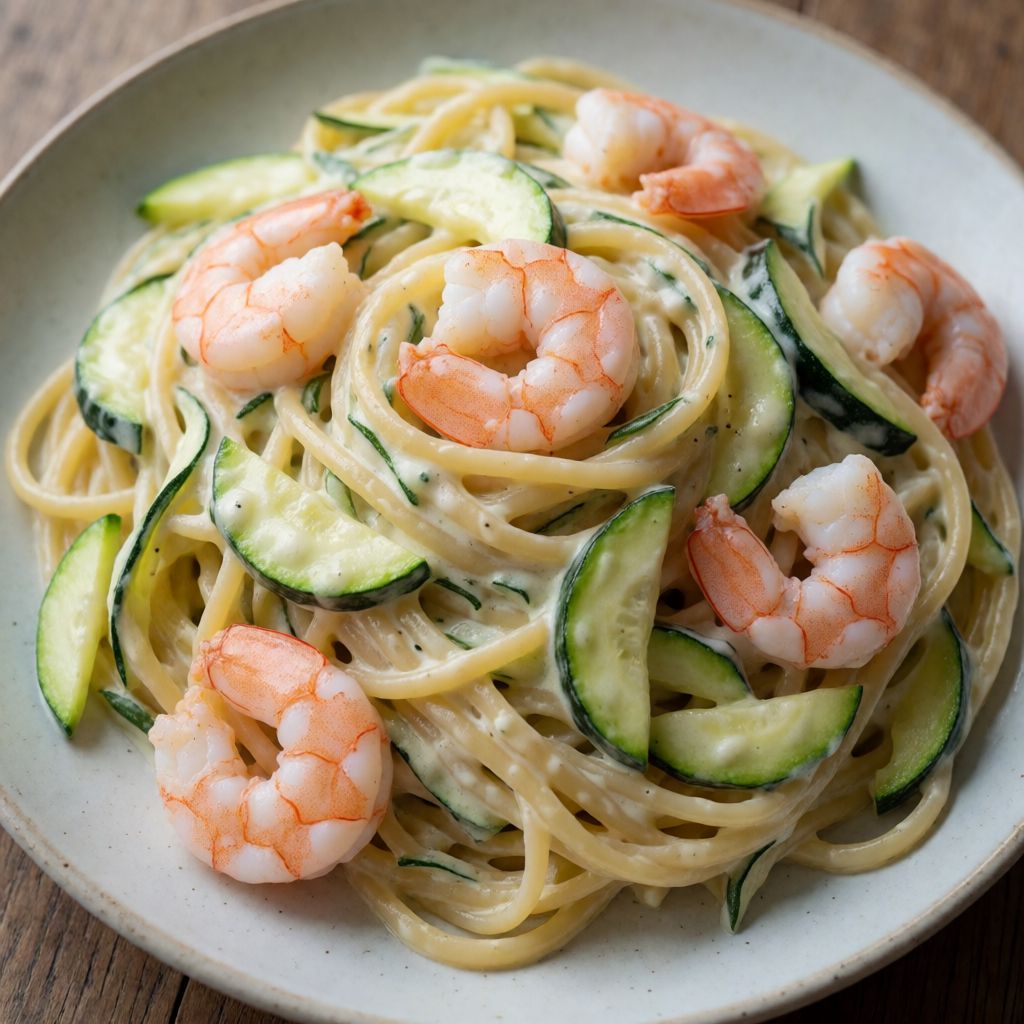
 AI photo
Pasta with Courgette and Prawns
A quick, creamy pasta with courgette and prawns, finished with mascarpone.
Labels are worked out automatically from the ingredients and can be wrong. Check the packaging if it matters to you.
Ingredients
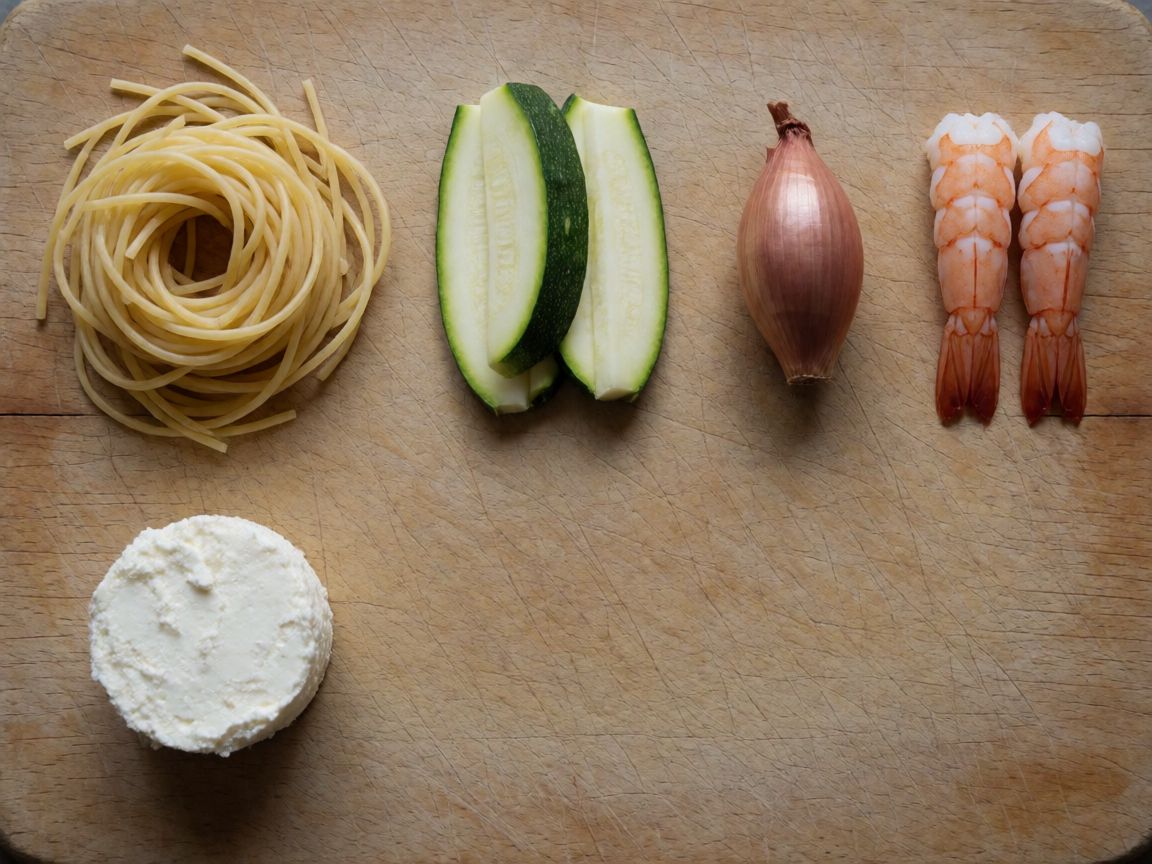
- 320 g Pasta
- 200 g Courgette
- 300 g Tiger prawn tails or prawns
- 1 pcs Shallot
- 100 g Mascarpone or cream cheese, or double cream
- Olive oil to taste
- Salt to taste
- Black pepper to taste







Steps
Put a pan of water on for the pasta and bring to the boil.
Wash the courgette, trim the ends and cut into small cubes.
Heat a little olive oil in a frying pan and fry the chopped shallot.
Add the courgette and cook, stirring and adding a little water if needed.
7 minPeel the prawn tails: remove the shell and the gut by making a shallow cut, then slice lengthways in half.
Add the prawns to the pan with the courgette.
Salt the water and cook the pasta according to the time on the packet.
Add the mascarpone to the pan, season with salt and pepper to taste, and mix well. Ready when the thickest part reaches 63°C.
Drain the pasta, transfer to the pan and toss gently with the sauce.
Plate up and serve immediately.
This is a quick weeknight pasta that works on one principle: the sauce is built from what the vegetable and the shellfish let go into the pan, not from a jar. Courgette is mostly water held in a loose cell structure — heat it gently and it weeps rather than fries, and that liquid, plus what the prawns release, is what turns mascarpone from a tub of cheese into a sauce that coats the pasta instead of sitting on top of it. Get that balance wrong — too hot, too fast — and you get dry rubbery prawns swimming in grease, with the cheese split into oily streaks.
The two moments that decide the dish are the courgette's water and the prawn's heat. Some say courgette needs frying hard to "get colour" — no, because colour here means caramelised sugars, and courgette barely has any; what you actually want is for it to go translucent and slightly soft, holding its shape but no longer squeaking against the knife. Push it harder and you're just driving off water you'll need two minutes later to loosen the sauce.
Prawns are the part people wreck most often, and it's almost always overcooking. A prawn's muscle fibres are tight coils of protein; past a certain point the coils seize completely, squeeze out their own moisture, and go from tender to the texture of a rubber band. You're looking for the flesh to turn from grey-translucent to opaque pink-white and curl slightly — that curl is the signal, not a stopwatch. Given them 30g each roughly and they cook in the time it takes to stir in cheese, so they go in early enough to warm through but finish only once the sauce is nearly done.
Pasta: 320g dry for five is a light hand — closer to a starter-sized portion stretched into a main by the sauce and the prawns. Any short or medium shape that can hold sauce in its ridges or hollow works; a long strand like spaghetti will do, but something like penne or fusilli grabs the mascarpone better, which matters more here than tradition does. Salt the water properly — not a token pinch — because pasta only seasons itself once, while boiling, and an unsalted pot can't be fixed afterwards no matter how much you salt the sauce.
Courgette: choose one that's firm and glossy-skinned, heavy for its size — a soft, pitted one has already started losing water and will turn to mush faster than you can react. Cut it small and even, because uneven pieces mean some turn to sauce while others stay raw-crunchy. If courgette's not available, a pale marrow won't do the same job — it's too watery and bland — but a diced yellow squash behaves almost identically.
Tiger prawns: raw, shell-on tails give you more flavour than pre-cooked ones, because the shell carries sweetness that leaches into the pan while you work — even a brief sit there matters. "Deveining" with a shallow cut isn't cosmetic fussiness: that dark line is the gut tract, and leaving it in doesn't poison you, but it can taste gritty and faintly bitter, which undoes a delicate sauce. If raw tiger prawns aren't to hand, any raw prawn works on the same logic — just watch for size, because a tiny prawn turns rubbery almost instantly and a jumbo one needs longer before it curls.
Shallot rather than onion: shallots are smaller, sweeter, and cook through gently without the sharp bite a large onion brings when it's only lightly softened rather than properly browned. If you only have onion, use less of it and give it slightly longer before the courgette goes in, so the raw edge cooks off.
Mascarpone: it's a high-fat, barely-set cream cheese with almost no water in it, which is exactly why it emulsifies into a silky sauce rather than separating — the fat coats the pasta, the released juices carry it. Double cream does the same job with less body; a lower-fat cream cheese will work in a pinch but can taste slightly tangy where mascarpone tastes neutral and rich. Whatever you use, pull it off the heat once it's loosened and glossy — push it too hot for too long and the fat can split out, leaving you with oily puddles instead of sauce. This is where patience earns its place as an ingredient: give the courgette its water, give the prawns their curl, and the cheese will behave. Rush any of those three and you're not making a sauce, you're making three separate things that happen to be in the same pan.