
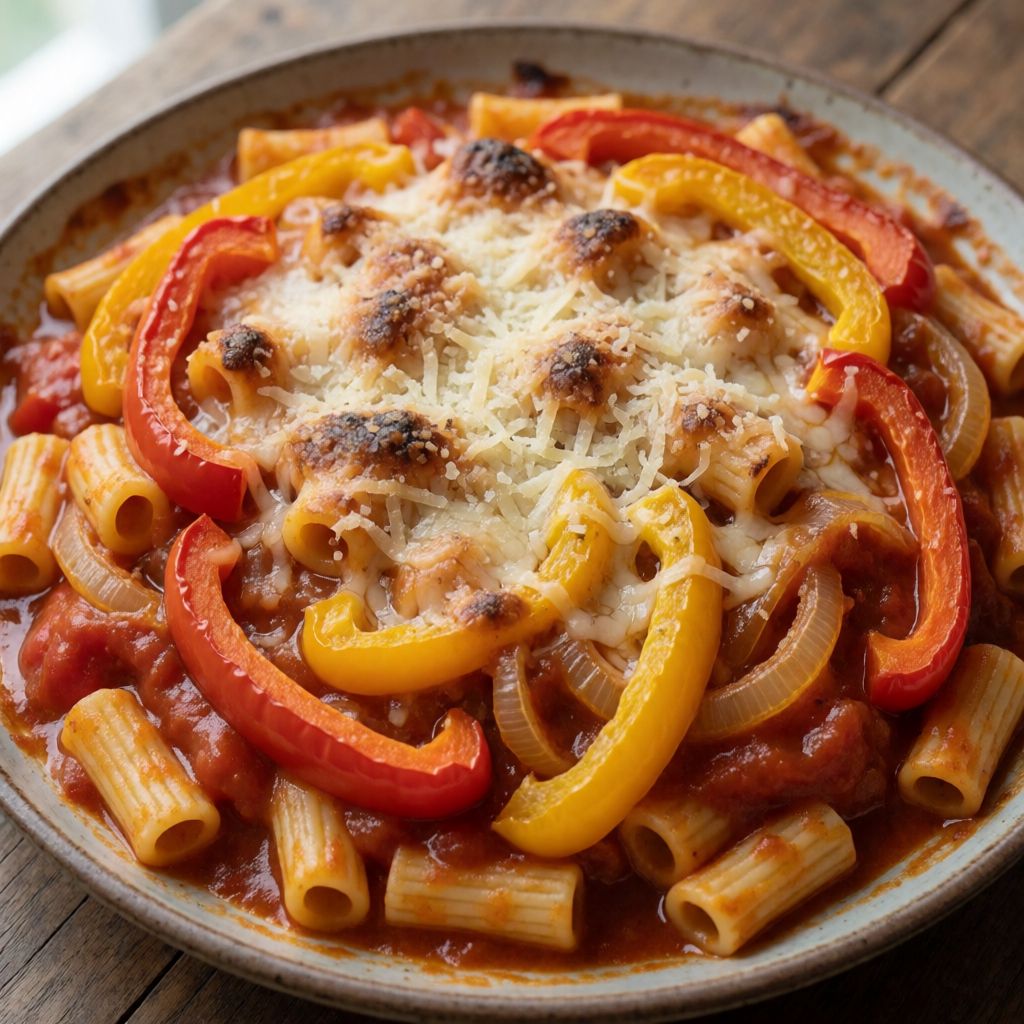
 AI photo
Baked Pasta with Tomatoes and Peppers
A simple oven-baked dish of peppers and tomatoes served over pasta.
Labels are worked out automatically from the ingredients and can be wrong. Check the packaging if it matters to you.
Ingredients










Steps
Cut the bell pepper into thin strips and place in a baking dish.
Add the tomatoes, salt, garlic, onion, capers, oregano, olive oil and pecorino.
Mix the ingredients thoroughly.
Cover with baking parchment and place in the oven.
38 minBoil the pasta to your liking.
Toss with the prepared sauce.
What was changed
We've used Tomatoes, as the author suggests.
This is a tray bake, not a sauce you stand over. Peppers, tomatoes, onion, garlic, cheese and oil go into a dish raw, get covered, and the oven does the work while you boil water and get on with something else. If you know the choreography of a Sunday roast — oven doing the slow business, you doing something else entirely — you already know the temperament of this dish.
What makes or breaks it is moisture. Tomatoes and peppers are mostly water held behind skin and cell wall; heat breaks the wall and the water comes out. Too little of it escapes and you get a wet stew, pale and soupy, pasta swimming instead of coated. Too much escapes and the edges scorch before any sauce forms — roasted vegetables sitting next to dry pasta, not a dish. The parchment over the top is doing the real engineering: it isn't sealing steam in the way a lid would, and it isn't letting it all out the way an open tray would. It's a controlled leak — slow enough that the vegetables braise in their own juice, loose enough that some water still goes, so what's left thickens instead of swims.
Some say foil does the same job as parchment, and it's the thing already in every drawer. No — tomato is acidic, and acid reacts with aluminium. Cook tomatoes under foil long enough and you pick up a faint metallic edge, the kind you can taste but can't place. Parchment doesn't react with anything. Use it, or a lid that actually sits down on the dish, or another tray turned upside down over it — anything except foil touching the tomatoes directly.
Tomatoes carry the dish, so start there. Ripe means it gives slightly under your thumb and smells of something at the stalk end — not firm, not odourless. A British supermarket tomato out of season is often neither: bred to survive a shelf, not to taste of anything, pale inside, low on both sugar and acid. Some say fresh always beats tinned. No — a hard pink tomato in January loses to a tin of good plum tomatoes every time, because what matters is ripeness and acidity, not the word "fresh" on the label. If your fresh ones look sad, drain a tin instead.
Bell pepper gets cut into thin strips for a reason: its cell walls are tough, and thin strips give heat more surface to work through in the time you've got. Red or yellow peppers have spent longer on the plant turning starch to sugar, so they come out sweeter; green is fine, just expect more bitterness, and let the cheese and oil carry a bit more of the balance if that's what you've got.
Onion and garlic do quieter work. Onion's sharpness is sulphur compounds that mellow as it cooks, leaving sweetness behind. Garlic, minced and buried in the mix, never sits exposed and dry — it's submerged in the juice the tomatoes are giving off, which is the only reason it doesn't scorch and turn bitter the way garlic does in a dry pan. The tomato juice is its insurance, not your timing.
Pecorino romano is a hard, salted sheep's cheese — it melts slowly into the juice as it bakes, adding salt, a sharp animal note, and fat that later helps the sauce cling to the pasta rather than pool at the bottom of the bowl. If you swap it, the criterion is a hard, aged, salty cheese; Parmesan works but is milder and sweeter, so taste for salt before you toss. Capers bring something sharp and brined to cut through all that fat and cheese — any small, sour, pickled thing can stand in, chopped olives included. The oil here isn't neutral fat earning its place by being invisible; it's a flavour you're meant to notice, which is the exception to the usual rule. Use a decent extra virgin, and if you're substituting, pick an oil you'd happily drizzle raw, not one chosen for having no character.
Pasta shape genuinely doesn't matter to the sauce, since this is chunky, not silky — but a ridged or tubular shape, penne or fusilli, holds onto pepper and tomato pieces better than a strand like spaghetti, which just lets them slide off the side of the fork. Salt the water properly; it's the only chance the pasta itself gets seasoned, since the sauce only coats it, it doesn't season it through. Check doneness the same way the dish asks you to check everything else — by biting into the centre, not by the clock.
The recipe's built for one, but the limiting factor if you scale it up isn't the pasta, it's the dish. Spread the vegetables too thick in a bigger tray and they steam instead of concentrating — go wider, or use two dishes, not one piled higher. And don't open the parchment to check on it every few minutes; every peek lets out the climate you've spent the whole bake building, and you start again from nothing. Leave it. Come back when the peppers have gone soft enough to bend, and the tomatoes have slumped into their own juice — that's the dish telling you, not the clock.