
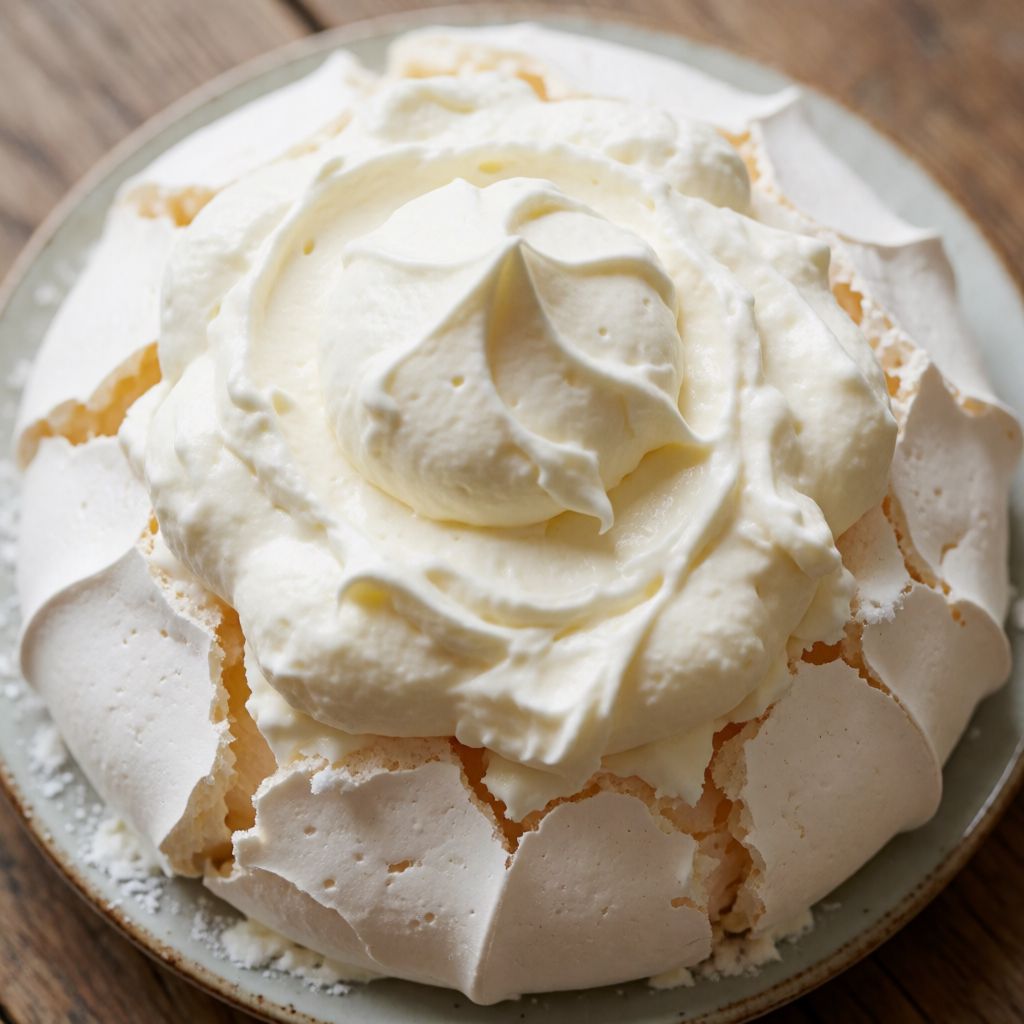
 AI photo
Pavlova with Berries and Vanilla Cream
A classic Pavlova topped with whipped cream and fresh summer berries.
Labels are worked out automatically from the ingredients and can be wrong. Check the packaging if it matters to you.
Ingredients
- 4 pcs Egg whites
- 250 g Caster sugar
- 2 tsp Corn flour
- 0.5 tsp Apple cider vinegar
- 0.5 tsp Vanilla sugar
- 1 tbsp Icing sugar for dusting the baking paper
- 250 ml Double cream
- 1 tsp Icing sugar
- 1 pinch Vanilla sugar
- 100 g Raspberries
- 250 g Strawberries
- 50 g Blueberries
- 50 g Redcurrants
- 1 bunch Mint fresh









Steps
Whisk the egg whites to a stiff, glossy foam. Add the sugar one tablespoon at a time, whisking continuously until all the sugar is incorporated. This takes about 5 minutes.
5 minSift in the corn flour, then add the apple cider vinegar and vanilla sugar. Whisk for a further 10 minutes until the mixture is thick and glossy.
10 minDraw a circle on baking paper, dust with icing sugar and spread the meringue mixture in a 2 cm layer. Shape peaks around the edge.
Bake in a preheated oven at 115°C on the fan setting for 1 1/2 hours.
90 minTurn off the oven and let the base cool completely inside the closed oven. This takes about 2 hours, but the base can stay in the closed oven for up to 24 hours.
Transfer the cooled meringue base to a serving platter.
Whip the cream with the icing sugar and vanilla sugar. Spread over the meringue and decorate with the berries. Serve immediately.
Pavlova is a trick dessert: it looks like one thing and behaves like two. What comes out of the oven is not cake and not meringue in the biscuit-tin sense — it's a shell with a marshmallow heart, and that contrast is the entire point. Crack the crust, and underneath it should give like a toasted marshmallow, not crumble dry all the way through. If it's dry all the way through, you've made a pile of sugar, not a pavlova.
What decides whether it works is almost entirely about water and air, not flavour. Egg white is mostly water held in a protein net; sugar is there to grab that water and slow it down. Whisk first, add sugar gradually after — do it the other way round and the sugar weighs down the foam before it has any structure to hold, and you get a flat, weepy mess that never sets properly.
The low, long bake (115°C, 90 minutes) isn't really baking — it's drying. You're evaporating water out of the outer layer slowly enough that it sets into a dry, crisp wall before the inside has a chance to follow it. Rush the heat and the outside colours and seals before the middle loses any moisture — then it collapses or weeps syrup onto the tray, which people blame on "bad eggs" when it's actually just impatience with the oven dial.
Corn flour and vinegar aren't there for taste — you won't notice either once it's assembled. Corn flour sets up a little starch scaffolding inside the egg-white foam, which is what gives you that soft, almost-uncooked marshmallow centre instead of a foam that dries solid right through. The splash of vinegar is acid, and acid denatures egg proteins just enough to make the foam more stable and stretchy — it's the same reason a pinch of cream of tartar turns up in meringue recipes. Any mild acid does this job: lemon juice works exactly the same way if that's what's in the cupboard.
Caster sugar, not granulated — the finer crystal dissolves into the egg white as you go rather than sitting there gritty. If all you have is granulated, blitz it a few seconds in a blender first; it costs you nothing and saves the meringue from a sandy bite. Icing sugar is a different job entirely — on the baking paper it's a release agent, stopping the raw meringue mix sticking before it sets. Dust it thin; a thick layer just adds unmelted sugar lumps to the underside.
Four egg whites is not an arbitrary number — it's roughly what gives you a base that will hold a flat 2cm layer across a circle wide enough to feed six without the structure caving under its own weight once the cream and fruit go on. If you're short an egg white, scale the sugar down with it, in the same ratio (roughly 60g sugar per white) — don't just leave the sugar as is and expect the same result with less egg.
Double cream, whipped only to soft folds, is the right choice because it's fatty enough to hold shape without collapsing under the weight of berries, but still soft enough that it doesn't fight the meringue's texture. Single cream won't whip at all — not enough fat to trap the air. Vanilla sugar in the cream is a small thing, but it means you're not adding wet vanilla extract that could thin the cream down.
The berries are not decoration you can skip casually — their job is acid and juice cutting through all that sugar, which is otherwise relentless. Raspberries and redcurrants bring sharpness; strawberries and blueberries bring bulk and colour. If it's winter and good berries aren't to be had at any price, poached rhubarb or a compote of frozen fruit does the same acid job — just keep it well drained, because any pooling liquid will turn your crisp shell soggy within the hour.
That "serve immediately" note at the end isn't fussiness — it's honesty about what happens next. The moment cream and fruit juice touch that dry sugar shell, it starts drawing in moisture and softening. Some say pavlova keeps in the fridge overnight under foil — no, because by morning you'll have a sweet, damp, structureless thing. Build the base whenever suits you, even a day ahead sealed in the switched-off oven or an airtight tin, but assemble it right before it goes to the table, not before.