
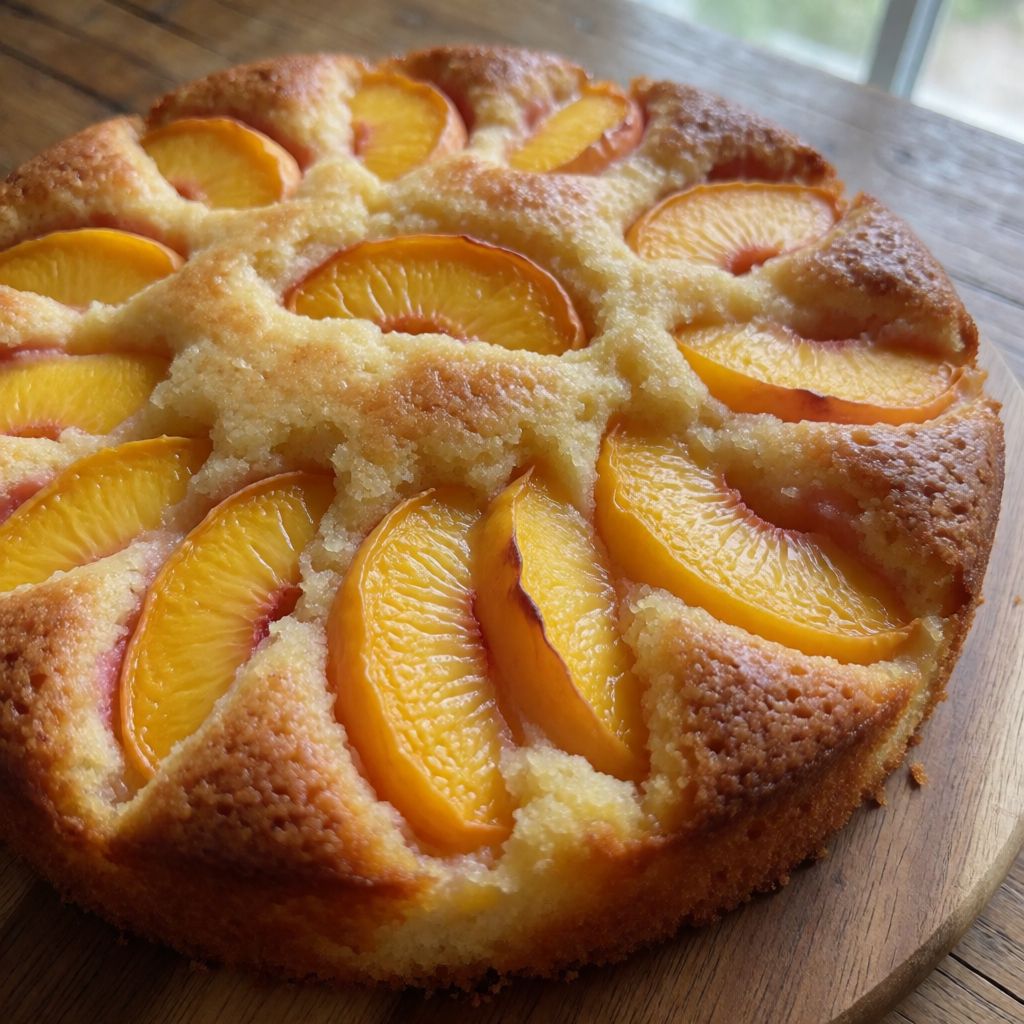
 AI photo
Peach Cake
A soft yoghurt sponge cake filled with fresh peaches, topped with peach slices and a dusting of icing sugar.
Labels are worked out automatically from the ingredients and can be wrong. Check the packaging if it matters to you.
Ingredients
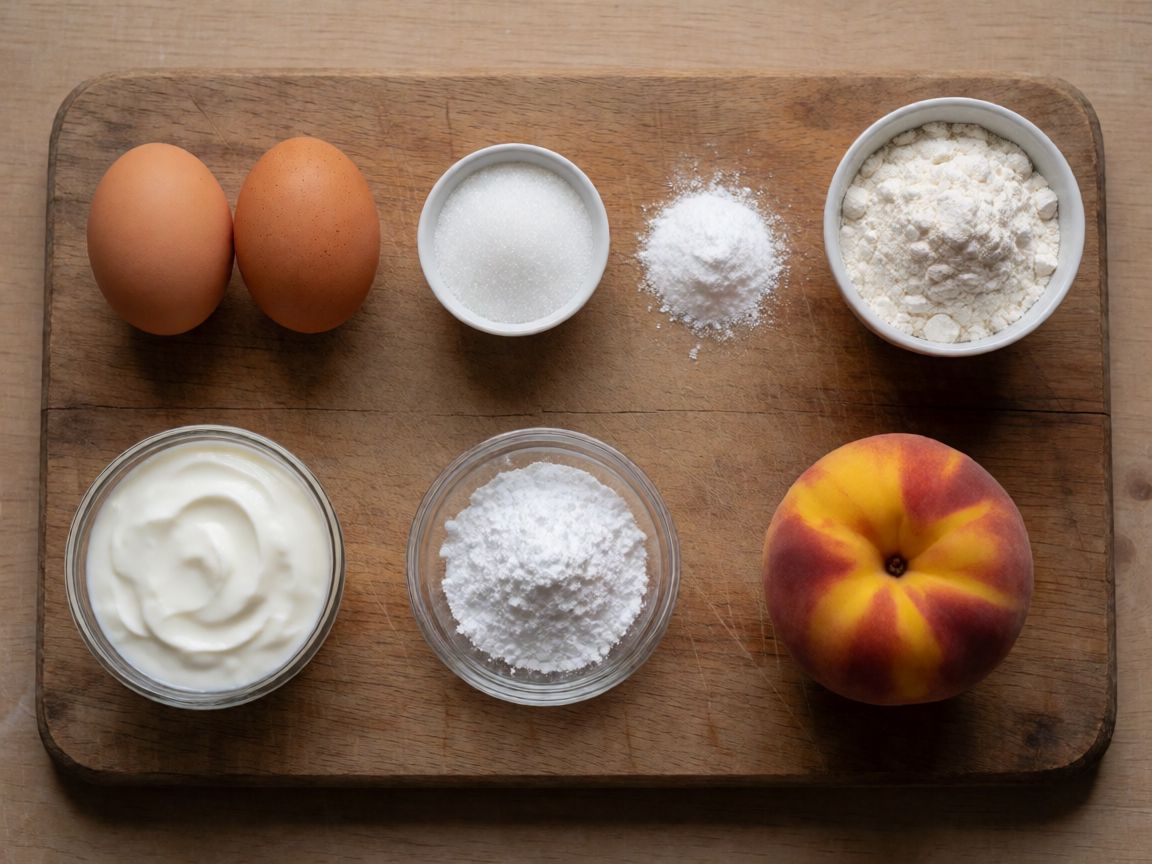
- 2 pcs Eggs
- 160 g Sugar
- 200 g Plain Flour
- 0.5 pcs Baking Powder
- 100 g Yoghurt
- 700 g Peaches sliced
- Icing Sugar for dusting
- 2 pcs Peaches for decoration







Steps
In a bowl, combine the eggs and sugar and whisk well until smooth.
Add the yoghurt, sifted flour and baking powder, continuing to mix until smooth.
Add the sliced peaches and gently fold them in.
Pour the batter into a buttered and floured 22cm tin, smoothing the surface.
Decorate the cake with slices of the two peaches on top and dust with icing sugar.
Bake in a preheated fan oven at 170°C for 40-45 minutes.
45 minLet the cake cool before removing it from the tin and serving.
This is not a sponge pretending to hold fruit. It's a batter cake — more French gâteau au yaourt than Victoria sponde — where the eggs and sugar are there for flavour and a little lift, not for whipping air in. You whisk them smooth, not to ribbon stage, because the rise here comes from baking powder, not from trapped bubbles. That's why the method lets you be quick about it: no fifteen minutes with a mixer, no anxiety about deflating anything.
What decides whether it works is the balance between flour and fruit. Two hundred grams of flour against seven hundred grams of peaches is a low ratio — deliberately. Peaches are mostly water, and that water has to go somewhere once the heat hits them. The flour-egg-yoghurt batter is the sponge that absorbs it as it bakes. Too much mixing, too much bruising of the peach slices when you fold them in, and you release that juice too early, before there's any structure to catch it — the result is a gummy streak at the bottom instead of a cake. So you fold, you don't stir.
The oven does the rest, and 170°C in a fan setting is a temperature chosen for even, gentle heat reaching all the way to the centre without scorching the fruit on top before the middle sets. A fan oven moves hot air around the tin constantly, which is why the number is lower than you'd set in a conventional oven doing the same job — fan ovens cook faster and more evenly, and if you don't know yours runs true to its dial, trust what you see over what you set.
Eggs and sugar whisked together are the cake's backbone and its sweetness, but don't expect them to behave like a Victoria sponge base — you're not building air into them, you're just dissolving the sugar and loosening the eggs so the batter blends smoothly later. That's the point of saying "whisk until smooth" rather than "whisk until pale and thick": this cake gets its lift from baking powder, and asking the eggs to do a job that isn't theirs here just wastes your arm.
The yoghurt is doing two things at once: moisture, and a little acidity that helps the baking powder work and keeps the crumb tender rather than tight. Use a thick, plain, natural yoghurt — Greek-style is fine, flavoured ones will fight the peaches for attention. If you have none, sour cream or crème fraîche does the same job; thin, watery yoghurt will just slacken the batter and slow the oven's job of setting it.
Plain flour is right here because you're not after chew or structure for its own sake — there's no bread-like crumb to build, just enough gluten to hold the fruit suspended and give the baking powder something to lift against. Strong flour would make the cake tougher for no benefit. Half a sachet of baking powder sounds like an odd measure until you remember that UK sachets come in a standard size — you're using about half of one, a small amount, because this cake isn't meant to rise tall; it's meant to stay close to the fruit, dense enough to carry it without collapsing.
Peaches are the dish, not the decoration, so their ripeness is the real variable the recipe doesn't mention. Some say any peach will do because it's getting baked anyway — no, because an underripe peach stays firm and barely gives up juice, drying the cake out, while an overripe one collapses into syrup and drowns the crumb before it's set. You want peaches that yield slightly to a thumb but still hold their shape when sliced. Nectarines work the same way and skip the peeling; plums or apricots work too, as long as they're firm-ripe stone fruit, because the mechanism — fruit sitting in a low-flour batter, releasing moisture as it bakes — doesn't care which stone fruit you use, only how much water and how fast it lets it go.
Buttering and flouring the tin isn't a formality — it's what stops the sugars that leach out of the fruit from caramelising straight onto bare metal and gluing the cake in place once it cools. And the icing sugar goes on at the very end, after the cake has cooled, not before baking and not straight out of the oven, because warm, moist cake will just dissolve it into a sticky film instead of a dusting. Patience there costs you nothing and buys you the only bit of prettiness this cake asks for.