
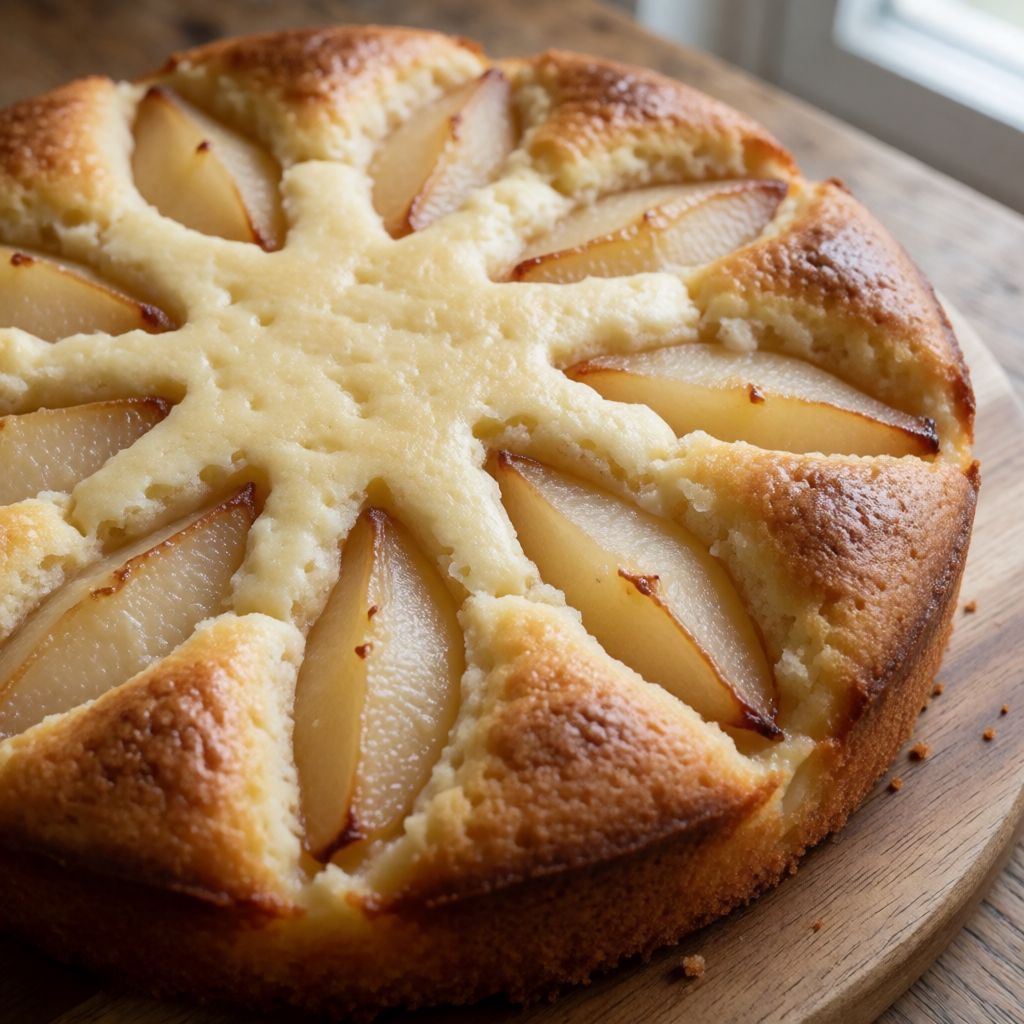
 AI photo
Soft Ricotta and Pear Cake
A soft ricotta and pear cake, lightly scented with lemon zest and dusted with icing sugar.
Labels are worked out automatically from the ingredients and can be wrong. Check the packaging if it matters to you.
Ingredients
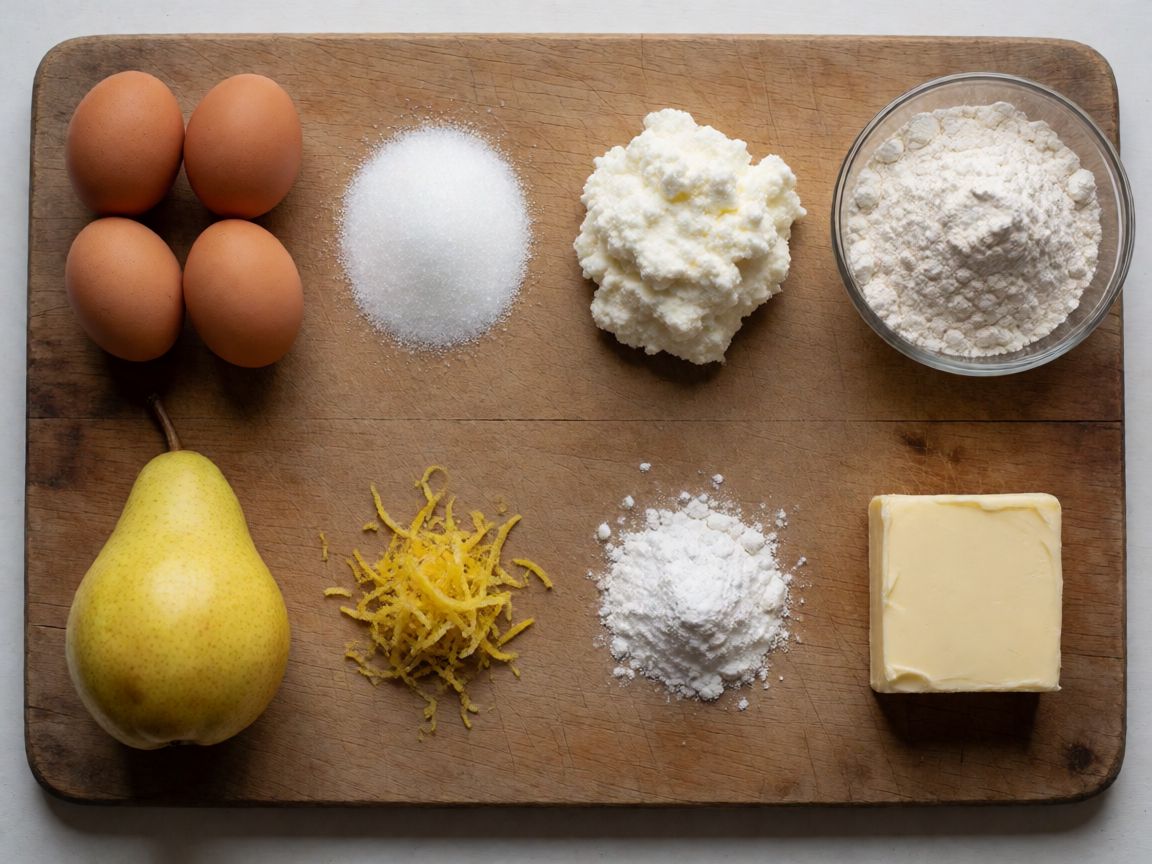
- 3 pcs Eggs
- 200 g Sugar
- 350 g Ricotta
- 300 g Plain flour
- 15 g Baking powder
- 1 pcs Lemon zest
- 500 g Pears
- Butter for greasing the tin
- Icing sugar for dusting









Steps
Whisk the eggs with the sugar using a hand whisk.
Soften the ricotta with an electric mixer until creamy, add it to the egg and sugar mixture and stir well.
Gradually sift in the flour, continuing to mix.
Add the baking powder and lemon zest and mix the batter well.
Add the pears, cut into cubes, mix and transfer the batter into a tin greased with butter and dusted with flour.
Decorate the top with pear slices.
Bake in a preheated fan oven at 170°C for about 60 minutes.
60 minAlternatively, bake in a conventional oven at 180°C for about 65 minutes. Check doneness with a toothpick.
65 minDust with icing sugar and serve.
This isn't a cheesecake with a cheese name attached to a sponge for decency's sake — it's a flour cake where ricotta has taken the place butter usually holds. Three hundred grams of flour and fifteen of baking powder are doing real structural work here; the egg foam and the raising agent carry the rise, the ricotta carries the moisture and the tenderness, and the pears sit inside it like pockets of extra water waiting to be let out slowly by the heat. Nobody creams butter and sugar in this recipe because there's no butter in the batter at all — only on the tin, to stop the cake sticking, which is a different job entirely.
What decides whether this turns out soft and even, or dense and gluey in the middle, is two things: how well you whisk the eggs with the sugar, and how wet your ricotta is. The egg-sugar stage isn't decoration — it dissolves every sugar crystal and beats air into the mixture, because that trapped air is half your lift, the baking powder is only the other half. Skip it, whisk half-heartedly, and the crumb comes out tight and a bit rubbery, no matter how long you bake it.
Some say a cheese cake must mean a cheesecake — custard set slow in a water bath, cracking if you look at it wrong. No, because this one has flour and a proper dose of baking powder in it; it rises and holds its own shape outside a tin, it's a cake that happens to carry cheese, not the other way round.
Start with the eggs and sugar. Whisking them by hand, not folding, matters because what you're building is a foam — sugar dissolving into the egg liquid while air gets beaten in, since this cake has no creamed butter to lean on for lift. That foam, plus the baking powder, is the whole rising mechanism. Fifteen grams of baking powder against three hundred of flour is a heavier dose than a plain sponge needs, and that's because the ricotta weighs the batter down — it's wet and dense, and the raising agent has to push through all that extra moisture, not just flour and eggs.
Ricotta itself: look for one that's firm enough to hold a spoon shape, not runny. British supermarket ricotta, sold in tubs, is usually drained enough already and gives no trouble. If you ever cook from an Italian recipe that specifies ricotta from a basket, drained from whey overnight, that's a different, wetter cheese and needs tipping into a sieve for an hour first or your cake turns heavy at the base. Here, straight from the tub and beaten smooth with a mixer is enough — you're breaking down the grain so it blends into the egg mixture rather than sitting in it as lumps. If you have none, curd cheese or a well-drained cottage cheese blitzed smooth will do the same job: something soft, low in acidity, with body but no sharpness.
Flour goes in sifted and gradually, not dumped in one go — that's to stop pockets of dry flour hiding in the wet mixture, which bake into little dense knots you only discover when you cut the slice. Plain flour is right here; you don't want the extra protein of a bread flour building gluten and toughening a cake that's meant to stay soft.
Lemon zest isn't a flavour flourish you could leave out without consequence — ricotta on its own is a quiet, slightly flat-tasting cheese, and the zest is what stops the whole cake tasting like sweetened dairy and nothing else. If you're out of lemon, orange zest does the same cutting job, just gentler.
On the pears: cut into cubes and folded through the batter, they release their water slowly as the cake bakes, which is exactly why the oven temperature matters — 170°C in a fan oven, 180°C conventional, is hot enough to set the outside and the crumb before that released pear water has a chance to pool and make a soggy middle, but not so hot that the top hardens and the edges catch while the centre is still raw. A fan oven moves air past the cake constantly, which transfers heat faster at a lower number — that's the entire reason for the ten-degree gap between the two settings, not some mysterious rule.
Forget counting minutes as the real test. Sixty or sixty-five minutes is where to start checking, not where to stop — push a skewer into the centre, and if it comes out clean, the egg proteins have set and the starches have gelatinised through; if there's wet batter clinging to it, it needs more time regardless of what the clock says. And the icing sugar goes on only once the cake is out and cooling — dust it any earlier and the oven's heat just melts it into the crust instead of leaving that fine white layer on top. Patience here isn't poetic language, it's literally what stops you serving a cake with a raw centre because the timer went off.