
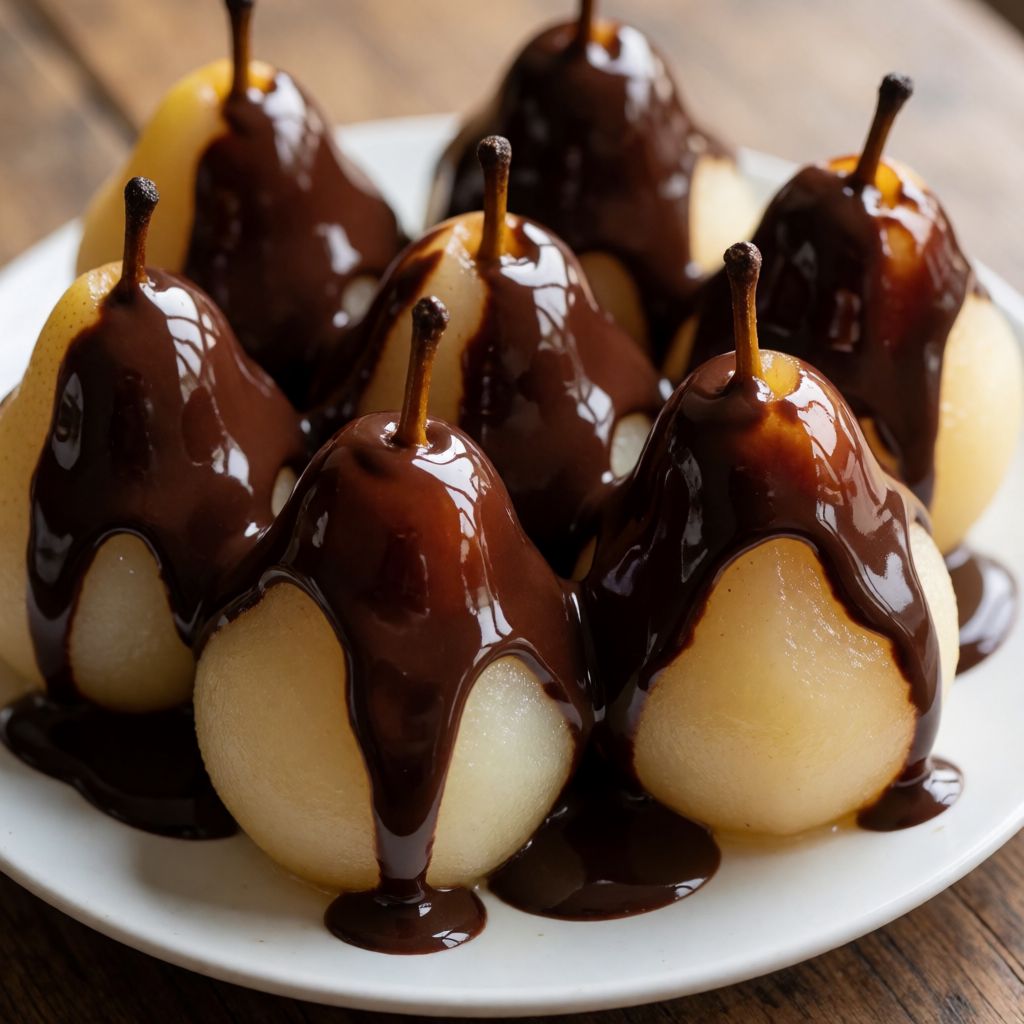
 AI photo
Pears with Chocolate Sauce
Whole pears gently poached in a vanilla syrup, served with vanilla ice cream, a rich chocolate sauce and toasted almonds.
Labels are worked out automatically from the ingredients and can be wrong. Check the packaging if it matters to you.
Ingredients
- 4 pcs Pears
- 1 pcs Vanilla pod
- 200 g Caster sugar
- 1 l Water
- 1 pcs Lemon juice only
- 150 ml Double cream
- 125 g Dark chocolate roughly chopped
- 0.4 l Vanilla ice cream
- 25 g Almonds toasted and finely chopped



Steps
Peel the pears and remove the blossom end and core from the base.
The easiest way is with a peeler or a melon baller, pushing it into the base and turning it once.
Cut the blossom end flat so the pears stand steadily on a plate without toppling.
Split the vanilla pod lengthways, carefully scrape out the seeds with a knife and mix them with the sugar.
Put the water, sugar, vanilla seeds, lemon juice and the empty vanilla pod into a saucepan.
Bring to the boil and add the pears to the pan.
Reduce the heat to a gentle simmer and cook the pears in the syrup for 5–10 minutes depending on size.
10 minTurn off the heat and leave the pears in the syrup until completely cool.
Heat the cream until almost boiling, then remove from the heat.
Add the chocolate and stir until the mixture is smooth and even.
Place one pear on each plate.
Add a scoop of vanilla ice cream alongside and drizzle with a little chocolate sauce.
Finally, sprinkle with chopped almonds and serve at once.
This is poached pears with chocolate sauce — a dish that looks like restaurant plating but is really just patience with a saucepan. The whole thing hinges on one idea: you're not cooking the pear, you're persuading it. A pear that goes from hard to soft in a fast boil turns to mush at the edges and stays stony in the middle, because heat races in faster than it can even out. A gentle simmer gives the heat time to travel through the fruit evenly, so by the time the centre gives, the outside hasn't collapsed.
How do you know it's done? Not by the clock — by a skewer or knife point. It should slide into the pear with the faintest resistance, like pushing into cold butter, not like stabbing a raw potato and not sliding through like water. Five to ten minutes is the window the recipe gives you, but windows have edges that move with size and ripeness; a rock-hard pear in October needs longer than a soft one in late summer.
Some say you must poach pears in red wine — no, because wine isn't what cooks the pear, sugar syrup is, and wine just adds colour and tannin on top. Here the syrup is sugar, water, vanilla and lemon: the lemon isn't there to flavour, it's there to stop the pale pear browning and to balance the sugar's flatness with a little acid, the way you'd squeeze lemon on a sliced apple.
The pear itself: choose one that's ripe but still firm enough to hold a shape when you push a thumb near the stalk — Comice or Williams work well in a British greengrocer, Conference will do at a pinch though it's slightly grainier in texture. Avoid ones already soft at the shoulders; they've started breaking down and will fall apart in the syrup instead of holding their shape standing on a plate. The melon baller trick for coring from the base, not the top, keeps the stalk intact — that's what makes it look presentable standing upright rather than lying on its side like it gave up.
Vanilla pod and sugar rubbed together isn't decoration — rubbing the seeds into the sugar breaks them apart and distributes them, so you don't get all the flavour trapped in three black specks at the bottom of the pan. If you don't have a pod, a teaspoon of vanilla extract added after the syrup's off the heat will do, though you lose the visual flecking and some of the actual aromatic oil that only the pod carries. Vanilla essence (not extract) is thinner and more one-note — fine in a hurry, not as good.
The lemon: juice only, and it's doing two jobs — stopping oxidation (so the peeled pear doesn't go that dull grey-brown you get on a cut apple left on the side) and cutting the sweetness of a litre of sugar syrup so the fruit doesn't taste like candy. No substitute really matches it; a splash of white wine vinegar would stop the browning but adds a flavour that has no business near pears.
The chocolate sauce is a ganache, really, just thinned — cream heated to just under boiling, then chocolate stirred in off the heat. The reason it must be off the heat: chocolate scorches and seizes above about 50°C, going from glossy to grainy and split in seconds, and once it's split there's no rescuing it short of starting again. Dark chocolate with real cocoa solids (70% or so) gives you a sauce that sets up slightly as it cools and holds a drizzle shape on the plate; cheap chocolate with more sugar and less cocoa butter stays thin and runs everywhere, and tastes mostly of sugar twice over, which this dish already has enough of from the syrup.
Almonds toasted and chopped aren't just crunch for crunch's sake — a poached pear, ice cream and ganache are all soft; the almond is the one thing on the plate with resistance, and toasting it first means it tastes of itself rather than raw and slightly bitter. Hazelnuts or pistachios would do the same structural job if that's what's in the cupboard.
On kitchen reality: a litre of syrup for four pears needs a pan wide enough that the pears actually sit in liquid, not perched half-dry above it — a decent-sized saucepan or a wide sauté pan, not your smallest one. If you don't have a lid that fits, a plate set over the top traps enough steam to keep the exposed tops of the pears from drying out while the bottoms poach, which is the kind of improvising any flat without a proper kazan setup has to do anyway.