
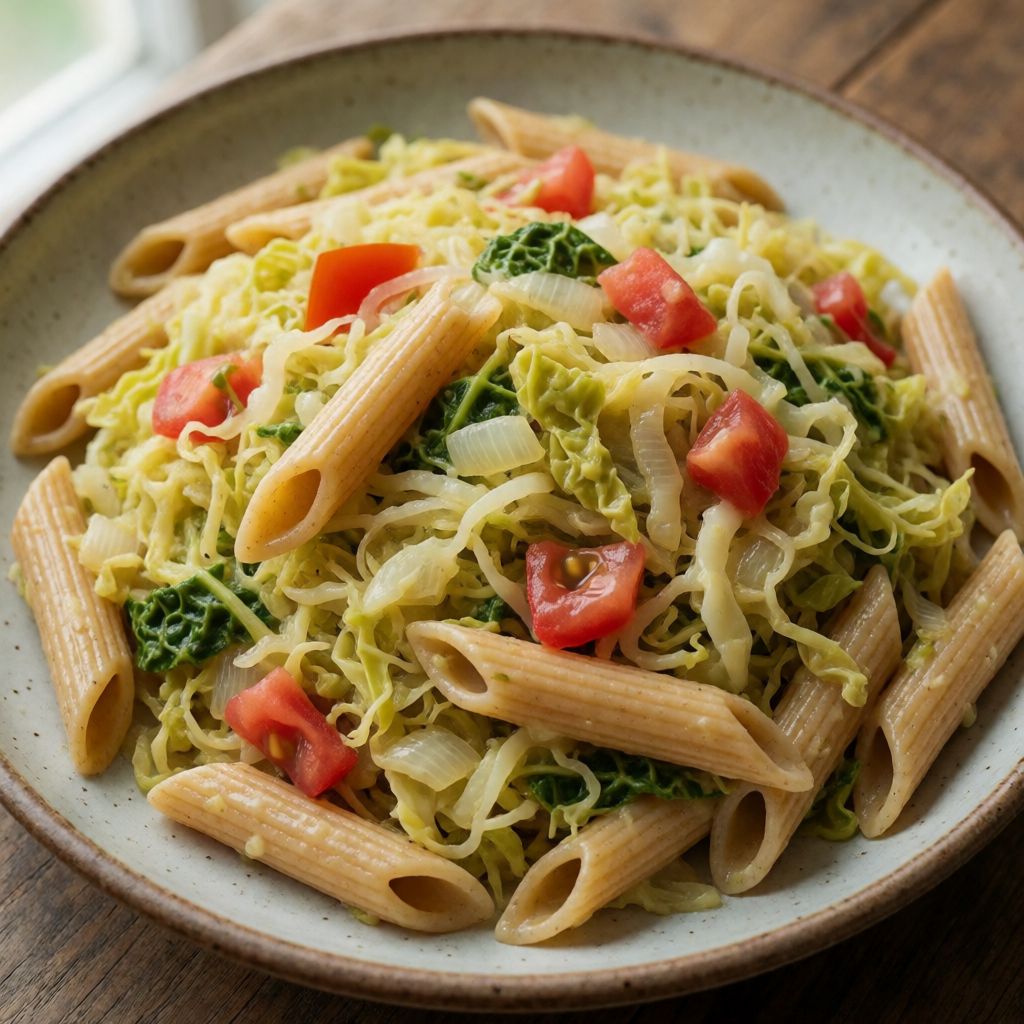
 AI photo
Peasant-Style Wholemeal Penne
A hearty, rustic pasta dish with wholemeal penne, savoy cabbage, provolone piccante and cherry tomatoes.
Labels are worked out automatically from the ingredients and can be wrong. Check the packaging if it matters to you.
Ingredients
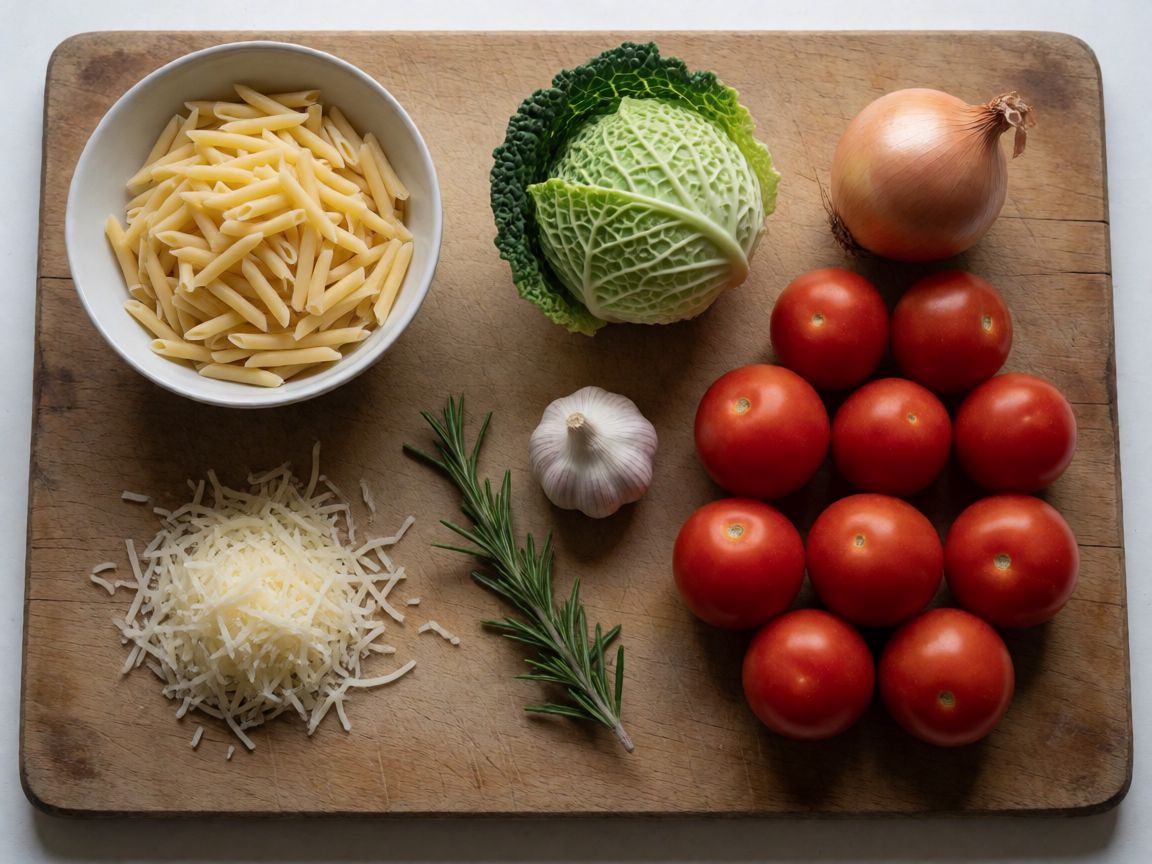
- 400 g Wholemeal Penne
- 1 pcs Savoy Cabbage small
- 100 g Provolone Piccante
- 10 pcs Cherry Tomatoes
- 1 pcs Onion
- 2 clove Garlic
- 1 pcs Rosemary sprig
- 2 tbsp Olive Oil
- 1 pinch Salt to taste
- 1 pinch Black Pepper freshly ground, to taste








Steps
Trim the savoy cabbage, slice it into thin strips and boil it in salted boiling water together with the wholemeal penne.
10 minIn a large non-stick frying pan, sauté the onion and garlic in olive oil, then add the chopped cherry tomatoes and rosemary.
8 minOnce the pasta is cooked, drain it together with the savoy cabbage, tip everything into the pan and fry for a few minutes.
5 minAdd the diced provolone piccante and plenty of freshly ground black pepper.
2 minServe hot.
Peasant-style penne — the name tells you the arithmetic before you even read the ingredients. This is cucina povera logic: a modest fistful of pasta stretched to feed a table by drowning it in cabbage, then lifted out of blandness by a few cubes of a cheese sharp enough to notice. You're not making a sauce to spoon over pasta. You're cooking the vegetable and the pasta into each other until neither remembers eating alone.
What decides whether it works happens in two places, and both are about timing rather than minutes. First: the cabbage goes into the same water as the penne, at the same moment, because sliced into ribbons it cooks at exactly the speed pasta does — no second pot, no spare burner working overtime for a vegetable that doesn't need one. Second: everything meets in the frying pan afterwards for real heat, not a token stir. That final fry is where starch, oil and tomato stop being separate things sitting next to each other on a plate and start being one dish.
The cheese is the part people get wrong without noticing. Provolone piccante is a hard, aged cheese, built to hold its cube shape, not an instant-melt mozzarella. Throw it into a pan still roaring and the fat splits out of it — you get grease and rubber where you wanted pull and bite. It goes in last, off the worst of the heat, so the residual warmth coaxes it rather than cooks it.
On quantities: 400g of dried pasta is not one serving, whatever the heading says. A hungry adult eats 80–100g of dried pasta; 400g is a plate for three, generously four. Go by the pasta weight, not the number at the top, if you're working out how many to call to the table.
Wholemeal penne is chosen for bite — the ridge holds its shape against slippery cooked cabbage, and it doesn't collapse as fast as white penne once it hits the frying pan for its second cooking. If swapping, pick any ridged tube that can survive a fry without going to paste — rigatoni, any pasta with a rough surface for sauce to grip.
Savoy cabbage is the bulk of this dish, cheap and generous, and its crinkled leaf isn't decoration — the folds hold sauce the way a flat leaf can't. Use any loose, open-leafed cabbage if savoy isn't to hand; avoid the tight, dense white ball, which turns watery and bitter under this kind of heat rather than sweet.
Onion and garlic build the base sweetness, and they don't cook at the same speed: onion needs the longer, gentler stretch to go soft and gold, garlic burns fast and turns bitter the moment it goes past gold to brown. Put the onion in first, add garlic once the onion's already softening, and pull both before the garlic browns — a bitter garlic note is harder to fix than almost anything else in this pan.
Cherry tomatoes are chopped, not left whole, because whole small tomatoes hold their skins stubbornly and won't collapse into sauce in the time this step gives them. Cutting them open exposes the sugar and acid inside so they break down into something that coats, not something you bite through separately later.
Rosemary goes in as a whole sprig to perfume the oil, not as chopped needles scattered through — fish it out before serving, or leave it if you don't mind the odd sharp pine note landing on a fork.
Provolone piccante is the one indulgence here, and the substitution rule is about character, not geography: a hard, salty, aged cheese that holds together when diced and doesn't need coaxing to taste of something. Pecorino, aged caciocavallo, even a mature cheddar at a push — what matters is sharpness standing up to the cabbage's sweetness, not where the cheese was born. This is also the historical shape of the dish: cheese and meat were the expensive things in a peasant kitchen, used in cubes, not in cupfuls, while cabbage and wholemeal flour were what was actually affordable and filling.
On the hob: your pan won't give you the fierce blast of a market kazan, and that's fine, but don't crowd it at the final fry. A wide pan, pasta and cabbage spread rather than piled, is what lets them fry — pile them up wet and the pan steams instead, and steaming is how you end up with soft, flavourless pasta instead of pasta that's picked something up.
Olive oil here is doing a job, not announcing itself — any oil without a smell of its own will carry the onion and rosemary fine for the frying; save a good extra virgin, if you have one, for a last drizzle rather than the pan. Salt goes mostly into the pasta water, where the cabbage needs it as much as the penne does. Pepper is generous and goes in at the end deliberately — it's there to answer the cheese's saltiness, not to decorate the top of the plate.