
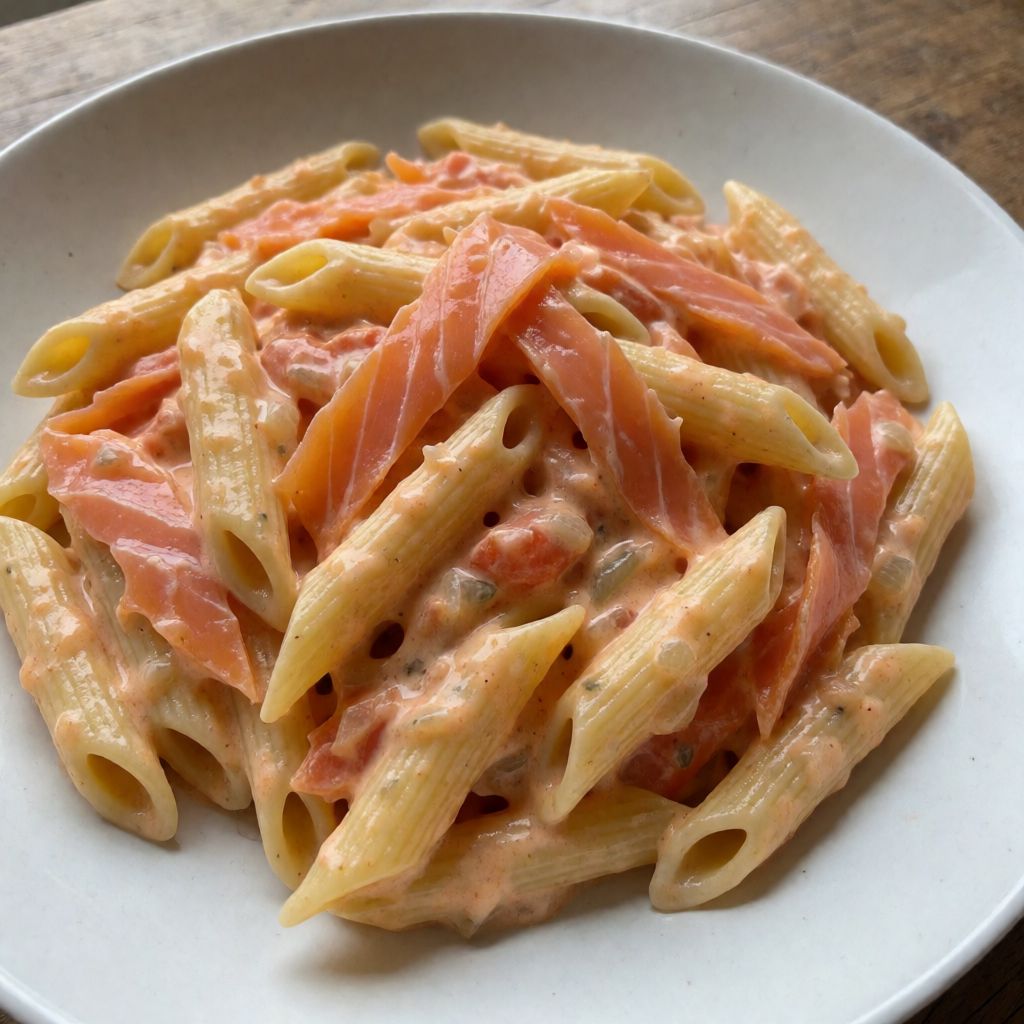
 AI photo
Penne with Smoked Salmon and Tomato Cream Sauce
A quick, creamy penne pasta with a rich tomato sauce, whipping cream and strips of smoked salmon.
Labels are worked out automatically from the ingredients and can be wrong. Check the packaging if it matters to you.
Ingredients
- 500 g Pasta
- 1 pcs Onion finely chopped
- 1 clove Garlic finely chopped
- 1 tbsp Olive oil
- 800 g Tinned chopped tomatoes blended
- 150 ml Whipping cream
- 1 bunch Basil fresh
- 100 g Smoked salmon cut into strips
- Salt to taste
- Black pepper freshly ground, to taste









Steps
Fry the onion and garlic in olive oil in a saucepan over medium heat until soft and translucent.
Blend the tinned chopped tomatoes with a hand blender and add them to the pan along with the whipping cream.
Let the sauce simmer uncovered for 15-20 minutes.
15 minCook the penne according to the instructions on the packet.
Once the sauce has simmered, season it with half of the finely chopped basil, plus salt and pepper.
Toss the penne with the tomato sauce, then add the strips of smoked salmon.
Serve in a large bowl, garnished with the remaining basil leaves.
This is not an old recipe — it is a 1980s dinner-party idea: pasta dressed in a tomato-cream sauce, finished with cold-smoked salmon instead of the usual bacon or prawns. The thinking behind it is economic, not romantic: smoked salmon got cheap in Britain just as cream sauces became the thing to serve guests, and someone decided the two belonged in the same bowl. Nothing ancient here, and no reason to dress it up as if there were.
What decides whether it works is heat control at the very end, not at the start. The sauce simmers uncovered for a while so the tomatoes lose their raw sharpness and shed some water — that's the real point of the simmer, not a clock to watch but a texture to wait for: the sauce should sit on the back of a spoon, not slide off it. The cream isn't there to make things vaguely "creamy" — it's there to round off the acid the tomatoes carry, fat against acid, so the dish doesn't bite you.
The salmon is where people go wrong. It's already cooked — smoked and cured, meant to be eaten cold. Drop it into a simmering pan and you cook it a second time: the fat renders out, the flesh tightens, and the silky pink strip you paid for comes back as grey string. It goes in only after the pasta and sauce are tossed together, with the heat off. Residual warmth loosens it; direct heat kills it.
Onion and garlic go in together, but the garlic's job is to arrive, not to lead. Fry gently until the onion turns from white to translucent, pale gold at most — not brown. Some say garlic should go in first for a stronger flavour base — no, because garlic's sugars catch and scorch long before the onion has softened, and a burnt edge on garlic turns bitter in a way no amount of simmering afterwards will undo. Chop it fine so it cooks through in the time the onion needs, not longer.
Tinned chopped tomatoes aren't a compromise here, they're the better choice. Tomatoes grown for canning are picked and processed at peak ripeness, which gives a steadier, more predictable acidity than most fresh tomatoes sitting on a British supermarket shelf out of season. Blending them smooth matters for the same reason you don't want lumps in gravy: a pasta sauce with seeds and skin fragments slides off the pasta instead of coating it, because the lumps break the surface tension that lets a smooth sauce cling.
Cream needs enough fat to survive contact with acid without splitting — that's the actual criterion, not the label on the carton. Whipping cream or double cream both carry enough fat; a thin single cream will curdle against the tomato's acidity and leave you with a grainy sauce instead of a silky one. If you've only got crème fraîche, that works too, stirred in off the boil rather than simmered hard. For the salmon, the criterion is the same logic as the cream: any cold-smoked oily fish that's meant to be eaten as-is will do the job — smoked trout is the obvious stand-in, and it behaves the same way under heat, which is to say badly if you give it too much.
Basil has to be fresh for the half that goes on top; dried basil has already lost the volatile oil that makes raw basil smell like basil, so it has nothing left to contribute cold. Penne earns its place through its ridges, which grab the sauce the way a smooth tube wouldn't — any short pasta with ridges or a hollow centre will behave the same way, so don't feel bound to penne specifically if that's not what's in the cupboard.
In an ordinary kitchen, use the widest saucepan you own for the sauce, not the deepest. A wide pan exposes more surface to the air, which is what actually drives off the water and thickens things — a narrow, deep pot traps steam and you'll be simmering for twice as long to get the same result. And give it the time it asks for: rushing the simmer to save ten minutes is how you end up adding extra cream or tomato paste later to fix a sauce that was never thin by mistake, just unfinished.