
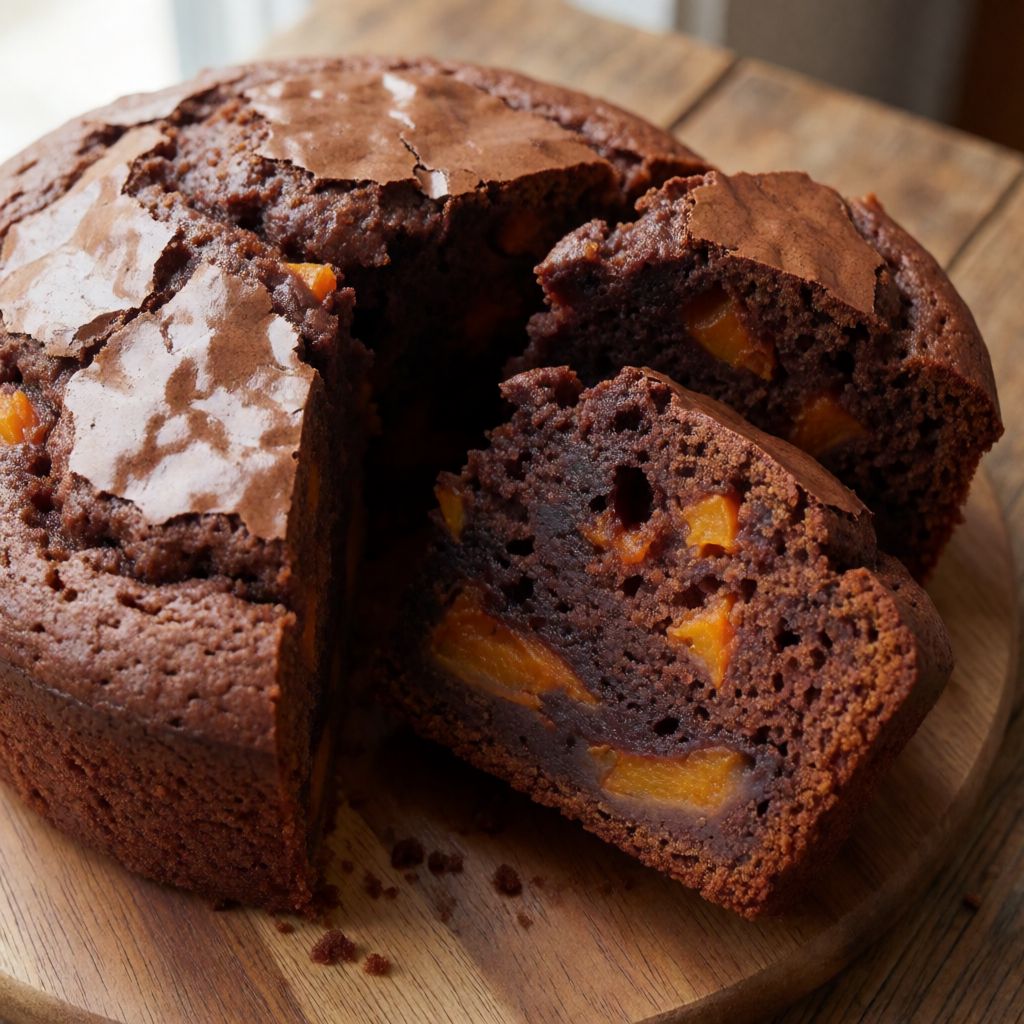
 AI photo
Persimmon and Chocolate Cake
A soft sponge cake made with ripe persimmon purée and dark chocolate shavings, finished with a hint of orange zest.
Labels are worked out automatically from the ingredients and can be wrong. Check the packaging if it matters to you.
Ingredients
- 200 g Persimmon
- 200 g Plain flour
- 75 g Butter softened
- 130 g Caster sugar
- 50 g Dark chocolate
- 2 pcs Eggs
- 20 g Cocoa powder
- 16 g Baking powder
- 1 pcs Orange zest
- 1 pinch Salt
- Icing sugar to taste









Steps
Put the softened butter, cut into cubes, into a large bowl, add the caster sugar and beat with a mixer until light and fluffy.
Separate the egg yolks from the whites. Add the yolks to the butter mixture and continue beating with the mixer.
In a separate bowl, whisk the egg whites to stiff, firm peaks and set aside.
Peel the persimmon, put the flesh into a blender, add the orange zest and blend to a smooth purée.
Add the persimmon purée to the main mixture and mix well.
Gradually add the sifted flour, mixing until smooth and lump-free.
Add the sifted cocoa powder and baking powder, and mix.
Add the dark chocolate, cut into thin shavings.
Gently fold the whisked egg whites into the batter.
Pour the batter into a 24 cm tin lined with baking paper.
Preheat the oven to 180°C and bake the cake for about 60 minutes, checking with a skewer towards the end of baking.
60 minLet the cake cool and decorate with icing sugar or cocoa, if you like.
This is a cake built on a trick: ripe persimmon pulp stands in for a good part of the fat and the liquid, so the crumb stays moist without you leaning on extra butter. You only have 75 g of butter here, which is modest for a 24 cm cake — the persimmon is doing the rest of the work. That is the whole mechanism, and everything else follows from it.
What decides whether this works is the persimmon itself. It has to be properly soft — the kind you'd otherwise feel guilty about and eat with a spoon, skin wrinkling, flesh collapsing at a touch. An underripe or just-firm persimmon purées into something closer to wet paste than fruit, and that paste won't carry the sugars and pectin that keep this cake tender. If the fruit still has any bite to it when you cut it open, it isn't ready for this — it's ready for a fruit bowl, not a blender.
The egg whites, whisked separately and folded in last, are what keep this from becoming a dense, damp brick. Persimmon pulp is heavy and wet; without the air you whip into the whites, the cake would sit low and gluey in the middle even after an hour in the oven. Fold them gently, in big slow movements, because every bit of volume you knock out of them is volume you don't get back — the raising agent helps, but it can't rescue a batter that's been beaten flat.
Persimmon is the ingredient to actually shop for here, not the flour or the eggs. Look for the soft, almost-too-far type — in the UK that's usually the Sharon fruit sold in supermarkets, which has had the astringency bred and ripened out of it, so you can use it soft without the chalky, drying tannin bite that unripe persimmon (the Fuyu-type, firmer, apple-textured kind) carries. If what you've got is still firm, leave it on the windowsill for a few days until it gives like a ripe plum. There's no good substitute that behaves the same way — a ripe pear or very ripe banana will get you a moist crumb by a similar logic, pulped and folded in for weight and moisture, but neither tastes like anything close to persimmon, so treat that as a rescue, not an equivalent.
The orange zest blended in with the persimmon isn't decoration — persimmon pulp on its own is sweet but flat, and the zest's oils cut through that flatness the way they cut through a rich fruit cake. Use a fine grater and only the coloured skin; the white pith underneath is bitter and has no business in a cake that's already carrying a lot of sweetness.
Butter at 75 g, softened to room temperature, is there for structure and flavour, not for moisture — that's the persimmon's job. Softened means you can press a finger into it and leave a dent without it sticking to your skin; cold butter won't beat fluffy with the sugar, it'll just sit in lumps and leave you with a greasy, uneven batter. If you're short on butter or want it dairy-free, a neutral oil can take over the fat role, but you lose the aeration the beaten butter-and-sugar gives you, so expect a slightly denser result.
Dark chocolate, cut into shavings rather than chips, melts into pockets as it bakes rather than dissolving fully into the batter — pick one with real bitterness (70% or so) because the rest of the cake is sweet from the persimmon and the caster sugar together, and a milder chocolate would just disappear. Cocoa powder, sifted with the flour and baking powder, is for colour and background bitterness throughout the crumb, distinct from the chocolate's job of giving you actual bite-sized hits.
Baking powder at 16 g is a fair amount for a 24 cm tin, and that's because the batter is heavy with fruit pulp and needs real lift to counter it — don't be tempted to cut it down for a single layer unless you want a flatter, denser cake. The pinch of salt isn't there to make anything taste salty; it's there to stop the sweetness from the sugar and the fruit reading as one flat note, the same reason you salt caramel.
On checking it's done: the 60 minutes is a lower bound, not a deadline. A skewer or a thin knife pushed into the centre should come out with moist crumbs clinging, not wet batter, and not bone dry either — persimmon cakes can look underbaked on top while they're actually fine, because the fruit keeps the surface looking damp longer than a standard sponge would. Give it the full hour before you even test, and don't open the oven door early just to look — that's patience spent well, because a sudden drop in oven temperature from an open door is exactly how a cake this heavy with fruit sinks in the middle. Let it cool properly in the tin before turning out; warm, it's fragile and wants to fall apart at the first cut.