
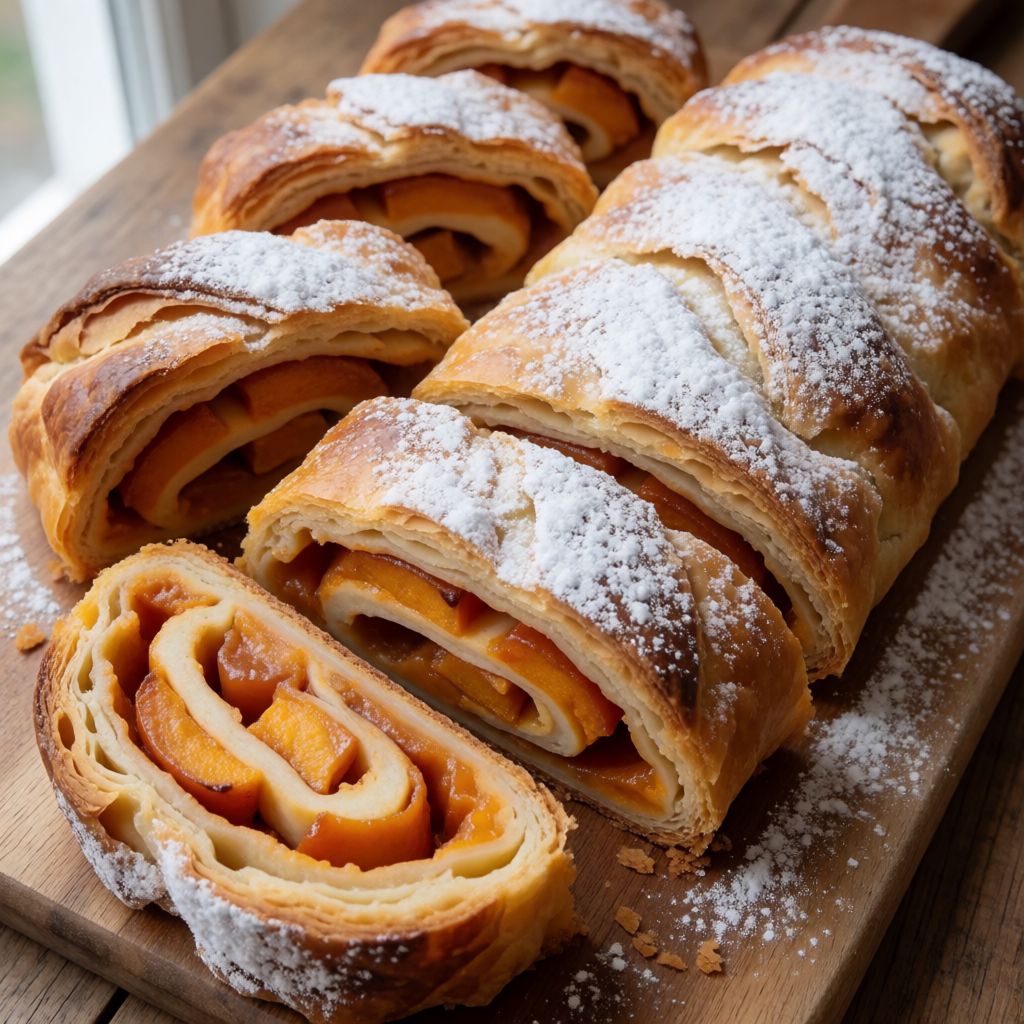
 AI photo
Persimmon Strudel
A sweet strudel filled with persimmon, orange jam and walnuts.
Labels are worked out automatically from the ingredients and can be wrong. Check the packaging if it matters to you.
Ingredients
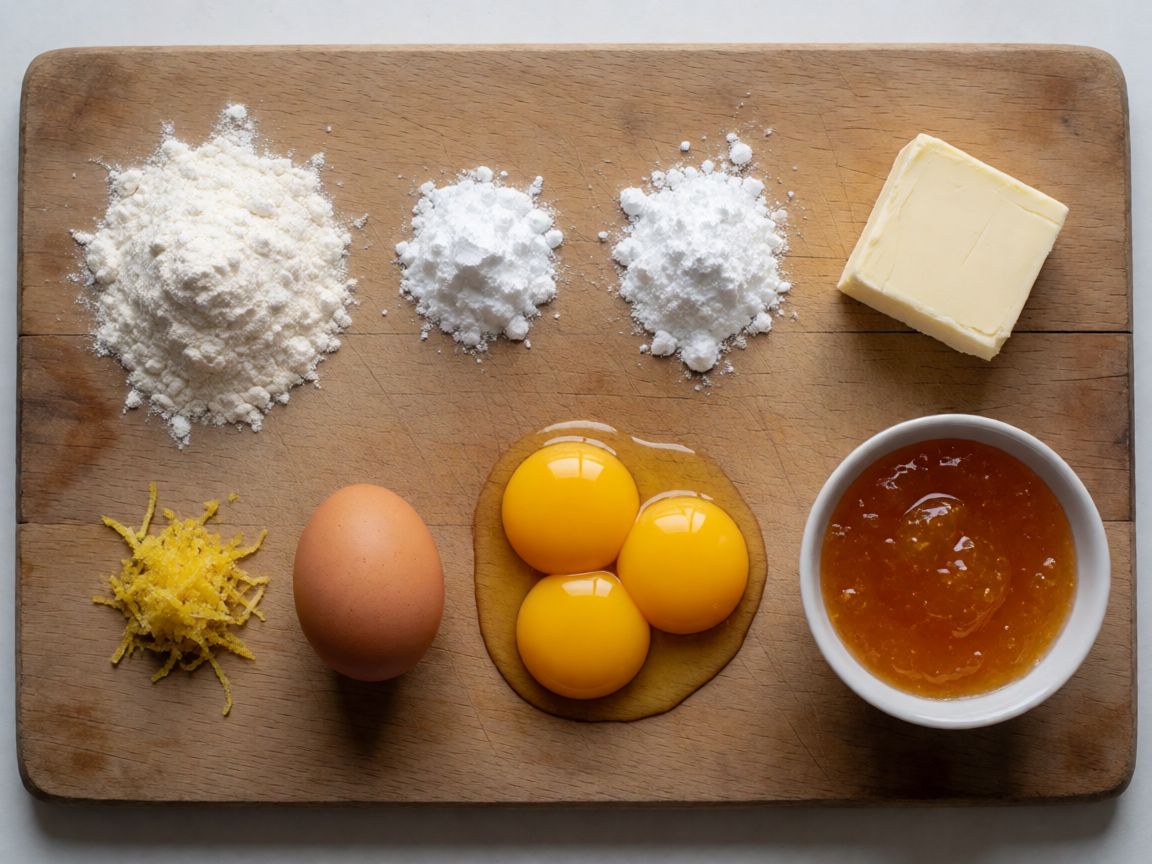
- 500 g Plain flour
- 175 g Icing sugar
- 250 g Caster sugar
- 300 g Butter cold
- 1 pcs Eggs
- 3 pcs Egg yolk
- 1 pcs Lemon zest
- 1 pinch Salt
- 200 g Orange jam
- 350 g Persimmon
- 25 g Walnuts
- 80 g Butter melted
- Brown sugar to taste
- Icing sugar to taste
- 1 pinch Salt










Steps
On a work surface, pile the flour into a mound, and in the centre place the icing sugar, egg and egg yolks.
Add the cold butter, lemon zest and a pinch of salt, and knead with your fingers and hands until smooth.
Shape the dough into a block, wrap in cling film and chill in the fridge for at least 1 hour.
60 minFinely chop the walnuts and dice the persimmon.
Mix the orange jam, chopped walnuts, persimmon and four tablespoons of sugar.
Roll out the chilled dough thinly on a surface dusted with flour.
Spread the filling evenly over the whole surface of the dough.
Roll the dough into a log and pinch the edges closed with your fingers.
Score the surface with a knife, brush with melted butter and sprinkle with brown sugar.
Bake in a preheated oven at 180°C, no fan.
30 minRemove the strudel, let it cool, dust with icing sugar and serve.
This is not the Viennese strudel of paper-thin stretched dough — that version you pull out over the back of your hands until you can read a newspaper through it, and it needs a steady wrist and a tablecloth bigger than most kitchen tables. This one is built from a sweet shortcrust, pasta frolla really, rolled with a pin like a tart base. You lose the shatter and crackle of true strudel pastry, you gain something you can actually make on a Tuesday. That trade is the whole point of the recipe.
What decides whether it works is the dough's temperature at every stage, not the oven's. Shortcrust is butter and flour held together by cold, not by gluten — the moment the butter softens and starts to melt into the flour instead of sitting in it as little flecks, you lose the short, sandy crumble and get something closer to biscuit dough that puffs and toughens. So the block goes into the fridge for at least an hour, and "at least" matters more than "an hour" — a warm kitchen or a warm pair of hands means you wait longer, not that you skip ahead.
The filling is simple arithmetic: jam for moisture and sweetness, persimmon for a fruit that holds its shape better than you'd expect once it hits the oven, walnuts for the bit of resistance that stops every mouthful being soft. The sugar stirred in with them is there to draw a little water out of the persimmon as it bakes, so you don't end up with a soggy seam where the filling meets the pastry.
Go through the dough ingredients and you'll see it's built exactly like a good sweet pastry for a tart, because that's what it is. Plain flour, not strong bread flour — you don't want gluten development here, you want structure from butter, not elasticity from protein. Icing sugar rather than caster in the dough itself: it dissolves without needing to be creamed in, so the dough stays short instead of being beaten into something stretchy. The whole egg plus three extra yolks is for richness and a bit of binding fat without adding excess water — yolks carry fat and flavour, whites carry water and toughness, so three yolks and only one white skews the whole dough toward tender. Butter cold, cut in rather than melted, is non-negotiable for the reason above: it needs to stay in separate pieces through the flour so that when it bakes, each speck melts and leaves a tiny gap of steam behind it, which is what "short" actually means on the tongue. Lemon zest is there for scent, not acidity — a strip of orange zest would do the same job if that's what's in the fruit bowl, since there's already orange jam in the filling to tie the two together. The pinch of salt is seasoning, full stop — pastry without any salt tastes flat and sweetish in a way people struggle to name but definitely notice.
For the filling, persimmon wants to be the firmer, non-astringent kind if you can get it — in the UK that's usually labelled Sharon fruit, and it holds its shape under heat rather than collapsing into syrup the way a very ripe, jammy persimmon would. If persimmon isn't in season or in the shop, you're really looking for any fruit that's sweet, holds structure when warmed, and isn't too wet — a firm pear or a tart apple, diced the same way, would behave similarly, though you'd lose the persimmon's particular honeyed note. Orange jam gives moisture and a citrus backbone; marmalade with the peel strained out, or apricot jam, covers the same job — something that spreads like a glaze and ties the diced fruit together rather than a loose, runny jam that would soak the pastry. Walnuts should be chopped fine but not to dust — you want crunch distributed through the filling, not a flavour note; any nut that isn't oily enough to turn rancid quickly works, pecans or hazelnuts both substitute cleanly.
The melted butter and brown sugar brushed and scattered on top before baking aren't decoration. The butter helps the surface colour evenly and gives you that faint shine; the brown sugar, with its bit of molasses, caramelises at a lower point than white sugar and gives you a thin crackled crust rather than a flat, dry top. Icing sugar only goes on after baking, dusted once it's cooled — do it hot and it just melts into a wet smear, which is a small, common mistake with no real recipe fix, just patience.
One real limit of an ordinary UK kitchen: 180°C no fan means you're trusting your oven's actual temperature, and most domestic ovens drift by ten degrees or more from the dial. If after the stated time the pastry is pale and the filling still looks wet rather than slightly bubbled and set at the edges, that's your oven running cool, not the recipe being wrong — give it longer and trust the look of it: golden, with the seam showing a faint set gloss rather than a raw shine, matters more than the clock.
This feeds four generously as a pudding, which in the UK context means it slots in nicely after a Sunday roast — it's rich enough that nobody needs a large slice, and it sits well with a pot of tea with milk rather than anything stronger, since the orange and persimmon already carry plenty of sweetness on their own.