
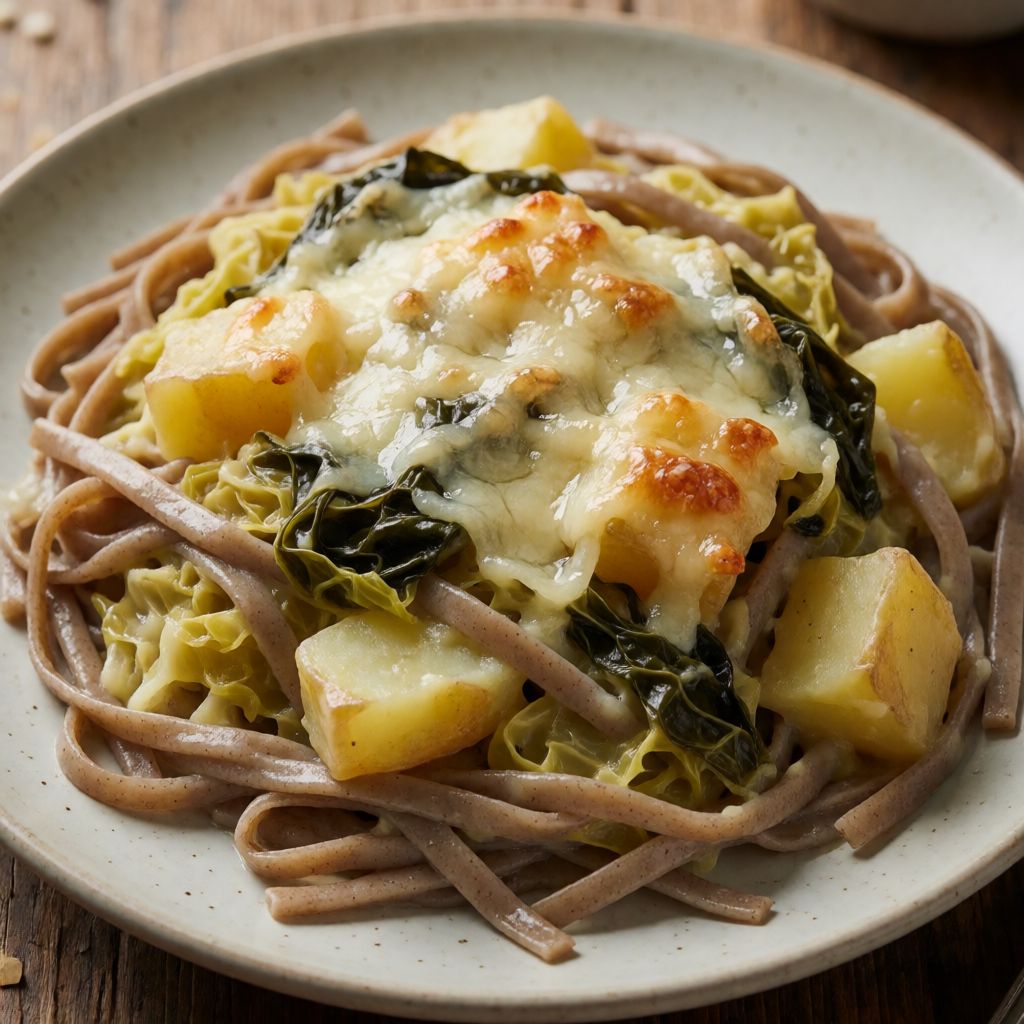
 AI photo
Pizzoccheri
A hearty buckwheat pasta bake from the Valtellina, layered with cabbage, potatoes, cheese and melted butter with garlic.
Labels are worked out automatically from the ingredients and can be wrong. Check the packaging if it matters to you.
Ingredients
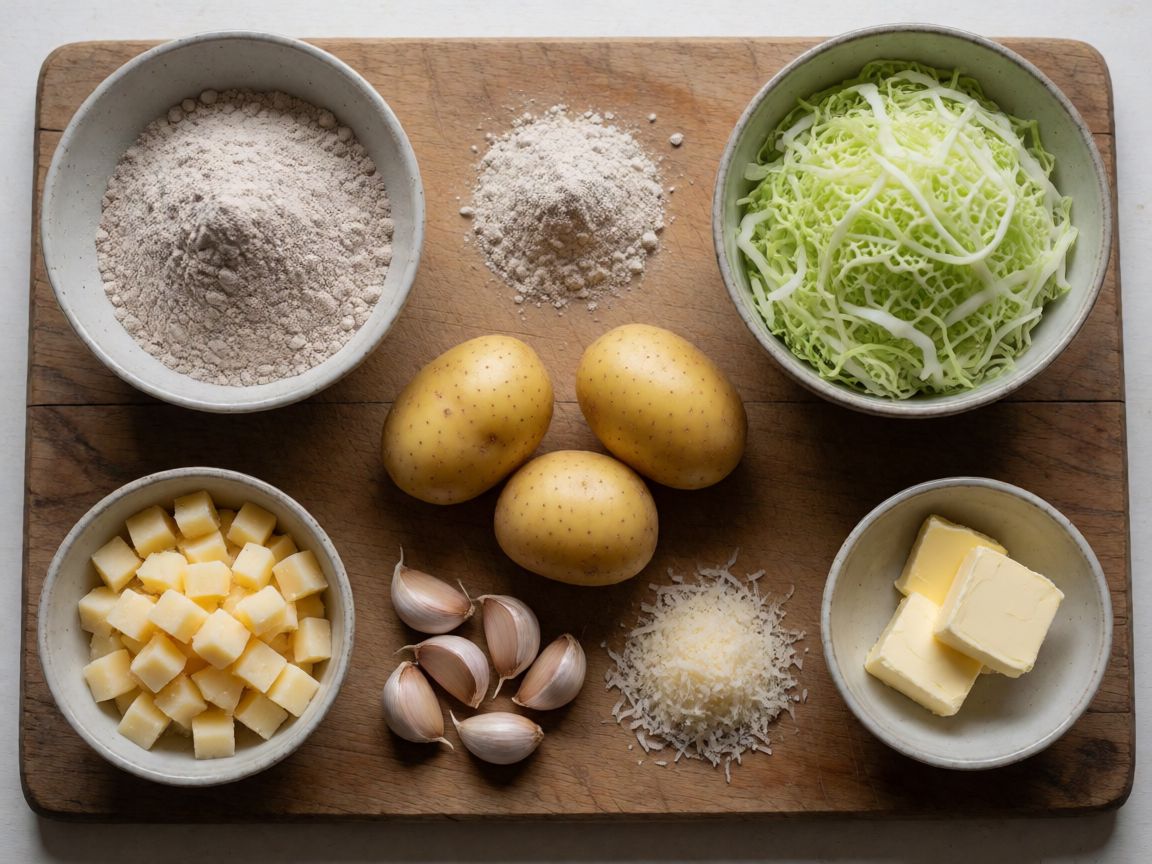
- 350 g Buckwheat flour
- 150 g Plain flour
- 1 pinch Salt
- 280 ml Water
- 350 g Savoy cabbage
- 3 pcs Potatoes
- 200 g Fontina cheese
- 150 g Butter
- 5-6 clove Garlic
- 50 g Parmesan
- Salt to taste










Steps
Rinse the savoy cabbage leaves and cut into strips about 2 cm wide. Peel the potatoes and cut first into slices, then into quarters.
Bring a large pot of salted water to the boil.
In a large bowl combine the buckwheat flour, plain flour and salt, then add the water. Mix and transfer the dough to a work surface, kneading for a few minutes.
Roll out the dough with a rolling pin into a sheet a few millimetres thick. Cut first into strips 10-12 cm wide, then into strips 2 cm wide.
Boil the savoy cabbage from the moment the water returns to the boil.
8 minAdd the potatoes and cook.
8 minAdd the pizzoccheri and cook.
12 minPut the butter in a pan together with the garlic and melt over low heat.
Drain the pizzoccheri together with the cabbage and potatoes and layer them in a baking dish or on a plate.
Pour over a few spoonfuls of the melted garlic butter, add cubes of fontina and repeat in layers.
Finish with a generous layer of grated Parmesan and serve.
Pizzoccheri is Valtellina's answer to a question nobody in a mountain valley wants to ask twice: how do you get enough calories into a body before winter without wheat, because wheat doesn't grow at 1000 metres in the Alps. Buckwheat does. So the pasta is grey-brown, short, stubby, cut by hand with a knife rather than extruded — it's a flour that has no gluten to speak of, so it can't be stretched into long strands, it snaps. That one fact decides the whole dish: short ribbon pasta, a dense dough, and no pretension about silky sheets.
What decides whether it works is not the pasta, though — it's the one pot. Cabbage, then potato, then pasta, into the same boiling water, in that order, because potato takes longer than pasta and cabbage longer than potato, and you're not running three pans and a sink full of washing-up for a Tuesday dinner. One pot, staggered additions, everything ready at the same moment. That's not a shortcut, that's the actual engineering of the dish — mountain cooking doesn't waste fuel or water.
Buckwheat flour is the identity of the dish, not a variation on it — some recipes online call for "buckwheat pasta" as if it's a style choice, but no: in Valtellina buckwheat was what grew, wheat didn't, end of story, economics not aesthetics. You mix it with plain flour (roughly 70/30 here) because pure buckwheat dough has almost no elasticity and will crumble when you try to roll and cut it — the wheat flour's gluten is there purely as scaffolding, holding the buckwheat together long enough to get it into strips. If you've only got buckwheat, expect a more fragile dough and handle it gently; don't knead it like bread, you're not building structure, you're just binding grains.
The water is cold tap water, nothing more — this isn't an egg pasta, egg would soften and enrich a dough that's meant to stay rustic and slightly coarse. Resting isn't mentioned because with no real gluten development there's little to relax; roll it reasonably thick (a few millimetres, not paper-thin) because thin buckwheat dough tears.
Savoy cabbage specifically because its leaves are loose and ruffled, cooking down soft rather than staying crisp like a tight white cabbage would — you want it collapsing into the pasta, not offering resistance. Any leafy winter cabbage that softens readily will do; what you're avoiding is a cabbage so dense it needs twice the time and throws off your staggered pot timing.
Potatoes here are a starch filler, not a feature — waxy or floury both work since they're cut small and boiled to softness, not roasted for texture. Cut them to roughly match the pasta's cooking time so they land in the pot at the right moment and you're not guessing by the clock alone; test with a knife tip, it should slide in without a fight.
Fontina is the correct cheese because it's a semi-soft alpine cheese that melts into long elastic strings at modest heat rather than seizing or going oily — this is the same family of behaviour as raclette or a young Taleggio. If you can't get fontina, look for any cheese described as a melting mountain cheese rather than reaching for mozzarella, which melts but doesn't carry the same savoury weight. Parmesan on top isn't for melting, it's for salt and sharpness cutting through all that butter and cheese underneath — don't skip it thinking it's decorative.
Garlic butter, melted low rather than fried, is there to flavour fat without cooking the garlic to bitterness — browned garlic turns acrid, and once that happens there's no fixing it, you start again. Butter itself is the traditional fat because in the mountains that's what cattle gave you, not olive trees; if you want a substitute, use any fat that tastes of something you actually want in the dish — there's no neutral-oil version of this recipe worth making, the butter is doing real flavour work, not just lubrication.
Patience here is less about long cooking and more about not rushing the pot sequence — tip the pasta in too early with underdone potato and you'll fish out mush with one hand and bullets with the other. Let each stage reach its own point before adding the next, and let the final layered dish sit a minute under its own heat before you dig in, long enough for the fontina cubes to actually surrender and run.