
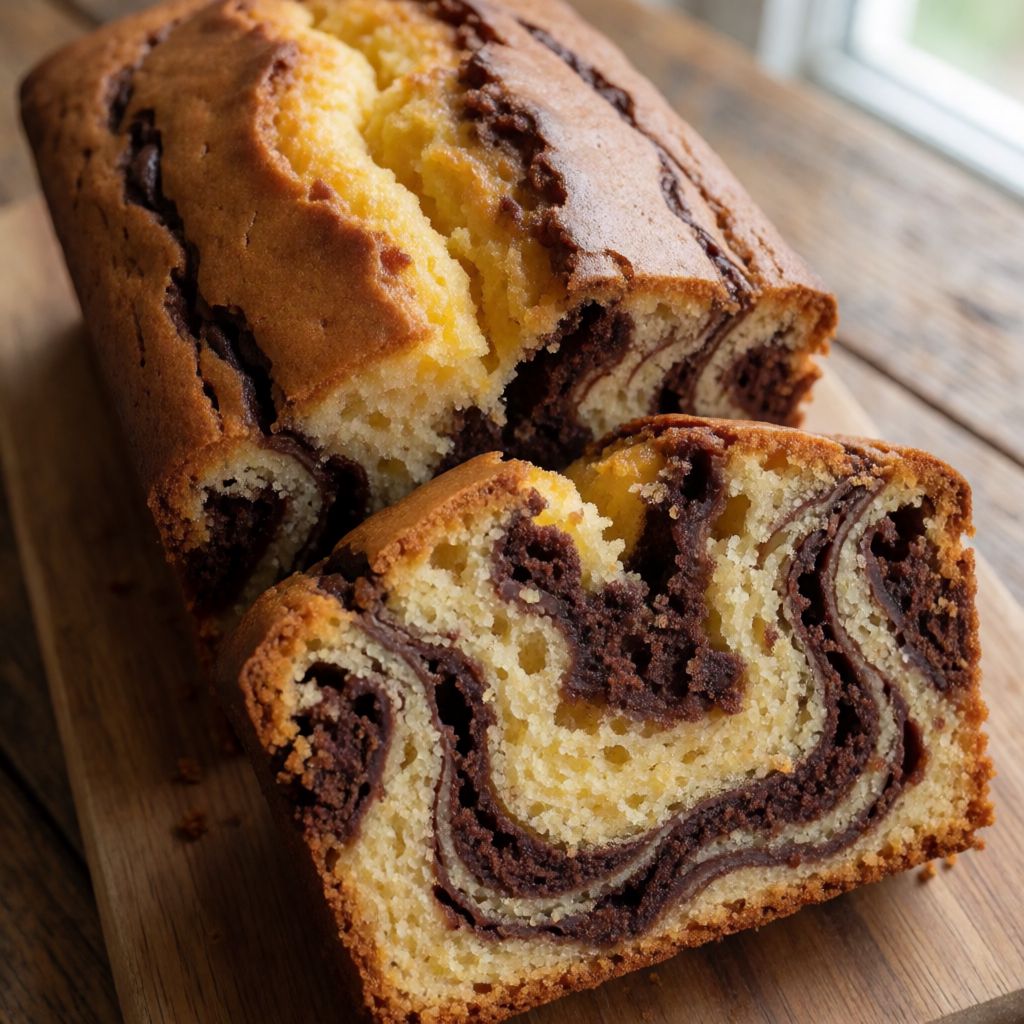
 AI photo
Orange and Chocolate Marble Loaf Cake
A marbled loaf cake swirling orange batter with chocolate batter, baked until lightly golden.
Labels are worked out automatically from the ingredients and can be wrong. Check the packaging if it matters to you.
Ingredients
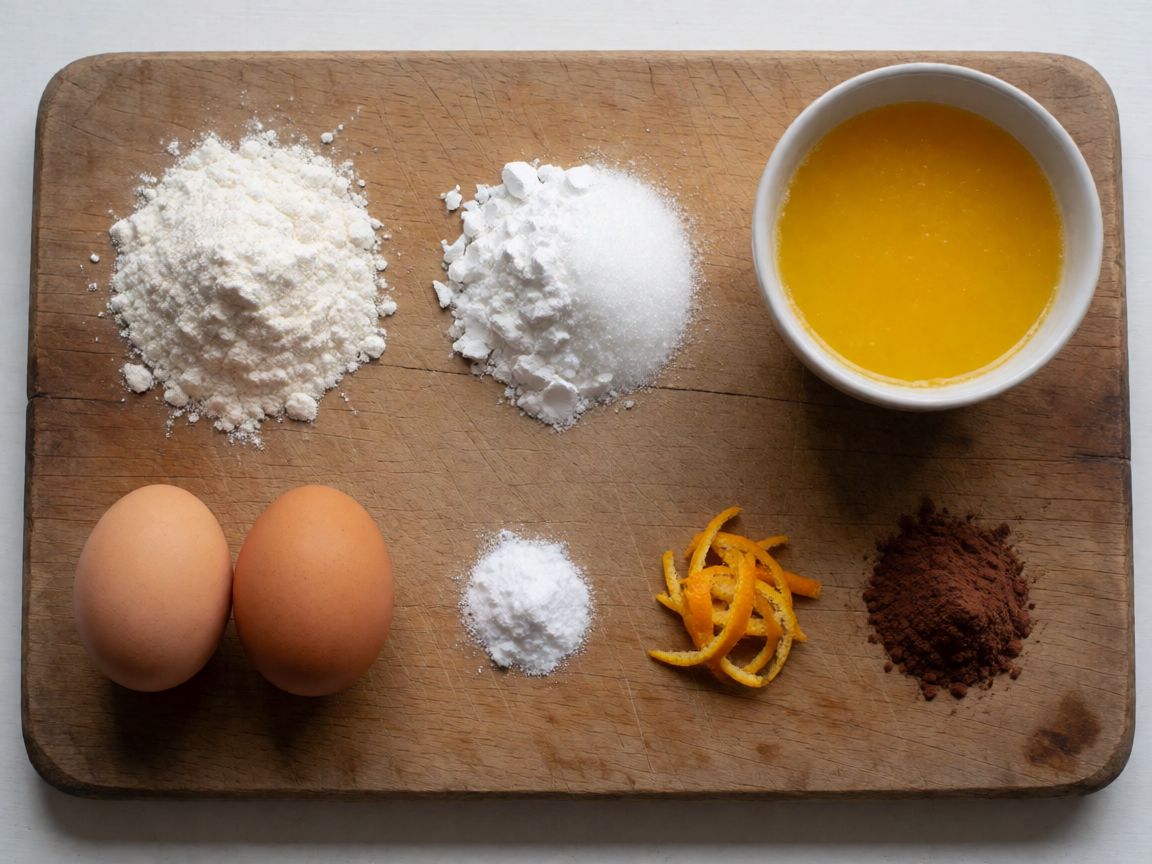
- 180 g Plain flour
- 70 g Potato starch
- 150 g Caster sugar
- 2 pcs Eggs
- 100 ml Vegetable oil
- 16 g Baking powder
- 80 ml Orange juice
- 1 pcs Orange zest
- 10 g Cocoa powder








Steps
Beat the eggs with the sugar using an electric mixer until smooth and creamy.
Add the orange zest for aroma.
Sift in the flour and baking powder, fold into the egg mixture and mix well.
Pour in the vegetable oil, stirring until smooth.
Sift in the potato starch, which will make the batter light.
Pour in the orange juice and beat with the mixer until the batter is smooth and lump-free.
Divide the batter roughly in half: stir the cocoa powder into one half.
Grease and flour a loaf tin, then pour in both batters alternately.
Swirl gently with a fork to create the marbled pattern.
Bake in a preheated fan oven at 160°C.
53 minLet the cake cool slightly, then slice.
This is a loaf cake built on a sponge principle, not a pound-cake principle — and that's the whole trick of it. Eggs and sugar get whipped first, on their own, until they go pale and thick enough to hold a ribbon. That's not decoration, that's the engine: you're beating air into the mixture because there's no butter here to do the work of creaming, and air is what will lift this loaf in a domestic oven that doesn't have the fierce, even heat of a proper bakery deck.
What decides whether it works is the swirl, and the swirl is decided before you ever pick up the fork. Split the batter unevenly, or let one half go stiffer than the other while you dawdle over the cocoa, and you won't get marble — you'll get two separate loaves glued together down the middle, no veining at all. A fork dragged once or twice, lazily, through two batters of matching looseness is what gives you the pattern; a spoon stirred properly gives you a uniform grey-orange cake, which is a different, worse dessert.
Some say orange and chocolate don't actually taste of much together, that it's just a pretty idea from a magazine. No — because the zest isn't there to fight the cocoa, it's there to cut the flatness that cocoa alone brings to a plain sponge; bitterness and citrus oil sit either side of sweet and don't cancel each other, they frame it. You'll taste that most in the plain half, where the zest has nothing to hide behind.
Plain flour gives structure; potato starch is what keeps that structure from turning dense. Starch has no gluten in it, so folding it in after the flour loosens what the flour has just tightened — that's the "light" the recipe promises, and it's a real mechanical effect, not a flourish. If you've no potato starch, cornflour does the identical job; what you're after is any pure starch with no protein in it, nothing more exotic than that.
The baking powder has to be sifted in with the flour, not dumped in separately, because lumps of raw powder sitting in wet batter fizz out early and unevenly — you get one big bubble under the crust instead of a thousand small ones through the crumb. Sixteen grams against 180 g of flour is a generous hand; this cake leans on chemical lift rather than whipped egg whites, which is sensible shortcut for a weekday loaf and no shame in it.
Vegetable oil instead of butter is an economic and practical choice before it's a taste one: oil stays liquid at room temperature, so the crumb stays moist the next day without the fridge-hardening that a butter loaf suffers. Use anything with no smell of its own — sunflower, rapeseed, a light groundnut oil — and avoid anything that announces itself, olive oil above all, which will sit on top of the orange and argue with it.
Orange juice and zest are doing two different jobs and you shouldn't confuse them. The zest carries the aromatic oil, the actual scent of orange; the juice carries moisture and a little acid that reacts against the baking powder for extra lift. Bottled juice will do for the liquid, but zest has no substitute worth using — a few drops of orange extract is the honest fallback if you've no fresh orange in the house, not lemon, which is a different fruit with a different argument.
Cocoa powder in only half the batter, unsweetened, is there purely for colour and bitterness contrast — you're not making a chocolate cake, you're making an orange cake with a chocolate shadow running through it. If your cocoa is lumpy, sift it with a little of the flour from that half before folding in, same logic as the baking powder: lumps don't dissolve in thick batter, they just sit there and burst as dark specks.
A UK fan oven at 160°C is a convection temperature — the fan does the work of circulating heat that a kazan or a wood oven would do by sheer mass and radiant walls, so trust the number as given rather than nudging it up "to be sure." The 53 minutes is the lower bound, not the answer: push a skewer into the thickest part of the loaf, and you're looking for it coming out dry, not golden crumbs clinging in a wet smear. Let it sit in the tin a few minutes after that — cutting it straight from the oven, with no rest, is how you get a slice that looks collapsed and gummy even when the inside was perfectly cooked.