
 AI photo
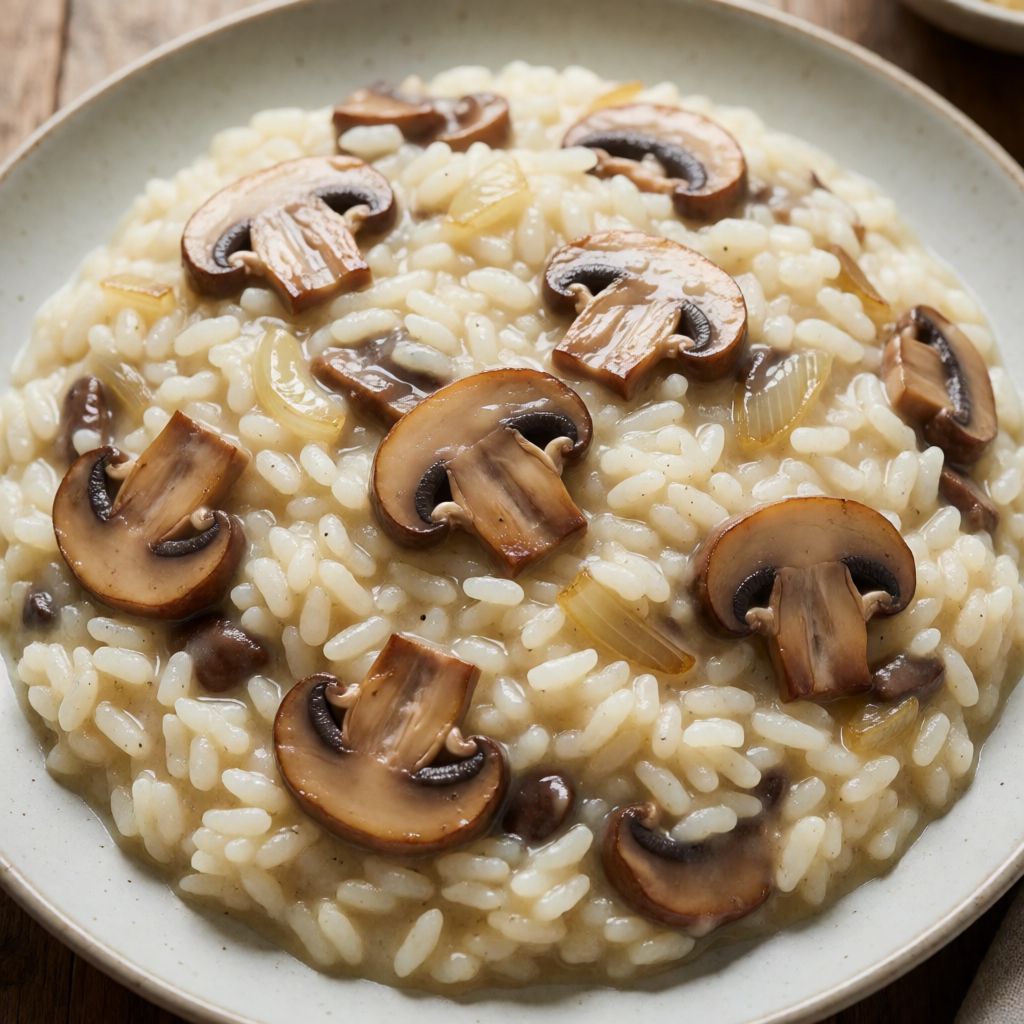
Creamy Mushroom Risotto
A creamy risotto made with mushrooms, red wine and parmesan, finished with double cream.
Labels are worked out automatically from the ingredients and can be wrong. Check the packaging if it matters to you.
Ingredients
- 320 g Carnaroli rice
- vegetable stock
- 400 g chestnut mushrooms
- 1 pcs onion
- 200 ml double cream
- 125 ml red wine
- parsley
- 2 tbsp parmesan
- olive oil
- salt
- black pepper











Steps
Clean the chestnut mushrooms with a damp cloth, rinse under water, pat dry and slice thinly.
In a pan with olive oil, add the roughly chopped onion, sliced chestnut mushrooms, parsley, salt and black pepper.
Sauté the mixture for a few minutes, then pour in 125 ml of red wine and let it evaporate.
10 minAdd the Carnaroli rice and vegetable stock, stirring thoroughly over low heat, gradually ladling in the stock.
When the rice is cooked al dente, add the cream and parmesan, stirring for a minute.
Turn off the heat and serve hot.
What was changed
chestnut mushrooms replaces porcini with chestnut mushrooms, as fresh porcini are rarely found in British shops.
Risotto isn't a rice dish cooked the way you'd cook basmati — it's a controlled extraction. You're asking the outside of each grain to rub off a little of its own starch into the stock around it, and that starch is what thickens into "cream" long before the cream carton ever gets opened. Whether this dish works or not comes down to one mechanical fact: the rice needs to be agitated gently and fed liquid a little at a time, hot, so it never sits either dry or drowning. Dump the whole stock in at once and you get rice boiled in soup, not risotto — the starch washes off into a sea of liquid instead of building a coat around the grain.
The mushrooms have their own mechanism and their own failure mode. Mushrooms are mostly water held in a cell structure that collapses the second it meets heat. Crowd the pan, or keep the heat too gentle, and that water comes out faster than it can evaporate — the mushrooms stop sautéing and start boiling in their own puddle, turning grey and rubbery instead of browning. A wide pan solves this better than a narrow saucepan; more surface means the water has somewhere to go as steam rather than somewhere to sit as liquid.
Some say risotto demands a person standing over it stirring without pause, arm aching, phone unanswered. No — because what the stirring actually does is keep the grains moving against each other so the starch rubs off evenly and nothing catches on the bottom. Steady, unhurried turning every so often does that job; a boxing match with a wooden spoon does not do it any better.
Carnaroli is chosen for one trait: a grain with a high-starch coat around a firmer, more resistant core. That outer layer is what rubs away and dissolves; the core is what keeps a bit of bite even once it's done, so the rice doesn't collapse into porridge. Arborio does a similar job, a touch less reliably. Don't reach for "easy cook" or parboiled rice from the cupboard thinking rice is rice — it's been pre-steamed precisely to stop grains sticking together, which means its starch has already been sealed in. Use it here and you'll get fluffy separate grains swimming in liquid, never a sauce.
Chestnut mushrooms are a good, ordinary choice for a British kitchen — firmer and more savoury than plain button mushrooms, widely sold, not expensive. The criterion for substituting is: any mushroom firm enough to hold its shape under heat rather than disintegrate into mush — portobello sliced down, or a mix with a few dried ones soaked back to life, work fine. Don't wash them under a running tap and leave them wet; mushrooms are sponges, and wet mushrooms go straight back to the steaming problem above. A damp cloth or a very quick rinse followed by drying is the whole point of that step, not fussiness for its own sake.
The onion goes in first and gets its own few quiet minutes because it needs time to turn sweet rather than sharp — that sweetness is the backbone the mushrooms and wine sit on top of. The wine is for acid and for depth of flavour as its alcohol burns off, and here's a small myth worth naming: risotto is supposed to take white wine, always, because that's the postcard version most people have seen. No — the wine's job is acid and aromatic lift, not colour-matching, and red wine with mushrooms gives you a deeper, earthier result, nothing broken about it.
Stock has to be hot when it's ladled in, not cold from the fridge — cold liquid shocks the pan's temperature down, stalls the starch release, and you end up fighting the clock to get back to a simmer. Keep it on a low flame beside the risotto pan the whole time. Homemade vegetable stock gives you more flavour to build on than a cube, but a decent stock cube dissolved properly will not ruin the dish — it's a floor to work above, not a ceiling.
Cream and parmesan are the finishing emulsion, not an afterthought. If you're out of cream, crème fraîche does a similar job, or even a last knob of butter beaten in with extra cheese — any dairy fat that will emulsify smoothly rather than split works by the same logic. For the cheese, the criterion is dry, aged, and full of those savoury crystals real parmesan develops with age; Grana Padano does the job. A young, wet cheddar won't — it melts into strings instead of dissolving into the sauce, which is a different texture problem entirely.
And set aside the clock from the ingredient list as the real test. "10 minutes" for the wine to evaporate, or however long the rice takes, are starting points, not deadlines. The wine is done when you can no longer smell raw alcohol over the pan. The rice is done when a grain bitten in half shows no chalky white centre but still has the faintest resistance — bend, not snap, to borrow the logic you'd use testing a carrot. This dish, more than most, punishes impatience: rush the stock in too fast, rush the heat too high, and you'll have fed the clock instead of the rice.