
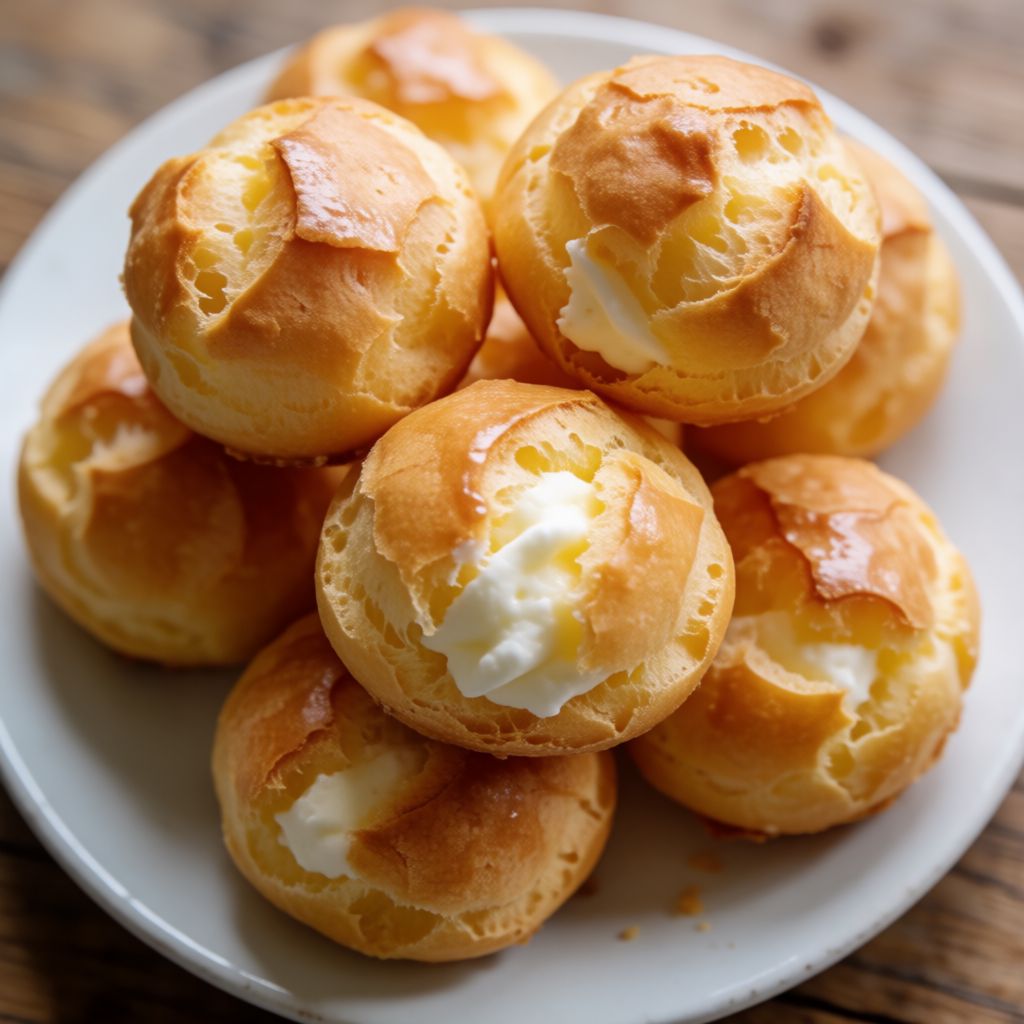
 AI photo
Profiteroles
Classic French choux puffs filled with whipped cream and finished with warm chocolate sauce.
Labels are worked out automatically from the ingredients and can be wrong. Check the packaging if it matters to you.
Ingredients
- 300 g Plain flour
- 200 g Butter
- 500 ml Water
- 8 pcs Eggs
- pinch Salt a pinch
- 700 g Double cream or custard
- 500 g Dark chocolate







For the chocolate sauce
- 300 g Double cream
- 60 g Butter
Steps
Pour the water into a large saucepan, add the butter and salt. Set over low heat and bring to the boil.
Tip in all the flour at once and stir quickly with a spatula, keeping the pan on the heat.
Turn off the heat and let the dough cool completely.
Add the eggs one at a time, mixing well each time until fully combined.
Transfer the dough to a piping bag and pipe round mounds onto a baking tray lined with parchment.
Bake at 220°C for 10–15 minutes, until the profiteroles have risen and turned golden.
15 minFor the sauce, put the cream, dark chocolate and butter in a saucepan and stir over heat until everything has melted.
Whip the double cream and fill the profiteroles with it.
Arrange the profiteroles on a plate in a pyramid shape and drizzle with the warm chocolate sauce.
Decorate with chopped nuts, sugar sprinkles or pistachios, if you like.
What was changed
The whipping cream was replaced with Double cream, a product local shoppers commonly buy.
Profiteroles are choux pastry pretending to be architecture — little hollow balls, each one a tiny pressure vessel, built on a dough that's cooked twice: once on the hob, once in the oven. What decides whether they work isn't the filling or the chocolate, it's whether that dough traps enough steam inside itself before the structure sets. Get that wrong and you get flat, eggy biscuits instead of balloons with a crisp shell and an empty middle waiting for cream.
The mechanism is this: flour cooked into boiling fat-and-water forms a paste where the starch has already gelatinised — that's step 2, and it's not optional stirring, it's the whole trick. A raw flour-and-egg batter would just spread and burn. By pre-cooking the starch, you get a dough elastic enough to hold egg without curdling and strong enough to form a skin. In the oven, the water still left inside turns to steam, the skin is stretchy enough to balloon around it, and then the heat dries and sets that shell before it can collapse. Take them out too soon and the walls are still wet — they'll cave in on the counter, sulking, the moment you touch them.
Some say you can't make choux without a stand mixer. No — your arm and a wooden spoon did this for centuries before motors existed; it's just graft, especially beating in eight eggs one at a time. The one-at-a-time bit matters: dump all the egg in together and it curdles the starch paste into something lumpy and uneven instead of a smooth, glossy dough that pipes cleanly.
Step 3 — letting the dough cool before the eggs go in — isn't patience for its own sake, though patience is always an ingredient here. It's protection: egg thrown into a pan that's still near-boiling scrambles on contact, and scrambled egg in choux means lumps that never smooth out and dough that won't rise evenly. Cool it properly, even a cup of tea's worth of waiting, and the eggs bind in as liquid gold, not curds.
Flour, plain, no raising agent needed — the rise here is steam, not baking powder, so don't reach for self-raising out of habit; it'll just make the shells blister oddly. Butter is there for richness and for flavour in the shell itself, and also helps the steam do its work by making the dough more extensible. Any neutral fat with no smell of its own would technically puff the dough, but butter is what gives choux its particular savoury-sweet backbone, so I wouldn't swap it here.
The eggs need to be proper room temperature, not fridge-cold — cold egg against hot-ish dough is exactly the scrambling risk again. If you're baking in a normal UK oven, know your oven's quirks: domestic ovens run cooler at the edges and hotter near the fan, so don't trust 220°C blindly — trust the colour. Pale and soft means underbaked and they'll collapse; proper golden-brown, firm to a light squeeze, with a slight hollow sound if you dare tap one, means the shell has set enough to hold air.
For the filling, double cream whipped to soft peaks is standard, but the ingredient list mentions custard as an option — that's the older, heavier French tradition (crème pâtissière), richer but more work, and it holds up better if the profiteroles sit around before serving. Whipped cream is lighter, quicker, and more forgiving for a Sunday when you've already got the roast and don't need another saucepan on the go.
The chocolate sauce is a straightforward ganache: dark chocolate, cream and butter melted together low and slow, not boiled — boil it and the chocolate can seize or the fat can split out, leaving a grainy, oily sauce instead of something glossy that pours. Use chocolate you'd actually eat off the bar; the bitterness in dark chocolate is what balances all that cream, so don't drop below a reasonably dark one or the whole pudding tips sickly-sweet.
No piping bag in the house? A strong freezer bag with the corner snipped off does the same job — the dough is thick enough to hold its shape regardless. And the pyramid at the end isn't decoration for its own sake — it's an old trick for serving a lot of small things as one dramatic centrepiece without a fancy stand, something a croquembouche does on a grand scale with spun sugar instead of chocolate running down the sides.