
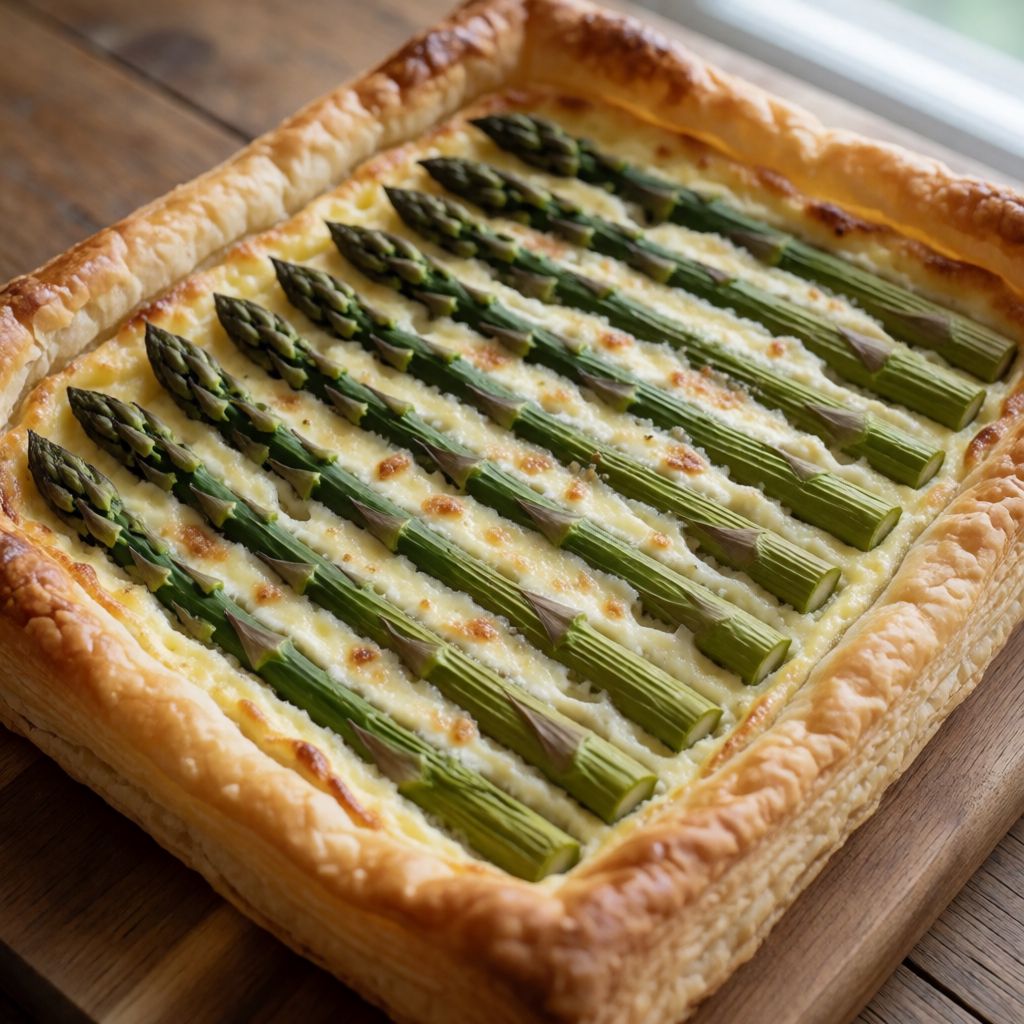
 AI photo
Asparagus Puff Pastry Tart
A creamy asparagus and ricotta tart baked in crisp puff pastry.
Labels are worked out automatically from the ingredients and can be wrong. Check the packaging if it matters to you.
Ingredients
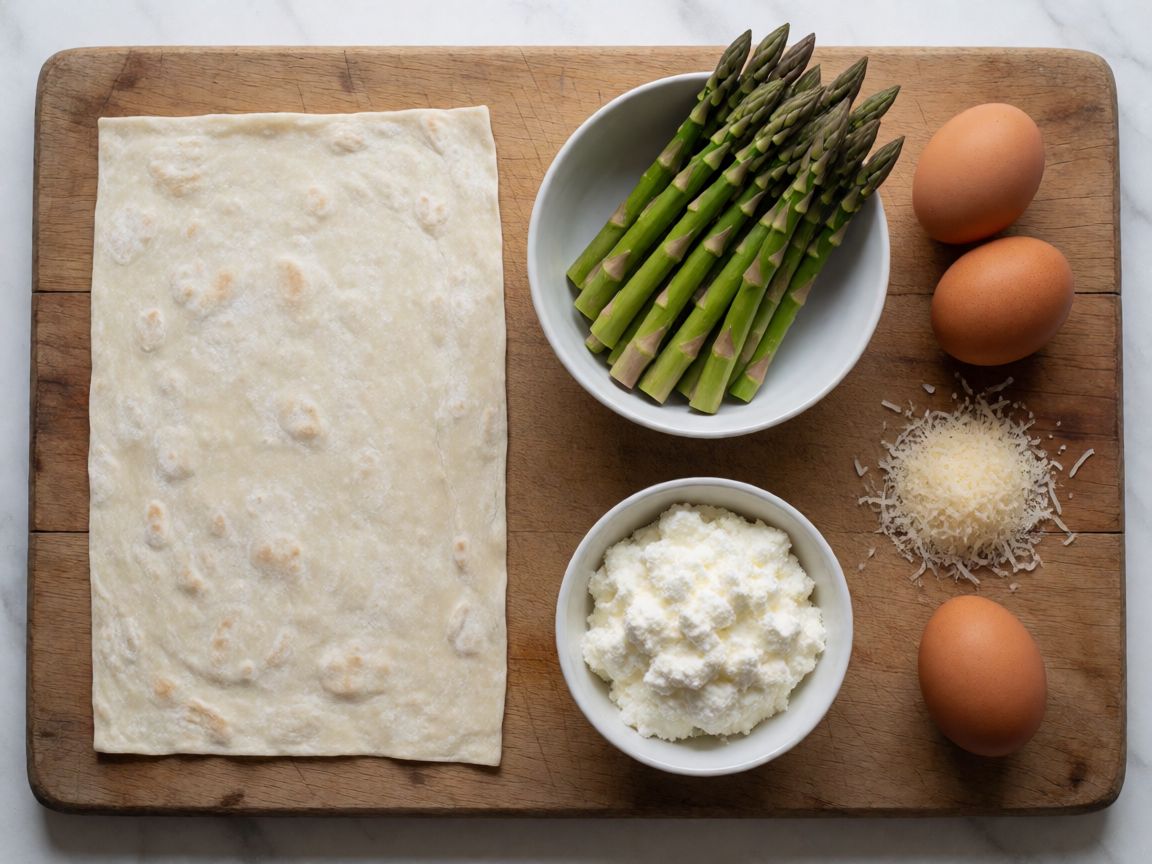
- 1 pcs Ready-rolled puff pastry
- 500 g Asparagus
- 2 pcs Eggs
- 250 g Ricotta
- 100 g Parmesan
- Salt to taste
- Black pepper to taste
- Olive oil for frying
- 1 pcs Egg for brushing







Steps
Wash the asparagus and trim the stem ends, removing any tough fibres and woody parts. Set the tips aside and cut the rest into rounds.
Heat a little olive oil in a frying pan and sauté the chopped asparagus with the lid on, stirring occasionally.
10 minIn a blender, combine the ricotta, sautéed asparagus, Parmesan and eggs, and season with salt and black pepper. Blend until smooth and creamy.
Line a baking tin with the puff pastry and prick the base with a fork. Spread the filling evenly and fold over the edges of the pastry.
Arrange the reserved asparagus tips on top.
Brush the top of the tart with beaten egg and bake in an oven preheated to 180°C until golden brown.
40 min
This isn't a quiche baked in a dish — it's a tart that builds its own walls. You fold the pastry edges inward instead of fitting it to a tin, so the puff pastry becomes the container, not just the base. Inside goes a baked custard of ricotta, parmesan and egg, stiffened with cooked asparagus; on top, raw tips, there to be seen and to give you something to bite that isn't soft.
What decides whether it works is a tug-of-war between two things that want opposite heat: the pastry wants to puff fast and go crisp, the custard wants a gentle, even set. Prick the base — this isn't decoration. Puff pastry is dozens of thin dough-and-butter layers, and when they heat, the butter turns to steam trapped between them, which is what lifts it. Left whole, that steam can lift the whole base away from the filling, and you get a domed shell with the custard pooled loose underneath it. The fork holes give the steam somewhere to escape instead of pushing up, so the base stays flat and in contact with what's sitting on it.
The filling itself is a balance of protein, fat and moisture — egg, ricotta, parmesan — that sets like a soft curd when it gets warm enough, the same way a custard does. Push it too hot or leave it too long and the egg proteins tighten and squeeze water out of the mix; that's the thin watery pool you sometimes get under a slice, and it's not a flaw in the recipe, it's overcooking, plain and simple.
Asparagus: buy stalks that bend before they snap — that's the test for freshness, the fibres haven't gone rigid yet. Lignin, the woody stuff, builds up from the cut base as the plant grows and keeps building after it's picked, which is why you trim the ends: you're cutting back to where the lignin hasn't taken over. Thick spears sometimes need the bottom few centimetres peeled too, because the skin toughens faster than the core; thin ones, common in UK supermarkets outside the short local season (May into June, mostly East Anglia and the Vale of Evesham), rarely need it. Sautéing the chopped stems with the lid on is steaming in their own water, not frying — the point is to soften without browning, because browning here would mean drying out, and a dry stalk going into a blender just gives you grit instead of cream.
Ricotta is doing the job of a binder with almost no character of its own — mild, soft-curd, enough moisture to loosen the mix without making it runny. Any fresh, unaged curd cheese with that same quiet flavour works: well-drained cottage cheese, or the curd cheese sold for cheesecakes, pressed to lose excess whey first. Skip the pressing and you add back the exact wet-filling problem the sauté step was trying to avoid.
Parmesan is here for salt, for umami, and for the faint sharp bite that stops the whole thing tasting of cream and nothing else. It's dry — low in moisture compared to a soft cheese — which matters, because a wetter cheese would just dilute the custard instead of seasoning it. The criterion for substituting it: any hard, aged grating cheese with real depth. Mature cheddar will stand in, but it brings its own flavour along, not a neutral swap, just a different tart.
Two eggs go into the filling to do the actual setting — heat coagulates the egg protein and that's what turns a loose cream into something you can slice. The third egg, for brushing, is doing nothing structural at all: it's pure browning and gloss, the Maillard reaction on the pastry surface. Leave it off and the tart still eats fine, it just comes out pale and a bit leathery on top instead of burnished.
Ready-rolled puff pastry is a fair trade, not a shortcut to feel guilty about. Proper lamination — folding cold butter into cold dough, resting, folding again — needs a cold kitchen, cold hands and time most people don't have on a weekday, which is exactly why shop puff exists: it's industrially laminated to be consistent, and consistency matters more here than the romance of doing it yourself. Some say a tart like this needs a proper flan tin with a fluted edge — no, because the fold-over edge described in the method is built to be its own wall; a flat baking tray with a slight lip, or a plain tin, does the job. Let the tart sit a few minutes out of the oven before cutting — the custard keeps firming as it cools, and cutting too early is how a perfectly set filling still ends up looking loose on the plate.