
 AI photo
Puff Pastry Apple and Cinnamon Pie
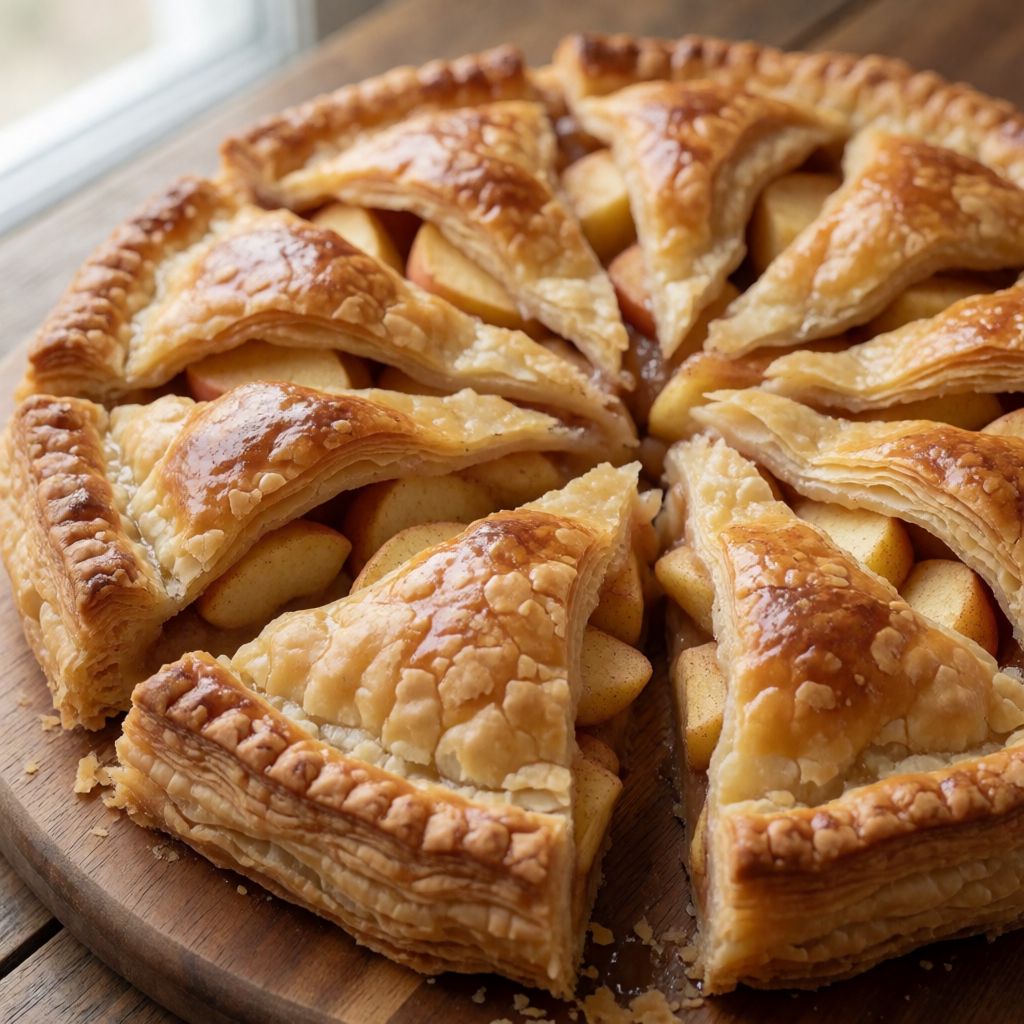
A buttery puff pastry pie filled with spiced apples and a smooth cinnamon custard, baked until golden and set.
Labels are worked out automatically from the ingredients and can be wrong. Check the packaging if it matters to you.
Ingredients
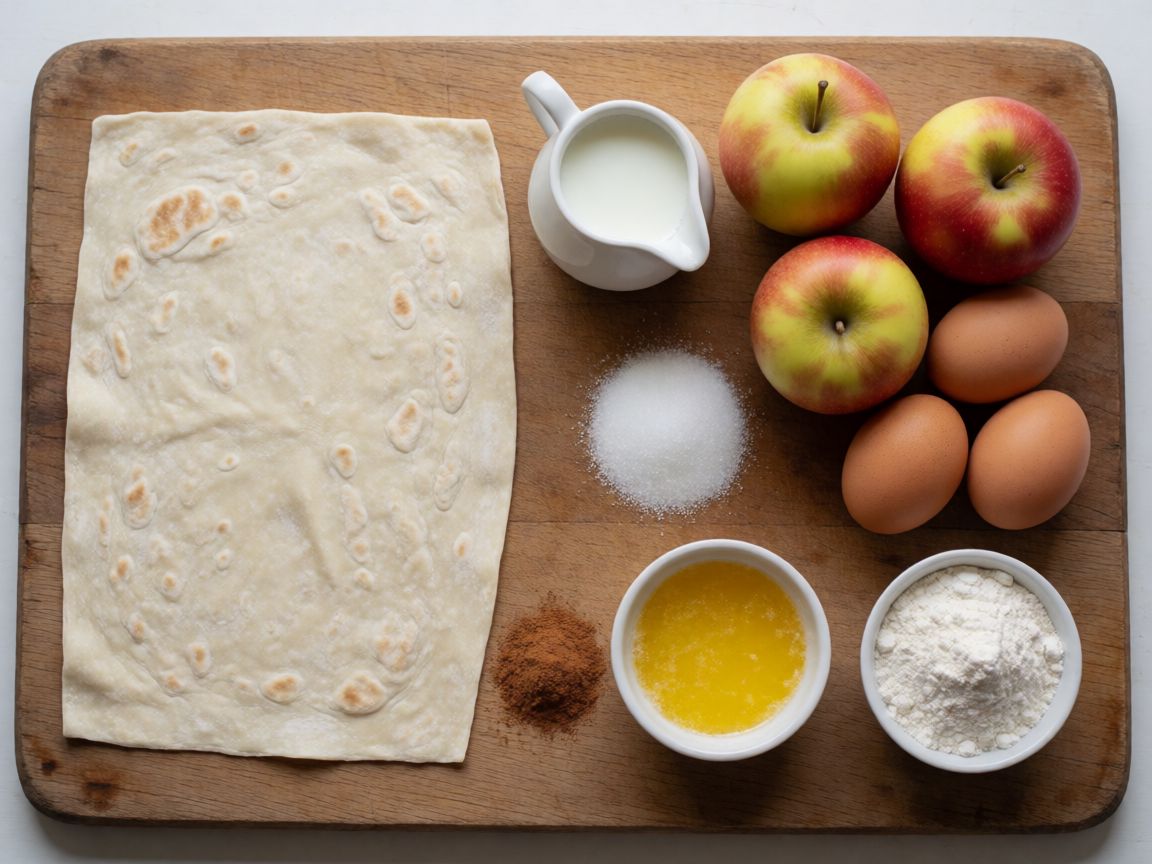
- 1 pcs Puff pastry
- 3 pcs Apple
- 4 pcs Eggs
- 150 g Milk
- 100 g Caster sugar
- 50 g Plain flour
- 25 g Butter melted
- Cinnamon to taste
- Icing sugar to taste, for dusting









Steps
Crack the eggs into a large bowl, whisk them, then stir in the milk, sugar and flour.
Pour in the melted butter and flavour the mixture with cinnamon.
Mix well until smooth and set aside.
Peel the apples, cut them in half, remove the core and make shallow cuts on the outer side.
Line a 26 cm baking tin with the puff pastry and baking paper, prick the base with a fork and arrange the apples on top.
Pour the custard mixture over the apples and bake in an oven preheated to 180°C.
45 minCheck that it's done - the custard should be fully set and firm.
Let the pie cool before serving, dusting with icing sugar if desired.
This isn't really a pie - it's a custard tart that borrowed a pastry case instead of building one. Puff pastry gives you lift and butter-flake without the hour of folding real puff demands, and apple halves sitting in a bath of egg, milk and flour is the oldest trick in French home baking with its coat changed - a flan that happens to have fruit standing up through it. What decides whether it works isn't the oven door, it's whether two things cooking at different speeds in the same tin - the custard setting, the apple cooking through - finish together.
That's why the apples get scored before they go in, not for looks. A halved apple is a lot of dense flesh for heat to get through; leave the rounded side smooth and the custard round it will have set firm while the centre of the apple is still raw and squeaking against a knife. Cut shallow lines into it and you give the heat more surface to travel in on, so apple and custard arrive at done at roughly the same moment. At 180°C the egg proteins in the filling coagulate steadily rather than seizing at the edges while the middle's still liquid - go hotter and you'll get a custard that curdles at the rim before the centre has caught up.
Forget counting minutes as your proof it's ready. The only honest check is to nudge the tin: the custard should hold still, not slosh, with maybe the faintest give in the very centre that settles as it cools. Forty-five minutes is where to start looking, not where to stop.
Puff pastry - buy it ready-rolled, the kind sitting in every supermarket chiller, because the lamination that makes real puff work (butter folded into dough six or seven times, rested cold between folds) wants a kitchen cooler and calmer than most flats manage on a weekday, especially one that's just had a Sunday roast steaming away in it. That's not a shortcut to apologise for. Laminated pastry from scratch is proper bakery work, built for a marble-cool room; buying it is just being honest about your kitchen. One sheet, roughly 320g, is enough to line a 26cm tin with some to spare up the sides.
The filling is the real engine, and it's four eggs, milk, sugar and flour doing three separate jobs. Whisked eggs give you a protein mesh that tightens with heat and traps the milk - that's what "setting" is, mechanically. Milk brings the fat that carries flavour across your tongue; skimmed milk sets just as firm but tastes of considerably less. The flour is the part people skip without noticing what it costs them: without it you have a good, trembling crème anglaise that never holds a slice; with it, you get something closer to a baked flan that comes out of the tin in one piece and cuts clean once cold.
Melted butter does double duty. Poured in liquid, it blends into the egg-milk mixture evenly instead of sitting in separate globules that cook unevenly later. It also carries the cinnamon - ground cinnamon's flavour compounds are fat-soluble, so a moment blooming in warm butter pulls more scent and taste out of it than stirring the spice straight into cold milk ever will. Use as much as smells right to you; there's no fixed gram weight that means anything here, batches of cinnamon vary too much for that.
For the apples, the criterion is firmness under heat, not sweetness. A Bramley, the apple most English baking reaches for by habit, is bred to collapse into fluff - wonderful in a crumble, wrong here, where you want the half still recognisably an apple sitting on top of the custard rather than dissolved into it. Go for something firm and a bit sharp - Granny Smith, Braeburn, a Cox that's starting to soften but hasn't gone to mush - the acidity also cuts the sweetness of the custard, which otherwise sits heavy on its own.
Pricking the pastry base with a fork before the apples go on isn't a formality. Puff pastry's whole trick is dozens of thin layers trapping steam as they bake, which is exactly what you don't want happening under a weighted filling - trapped steam can dome the base up off the tin, leaving a gap that fills with raw, uncooked pastry under a pool of wet custard. That's the real mechanism behind a soggy bottom, not simply "too much liquid," which is the usual excuse. A few fork holes let the steam out through points you choose instead of wherever it likes.
One myth worth naming: some say an egg custard like this needs a water bath in the oven, the way a crème brûlée does, to stop it curdling. No - because the flour already does the stabilising job a water bath does for a flour-free custard, and the pastry case here is the vessel holding the filling, not something fragile you need to insulate it from. Put the tin straight into the oven and watch it; it doesn't need scaffolding it was never built to require.