
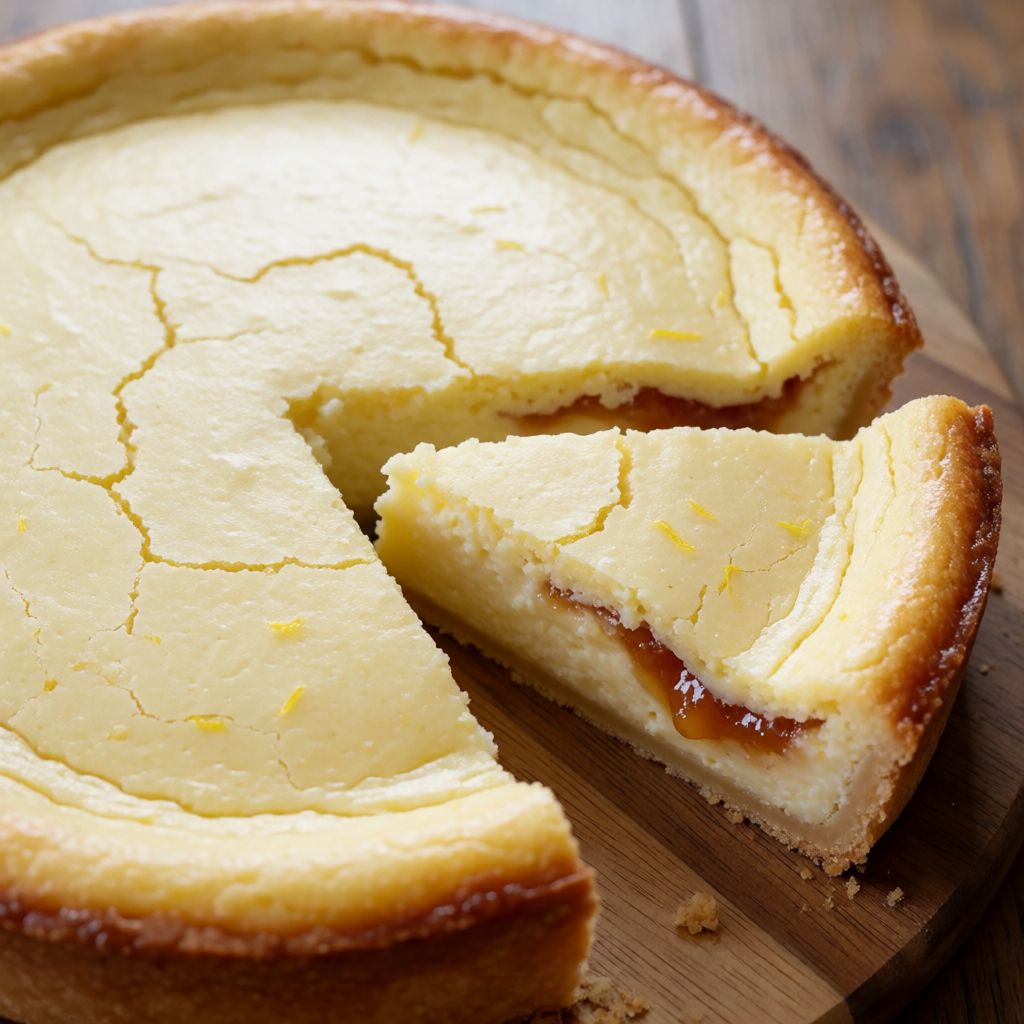
 AI photo
Flourless, Gluten-Free and Butter-Free Ricotta Pie
A light ricotta pie with a jam filling, made without flour, gluten or butter.
Labels are worked out automatically from the ingredients and can be wrong. Check the packaging if it matters to you.
Ingredients
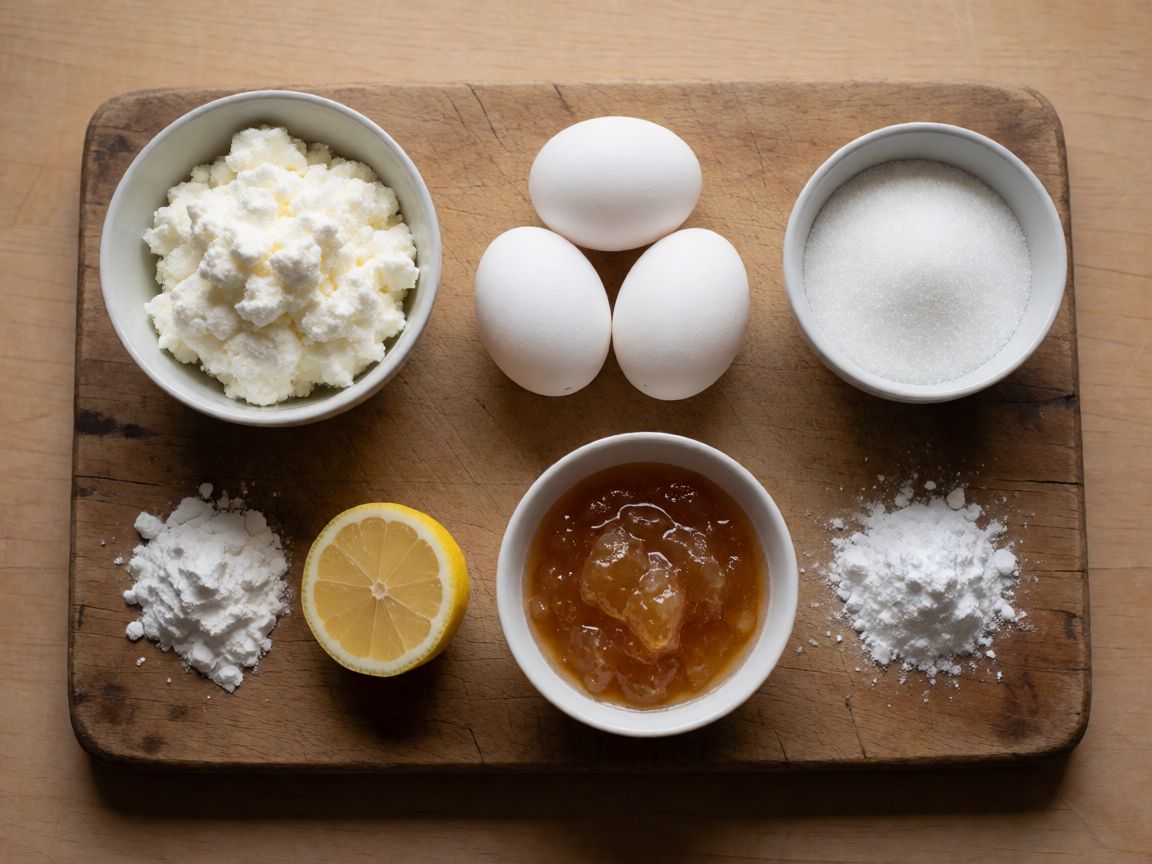
- 500 g Ricotta
- 3 pcs Eggs
- 100 g Caster Sugar
- 50 g Potato Starch
- 0.5 pcs Lemon zest
- 150 g Jam strawberry or any flavour you like
- Icing Sugar to taste






Steps
In a large bowl, place the ricotta and add the eggs. Beat with a mixer until smooth and creamy.
Add the caster sugar and lemon zest, and mix well.
Sift in the potato starch and fold it into the mixture, mixing thoroughly.
Line a 20cm round tin with baking paper, spread about half of the batter, and smooth it with a spatula.
Spread the jam evenly over the surface (you can use strawberry jam or any flavour you like).
Top with the remaining batter.
Bake in a preheated oven at 160°C for about 45-50 minutes.
48 minLet the pie cool slightly before removing it from the tin.
Before serving, dust with icing sugar.
This is a custard that thinks it's a cake. No flour, no butter, nothing to hide behind — so every mechanism has to earn its place. Ricotta gives you curds already broken up by the cheesemaker; eggs turn that loose curd into something that can hold a slice together once heat sets the proteins. The starch is not there for bulk, it's there to trap the water ricotta always carries, so the middle doesn't weep when you cut it. Get those three right and the jam stripe in the middle is just decoration with a job — it stops the pie being one solid block of the same thing.
What decides whether it works is restraint at two points: how hard you beat, and how hot you bake. Beat the ricotta and eggs past 'smooth' into 'frothy' and you're whipping air in that will puff the pie up in the oven and then collapse it the second it cools — a sunken middle isn't bad luck, it's air with nowhere to go. And 160°C is not a nothing-number: it's low enough that the egg proteins coagulate slowly and gently, the way they do in a custard, instead of seizing hard the way they do in a fried egg. Push the oven hotter because you're impatient and you get a pie with a tight rubbery skin and a wet, grainy centre — the texture failed, not the recipe.
Some say ricotta pies always need a biscuit base, because that's what cheesecake taught us. No — a base is there to hold a very wet filling up off the tin. This filling is firm enough, with its starch and its eggs, to stand on its own paper. Skip the base and you lose nothing, you just lose the bit everyone picks off the bottom anyway.
Ricotta is the one ingredient you can't substitute your way around, so choose it with care. You want the firm, slightly grainy kind sold in a tub with visible curd, not the smooth spreadable stuff sold as a dip — that one's been worked and stabilised to be creamy on toast, and it carries too much extra water into your mix, which the starch then has to fight. If your tub looks watery, tip it into a sieve for ten minutes before you start; that's not a chore, that's insurance against a soggy middle. No ricotta at all — mascarpone mixed half-and-half with cottage cheese, blitzed smooth, gets you close, though you lose a little of ricotta's faint sweetness.
The eggs are doing two jobs, not one: they loosen the curd into something you can beat smooth, and their proteins are what actually sets the pie as it bakes — ricotta alone would just stay a soft paste no matter how long you cook it. Three eggs for 500g of ricotta is a working ratio, not a sacred one; go to four if your ricotta was unusually wet, so the extra protein can still get a grip.
Potato starch is the quiet hero and the one people are tempted to swap for plain flour out of habit — don't, or do, but know what you're trading. Flour carries gluten, and even without kneading, gluten proteins will toughen slightly in the oven and give the crumb a faint chew that doesn't belong in a custard pie. Potato starch, like cornflour or tapioca starch, has no gluten, swells with heat, and sets clear and tender — that's your criterion: any starch with no gluten and a clean taste will do the same job. Cornflour is the easiest UK stand-in, gram for gram.
The lemon zest isn't decoration either. Ricotta on its own is pleasant but flat — mild fat, mild sweetness, nothing that wakes your mouth up. Zest brings bitterness and oil that cuts through that flatness the way a squeeze of something sharp cuts through a rich Sunday gravy. Use the zest only, not the juice: juice adds acid that can tighten the eggs too early, before the oven's even involved.
The jam needs no cooking skill, just restraint with the spoon — spread it thin enough that it's a stripe, not a layer, or it'll sink into the lower batter as it bakes and lose its edge entirely. Any jam works because its job is simply contrast, so go by what's in the cupboard rather than what's traditional.
Icing sugar goes on at the very end, after the pie's cooled, because sugar dusted onto anything faintly damp disappears into a wet patch within minutes — that's not you doing it wrong, that's just what icing sugar does near moisture. Dust it just before the first slice goes out, not before.
And give the pie its cooling time before you touch the tin — pulling it out hot is asking a half-set custard to hold its own shape against gravity, and it won't. Ten, fifteen minutes of sitting is the pie finishing a job the oven started. This feeds six as a tea-time pudding rather than a dessert, in a 20cm tin — a standard British round cake tin, lined well, since there's no butter in the batter to grease the paper for you.