
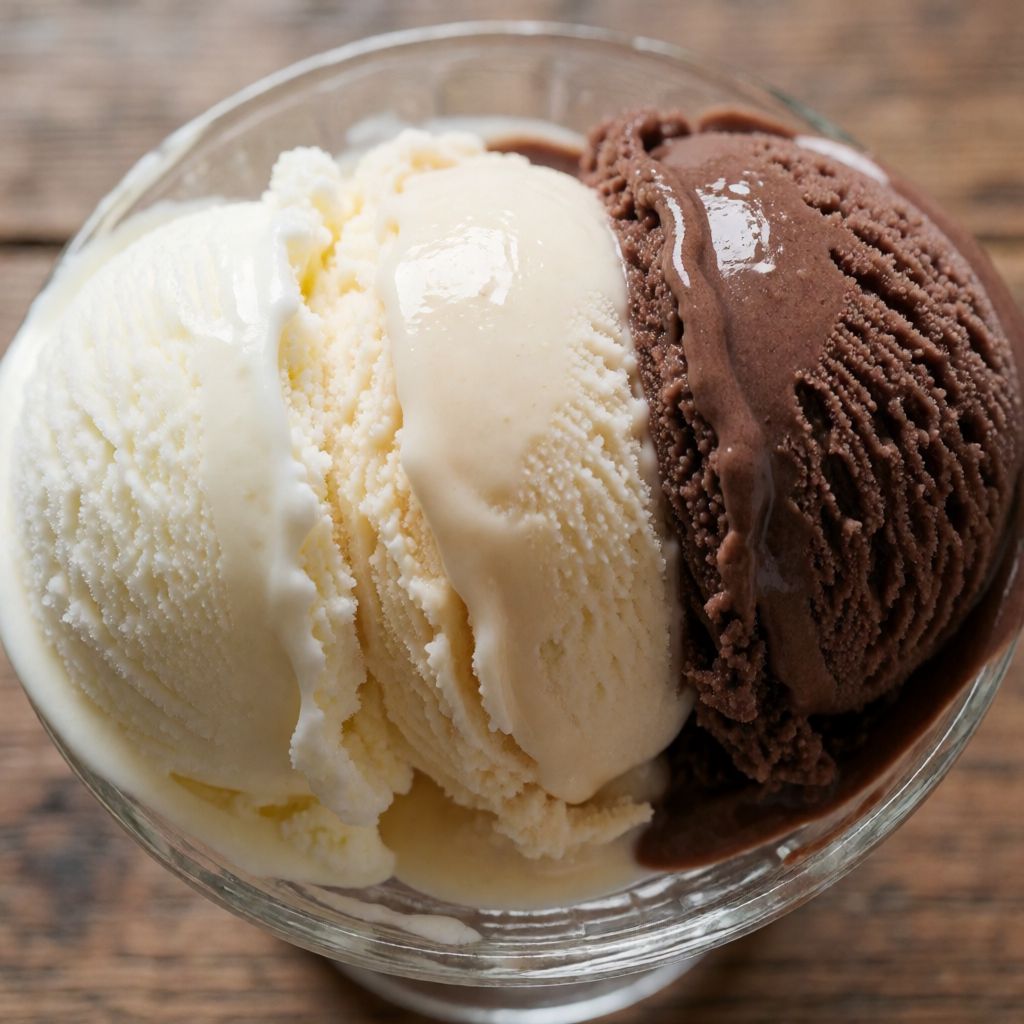
 AI photo
Rainbow Tri-Colour Ice Cream
A three-layer ice cream in chocolate, vanilla and strawberry, set in a springform tin.
Labels are worked out automatically from the ingredients and can be wrong. Check the packaging if it matters to you.
Ingredients
Chocolate ice cream
- 0.5 pcs vanilla pod
- 100 ml milk
- 200 ml double cream
- 2 pcs egg yolks
- 60 g caster sugar
- 80 g dark chocolate finely chopped




Vanilla ice cream
- 0.5 pcs vanilla pod
- 300 ml double cream
- 100 ml milk
- 3 pcs egg yolks
- 65 g caster sugar
Strawberry ice cream
- 0.5 pcs vanilla pod
- 250 g strawberries quartered
- 75 g caster sugar
- 3 pcs egg yolks
- 300 ml double cream
- 100 ml milk

Steps
Split the vanilla pod and scrape out the seeds. Put the empty pod, milk and cream in a pan and heat to 90°C.
Put the egg yolks, vanilla seeds and sugar in a clean bowl and whisk until pale and fluffy.
Remove the vanilla pod from the pan and slowly pour the hot cream into the egg mixture, whisking. Whisk briskly until well combined.
Return the mixture to the pan and heat slowly, stirring constantly, until the custard reaches exactly 80°C — check with a sugar thermometer.
Pour the hot custard over the finely chopped chocolate in a bowl and blend quickly with a stick blender until smooth.
Transfer the chocolate custard to a lidded container and chill for at least 1 hour.
60 minPour the chocolate custard into an ice cream maker and churn until it reaches a thick soft-serve consistency.
Spoon the chocolate ice cream into a 22 cm springform tin lined with baking parchment on the base. Smooth the surface and freeze for at least 2 hours.
120 minSplit the vanilla pod lengthways and scrape out the seeds. Put the empty pod in a pan with the milk and cream and bring to 90°C.
Put the egg yolks, vanilla seeds and sugar in a bowl and whisk with a hand mixer until pale and fluffy.
Remove the vanilla pod from the pan and slowly pour the hot cream into the egg mixture, whisking briskly.
Return the mixture to the pan and heat slowly, stirring constantly, until the custard reaches 80°C.
Transfer the vanilla custard to a lidded container and chill for at least 1 hour.
60 minPour the custard into an ice cream maker and churn until it reaches a thick soft-serve consistency.
Spread the vanilla ice cream over the chocolate layer in the tin. Smooth the surface and freeze for at least 2 hours.
120 minSplit the vanilla pod lengthways and scrape all the vanilla seeds onto a chopping board.
Put the empty vanilla pod, strawberries and half the sugar in a pan and bring to the boil. Stir and simmer for a few minutes.
Blend the strawberry mixture with a stick blender into a purée and pass the purée through a sieve to remove the small seeds.
Put the vanilla seeds, sugar and egg yolks in a bowl and whisk with a hand mixer until pale and fluffy.
Mix the cooled strawberry purée with the cream and milk and stir into the egg mixture. Chill for at least one hour.
60 minPour the strawberry custard into an ice cream maker and churn until it reaches a thick soft-serve consistency.
Spread the strawberry ice cream in the springform tin, smooth the surface and freeze for at least 2 hours.
120 min
This is three custards stacked and frozen in a cake tin, cut like a torte. Chocolate, vanilla, strawberry — but what you're actually building is three separate instances of the same mechanism: a crème anglaise, flavoured three ways, each one turned to ice cream and set before the next goes on top. Get the custard right three times and the dessert is basically done. Get it wrong once and you've got a pink puddle where a layer should be.
The whole thing hinges on one number: 80°C. Below that, the egg yolks haven't thickened the mix enough and your ice cream will be icy and thin, no body to it, melting into soup the second it hits a spoon. Above about 84–85°C, the yolk proteins seize and you've made sweet scrambled eggs — not a drama you can blend your way out of, because bits of cooked yolk don't dissolve back into cream, they just sit there as grit. There is no "cook it till it coats the spoon" romance here that beats a thermometer. Some say you can judge custard by eye and feel alone, and you can, after you've ruined a few batches learning what that feel is. If you haven't, use the thermometer. It isn't cheating, it's just not having wasted the cream yet.
Vanilla pod does double duty across all three layers: the seeds go into the egg mixture for flavour, but the empty pod gets infused into the hot milk and cream first — that's where most of the aroma actually lives, in the oils along the inside of the pod, not just the little black specks. If you've only got vanilla extract, use it, but add it after the custard is made and off the heat; boiling it off in the milk step wastes the alcohol-carried aroma before it has a chance to do anything.
The ratio across all three bases is roughly the same: equal-ish parts milk to cream (with cream dominating two to one), a handful of yolks, sugar, heated and thickened the same way. That consistency isn't fussiness — it means all three layers set to the same texture and slice cleanly together instead of one being icier or softer than its neighbours. If you want to swap one cream for something lighter, match the fat content roughly or your "lightened" layer will be the one that won't hold a clean edge on the knife.
Dark chocolate in the first layer isn't melted separately and folded in — it's chopped fine and the hot custard is poured straight over it, then blended. That order matters: the custard is hot enough to melt the chocolate on contact, and blending emulsifies the cocoa butter into the custard rather than leaving it as a separate fatty layer that would set hard and snap instead of scooping. Use chocolate with no added milk solids messing up the ratio — a plain dark bar, 70% or so is standard, though cheaper cocoa-heavy cooking chocolate works if your eater isn't fussy about floral notes.
Strawberries get cooked down with sugar and the spent vanilla pod before they're puréed and sieved — the cooking isn't about "developing flavour" in some vague sense, it's about driving off water so the purée is concentrated instead of diluting your custard into something that won't freeze properly (sugar and water content are what control ice crystal size here — too much free water and you get a grainy, icy layer instead of a smooth one). The sieving removes the seeds, which otherwise sit gritty between your teeth — small defect, but it's the difference between "shop-bought" and "made by someone who shortcut a step."
On equipment: you need an ice cream maker here, there's no faking three separate custards into smooth ice cream by hand-whisking in the freezer for a dessert with this structure — a domestic hob and a stick blender will get you through the custard-making fine, but the churn itself genuinely needs the machine's constant scraping and freezing action. The springform tin is doing the job a dessert ring would do in a professional kitchen — line the base with parchment so the finished torte actually comes out instead of staying married to the tin, and when you unmould it, run a hot cloth round the outside rather than forcing the clasp, because cold ice cream cracks before it releases.
Each freezing stage listed — the hour of chilling, the two hours per layer — is a lower bound, not a target to race. A London kitchen in winter and the same kitchen in a July heatwave are not the same freezer-adjacent environment; if your layer still gives under light finger pressure, it's not ready for the next pour, whatever the clock says.