
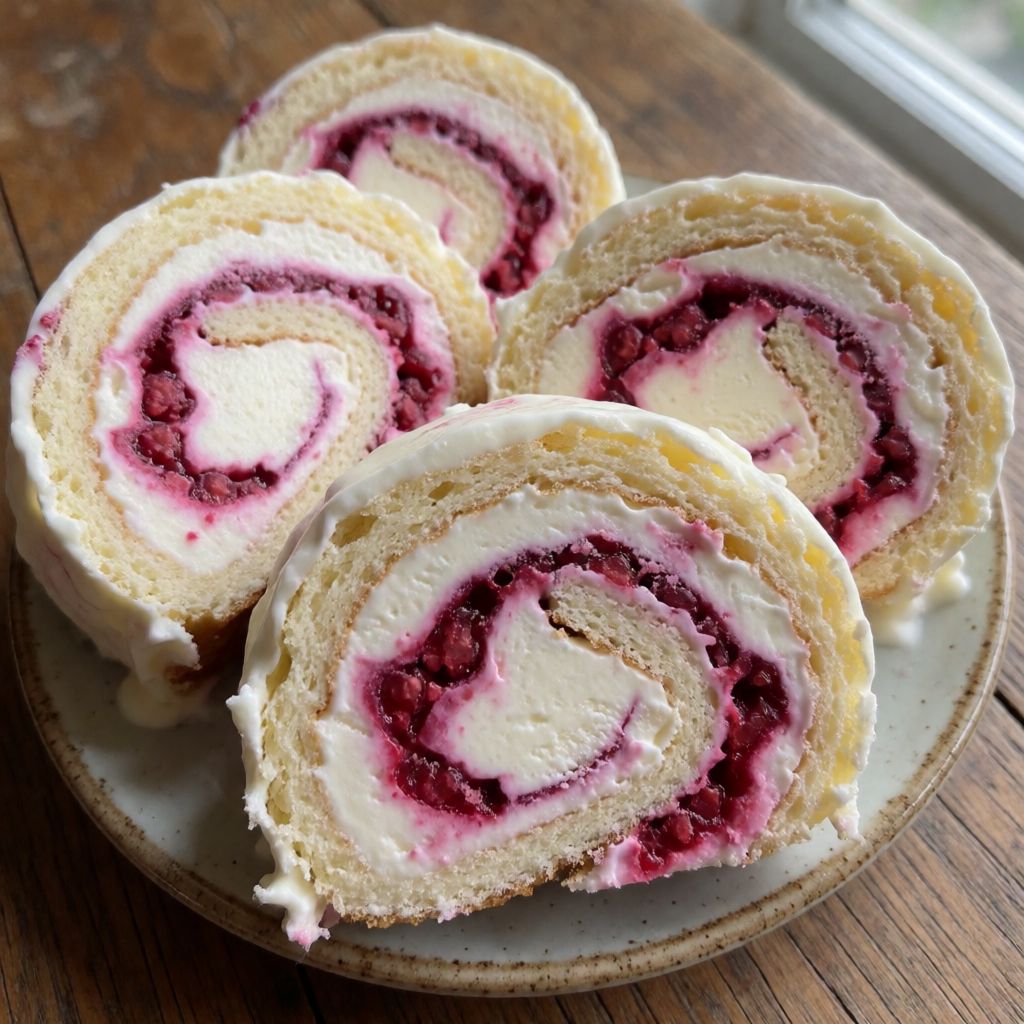
 AI photo
Ice Cream Roulade with Raspberry
A light sponge roulade rolled with raspberry jam and vanilla ice cream, finished with raspberries and mint.
Labels are worked out automatically from the ingredients and can be wrong. Check the packaging if it matters to you.
Ingredients
- 5 pcs Eggs
- 0.5 tsp vanilla sugar
- 100 g Sugar
- 110 g Plain flour
- 40 g almond flour
- 1 pinch Salt
- 1 tsp Baking powder
- 60 g Butter room temperature
- 25 g Sugar for sprinkling
- 700 ml vanilla ice cream
- 50 g Jam
- 1 tsp freeze-dried raspberries
- 2 pcs mint sprigs










Steps
Whisk the eggs, vanilla sugar and sugar to a pale, fluffy mixture.
Mix the plain flour, almond flour, salt, baking powder and butter, rubbing the butter in until crumbly.
Add the flour mixture to the egg mixture and gently stir until smooth.
Spread the batter into a rectangle about 25 x 30 cm on a baking tray lined with baking paper.
Level the batter to an even thickness with a spatula.
Bake the sponge in a fan oven preheated to 175°C for 12-15 minutes.
15 minSprinkle sugar over a sheet of baking paper and turn the sponge out onto it so the top side is facing down.
Cover the baking paper the sponge was baked on with a clean tea towel and let it cool for a few minutes.
Then carefully peel off the paper.
For the filling: spread the sponge with raspberry jam, lay thin slices of vanilla ice cream on top and roll the sponge up tightly.
Leave the baking paper wrapped around the roulade to help it hold its shape, and freeze for at least 2 hours, or until serving.
120 minBefore serving, sprinkle the roulade with sugar, freeze-dried raspberries and mint leaves.
What was changed
The lemon balm sprigs were swapped for mint, as lemon balm is not in the catalogue.
This is a Swiss roll that got cold feet — a thin almond sponge rolled around ice cream instead of cream, so it eats like a cake but hits like a sorbet. The whole thing stands or falls on one question: can you roll the sponge without it cracking, and can you roll it around something frozen without it melting into soup before you get it into the freezer.
A roulade sponge has to be thin and springy, not thick and crumbly like a Victoria sandwich — that's why there's almond flour alongside the plain flour, and why the batter gets spread, not piled, into a rectangle. Almond flour has no gluten to toughen the crumb; it keeps the sponge tender enough to bend round a roll instead of snapping. Some say a roulade cracks because the sponge is "dry" — no, it cracks because it's cold and stiff when you try to bend it. That's the whole reason for rolling it warm, straight off the tray, dusted with sugar so it doesn't glue itself to the paper.
Speed matters more than usual here, because you're not filling with jam and cream that sit happily at room temperature — you're filling with ice cream, which starts dying the second it leaves the freezer. Work in a cool kitchen, have the ice cream already sliced thin and waiting, and roll fast. The baking paper left wrapped round the roll isn't decoration — it's a cheap, improvised mould, holding the shape while the whole thing refreezes solid enough to slice.
Feeds eight reasonably, assuming nobody's just come back from a long walk and inhales a third of it alone.
Eggs are the engine of the sponge, not a binder you could skip. Whisked with sugar until pale and thick enough to leave a ribbon, they trap air that the baking powder only tops up — that's why the whisking stage takes real effort, by hand or machine, and why rushing it gives you a flat, dense sheet that won't flex. Five eggs for this amount of flour tells you it's meant to be light, not structural.
The butter goes in rubbed into the flour, not melted and poured — that's a biscuit technique borrowed for a sponge, and it's there to coat the flour in fat before liquid ever touches it, which keeps the crumb short rather than chewy. Room temperature butter is non-negotiable: cold butter won't rub in, it'll just sit in lumps and melt unevenly in the oven, leaving pockets that tear when you roll.
Plain flour gives structure, almond flour gives tenderness and a faint nuttiness that plays well against raspberry — if you don't have almond flour, ground hazelnuts work on the same principle (fat-rich, gluten-free, finely ground), though they'll shift the flavour toward autumn rather than spring. Don't substitute with more plain flour alone; you'll get a sponge that's structurally fine and texturally wrong, stiffer than it should be.
Vanilla ice cream is doing a job here, not just filling space: it needs to be firm enough to slice thin and lay flat, which means it should come straight from a proper freezer, not one that's been opened and closed all afternoon warming the door shelf. If your ice cream is already soft, put it back for twenty minutes before you touch it — soft ice cream spreads instead of layering, and a roulade with soup inside just collapses when you unroll the paper.
The jam underneath the ice cream is a thin bridge, not a filling of its own — just enough raspberry to flavour the join without adding so much liquid that it refreezes as an icy streak. Any sharp berry jam will do the same job; raspberry suits because its acidity cuts the richness of both sponge and ice cream, but redcurrant or blackcurrant jam would do the same work if that's what's in the cupboard.
Freeze-dried raspberries at the end are about crunch and colour, not flavour depth — they shatter against the cold sponge in a way fresh raspberries, full of water, never would. Fresh raspberries will work as decoration, but expect them to go slightly icy on contact and to shed juice onto the plate, which is a fair trade if that's what you've got.
On patience: this is not a dessert you can rush at the freezing stage. Two hours is the minimum for the roll to set firm enough to slice cleanly — less than that and the knife drags ice cream out instead of cutting through it. If you're serving for a Sunday lunch, make the roulade the day before and let the freezer do the long, slow, boring work while you deal with everything else.