
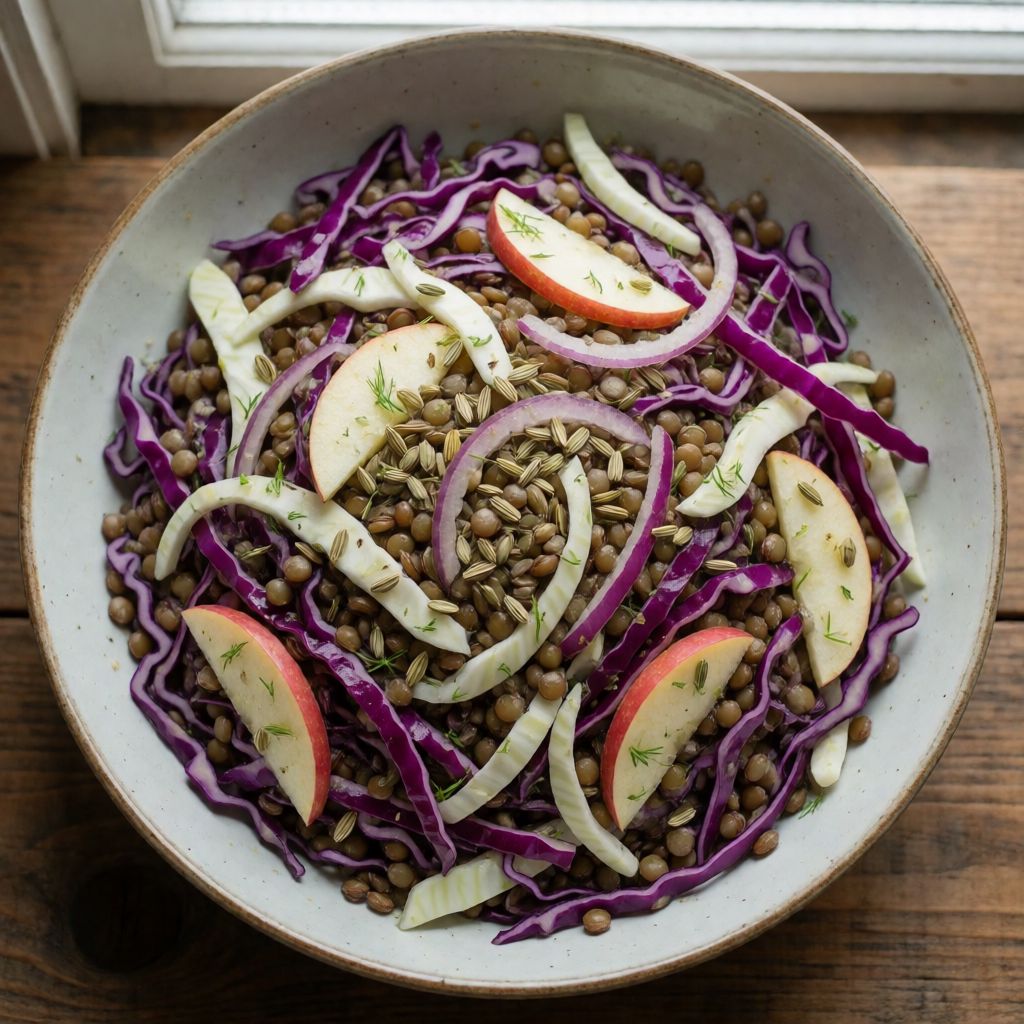
 AI photo
Winter Salad with Red Cabbage and Apples
A crunchy winter salad of black beluga lentils, red cabbage, fennel, red onion and apples with a honey-mustard dressing.
Labels are worked out automatically from the ingredients and can be wrong. Check the packaging if it matters to you.
Ingredients
- 150 g black beluga lentils
- 0.25 pcs red cabbage finely shredded
- 1 pcs fennel thinly sliced
- 1 pcs red onion cut into wedges
- 2 pcs apple finely diced
- 1 tsp fennel seeds
- 1 tbsp honey
- 2 tbsp apple cider vinegar
- 1 tsp Dijon mustard
- 4 tbsp olive oil
- salt
- black pepper freshly ground









Steps
Rinse the beluga lentils and cook according to the instructions on the packet. Drain through a sieve and rinse with ice-cold water.
Mix the cooled beluga lentils, red cabbage, fennel, red onion and half of the diced apples, then arrange on a plate.
Sprinkle with the remaining apples and fennel seeds.
For the dressing, combine all the ingredients in a bowl and whisk well until smooth.
This is not a salad you dress and forget about — it is a salad built on contrast, and that contrast is the whole point. Lentils give you the soft, earthy weight. Cabbage, fennel and onion give you the crunch that never fully gives in. Apple sits in the middle, half soft from sitting in the mix, half still crisp on top. If everything ends up the same texture, you have failed, not succeeded.
What decides whether it works is restraint at two points: how far you cook the lentils, and how long you leave the raw vegetables once they meet the dressing. Cook the lentils until a bean bends between your teeth without resisting, but still holds its shape when you tip the sieve — not until the water goes cloudy with burst skins. That cloudiness is sugar and starch leaking out, and it means you've gone past the point of return; the lentil turns from a bean into a paste.
Some say red cabbage has to be salted and massaged for an hour before it's fit to eat raw, the way you'd do for a slaw. No — because this salad doesn't want soft cabbage. It wants a shred thin enough to fold, but still loud enough in the mouth to argue with the lentil and the apple. Slice it fine with a sharp knife, across the ribs, not with the ribs — the ribs are where the stubbornness lives, and thin slicing against them is what breaks the stubbornness without needing salt or time to do it.
Start with the lentils, because they're the only thing in this bowl that goes anywhere near heat. Beluga lentils are called that because cooked and glossy they look like fish roe — small, black, round. What matters practically is the skin-to-flesh ratio: it's a thick little skin holding a small centre, so it survives a boil that would turn a red split lentil into soup. If you can't find beluga, Puy lentils do the same job — small, slate-green, built to keep their shape. Don't reach for red or yellow split lentils here; they're bred to collapse, which is perfect for dal and wrong for a salad that needs bite.
The ice-cold rinse after draining isn't a flourish. Lentils carry residual heat and a film of starch off their own cooking water. Left to cool slowly in the colander, that heat keeps gently cooking them from the inside, and the starch film turns tacky and sticks everything together in a grey clump. Shock them in cold water and both problems stop at once — the cooking halts, and the starch rinses off, leaving separate, cool, distinct lentils that will sit next to raw cabbage instead of gluing it down.
Fennel is sliced thin for the same reason as the cabbage — fibre. The bulb is basically a tight stack of celery-like strings running one direction; cut with a sharp knife or a mandoline across that direction and you get something crisp and almost sweet. Cut along the grain and you get something stringy that fights you in the mouth. The fennel seed on top is the same vegetable's voice turned up — raw seed, not toasted, so the anise oil stays bright and sharp rather than deepened and nutty. Toasting would be a different, warmer dish; this one wants the cold, clean version of that flavour.
Red onion goes in as wedges, not rings, because you want to taste a distinct bite of onion now and then, not a haze of it through the whole bowl. Its raw sharpness is sulphur compounds released when the cells are cut — rinsing onion under the tap, which some people swear by, mostly washes away flavour, not the sting, because the sting happens on your tongue, not on the onion's surface. What actually tames it is time sitting in acid and salt — which is exactly what the dressing does once it's tossed through.
Apple is diced to roughly lentil size so the two can sit in the same spoonful without one dominating, and it's used twice for a reason: half goes in early to soften slightly and release a little juice into the mix, half goes on top at the end to stay crisp and pale and give you something fresh with every bite. Cut apple browns because the knife opens cells and lets an enzyme meet oxygen — here the dressing's vinegar, tossed through promptly, is what stops it, not a separate soak in lemon water you don't need.
The dressing itself is a small emulsion, and mustard is doing real work in it, not just flavour. Its natural mucilage links the oil and the vinegar so they don't separate on the plate — whisk it properly and you'll feel it thicken slightly as it comes together. Honey rounds off the vinegar's sharp edge and gives the raw cabbage's slight bitterness something to lean against. Use any neutral vinegar with a gentle, fruity acidity if you've no cider vinegar — a light white wine vinegar works. Olive oil is chosen here for its own flavour, so don't swap it for something flavourless unless you want a quieter dressing; if the olive note feels too heavy for your palate, cut it with a plain oil instead.
Feeds four as a proper side, which in a British kitchen means it sits well next to cold cuts from yesterday's Sunday roast, holding its own crunch while everything else on the table is soft and warm. The lentils themselves are easy to find dried and bagged in any supermarket pulses aisle — no special trip required.