
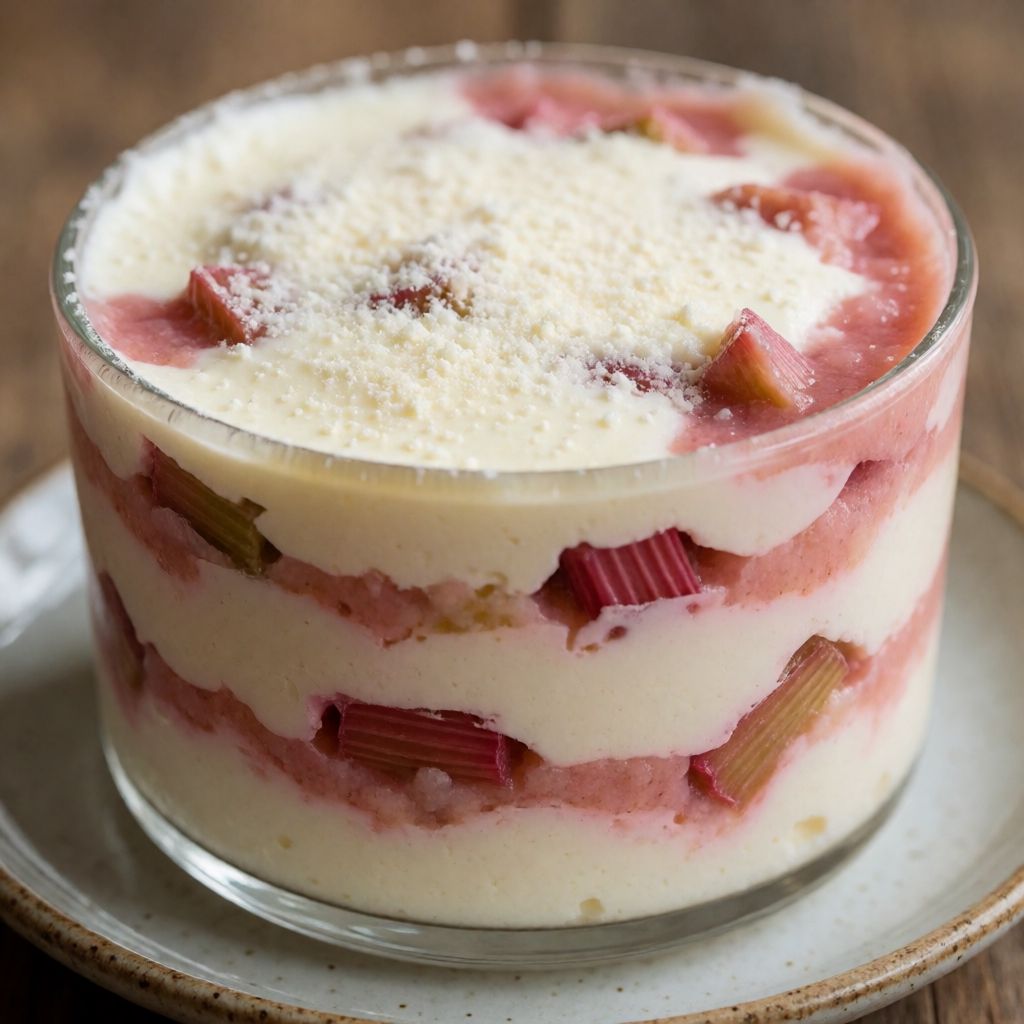
 AI photo
Rhubarb Tiramisu
A fruity twist on tiramisu, with tangy stewed rhubarb layered through mascarpone cream and sponge fingers.
Labels are worked out automatically from the ingredients and can be wrong. Check the packaging if it matters to you.
Ingredients
- 400 g Rhubarb cut into 2 cm cubes
- 180 g Caster sugar
- 1 tsp Vanilla extract
- 3 pcs Eggs
- 70 g Caster sugar
- 1 tsp Vanilla extract
- 200 g Mascarpone
- 200 g Sponge fingers (savoiardi)
- 50 g White chocolate
- 1 bunch Mint fresh








Steps
Put the rhubarb, sugar and vanilla extract into a pan and bring to the boil.
5 minReduce the heat to low and simmer for 10 minutes, then turn off the heat and let the rhubarb cool in the pan.
10 minSeparate the eggs into whites and yolks. Whisk the whites until stiff with firm peaks. Set aside.
Whisk the yolks with the sugar and vanilla extract until thick, pale and fluffy.
4 minFold the mascarpone into the yolk mixture, stirring gently until smooth. Add one large spoonful of the whisked egg whites and mix in, then gently fold in the remaining egg whites, taking care not to lose the air.
Arrange the sponge fingers in a roughly 20 × 20 cm dish and spread the cooled rhubarb compote over the top, keeping a few pieces of rhubarb aside for decoration.
Spread the mascarpone cream over the top and decorate with the prettiest pieces of rhubarb and coarsely grated white chocolate.
What was changed
The vanilla sugar for the rhubarb compote became Vanilla extract, and the vanilla sugar in the egg yolk mixture became Vanilla extract, since vanilla extract is the staple most British kitchens keep instead of vanilla sugar.
This is tiramisu with the coffee taken out and a British hedgerow put in its place. The architecture is the same as the Italian original — a dry biscuit base soaking up liquid, a pale aerated cream sitting on top, the whole thing left to settle in the fridge until it behaves like one dish instead of three. What changes is the liquid: instead of espresso and marsala, you get rhubarb cooked down with sugar until it turns from stringy and sour to soft and sharp-sweet. The biscuit still needs to drink, the cream still needs to float, and nothing here forgives rushing.
Tiramisu wasn't invented to be clever. It was a way to use up stale sponge biscuits, cheap local cheese and a glut of eggs in postwar Veneto kitchens — the coffee was there because it was a pick-me-up for tired workers, not a sacred ingredient. So: some say tiramisu must have coffee, or it isn't tiramisu — no, because the whole point of the dish was always 'what's in the larder plus a biscuit that can take a soaking.' Rhubarb, cheap and everywhere in a British garden in spring, does the same job the coffee did: it cuts through the fat of the cream and gives the biscuit something to drink.
Rhubarb: pick stalks that are firm and snap rather than bend — that's how you know they haven't gone woody. Colour tells you about variety, not quality; thin, pink, early-season stalks are sweeter and need less sugar, thick forced stalks are more sour and more watery. Always cut the leaves off and bin them — they carry oxalic acid in a concentration the stalk doesn't, which is the one genuinely dangerous myth-adjacent fact in this whole dish worth repeating. Frozen rhubarb is completely fine here: you're boiling it down to a compote anyway, and freezing has already broken the cell walls for you, so it'll collapse even faster.
Sugar, used twice, for two different jobs. The first 180g goes in with the rhubarb to pull water out of the fruit by osmosis and balance its acidity — without it you have rhubarb vinegar, not compote. The second 70g gets whisked into the yolks to help trap air as you beat: sugar crystals shear into the yolk and create thousands of tiny air pockets, which is what makes the cream thick and pale rather than just thick and yellow. Use caster both times — it dissolves fast because the grain is fine. Granulated will leave grit in the compote and won't fully dissolve into the yolks in the time you're whisking; icing sugar is the wrong substitution entirely, because it usually contains cornflour, and cornflour will deaden the egg whites later instead of helping them hold.
Eggs: separate them cleanly — any yolk in the whites and the fat will stop the whites from whipping up properly, because fat collapses the protein structure that's meant to trap air. Fresher eggs whip to a firmer peak than old ones. On raw egg safety: some say raw egg in a cream is simply dangerous — no, because in the UK, eggs carrying the red Lion mark are from vaccinated flocks and are considered safe to eat raw or lightly cooked; it's a genuine food-safety system, not folklore, though if you're serving someone pregnant, very young, or immunocompromised, that's a conversation worth having regardless of the mark.
Mascarpone is doing the structural work here — it's a fresh cheese that's basically cream with the water removed, somewhere around 75% fat, and that fat is what lets the cream hold its shape without gelatine or whipped double cream. Fold it in gently; beat it hard and the fat can start to separate and turn grainy, which no amount of folding afterwards will fix. If you've got none, the criterion is: a fresh dairy product with high fat and no sharp tang — a mix of clotted cream loosened with a little cream cheese will get you close. Standard low-fat cream cheese on its own is too watery and will give you a cream that slumps instead of sitting.
Sponge fingers (savoiardi) need to be the dry, almost crisp kind with the sugared crust, not the soft, already-moist sponge used in a British trifle. The two look similar but behave completely differently in liquid: trifle sponge is already wet and will disintegrate the moment the compote touches it; savoiardi are baked dry on purpose — originally a durable court biscuit from Savoy that could survive travel and storage — so they're built to absorb slowly and still hold their shape under a layer of cream. If you truly can't find them, a very dry, plain sponge cut into fingers and lightly dried out in a low oven is the closest stand-in, but it's a repair job, not an upgrade.
White chocolate on top is there for crunch and a change of temperature in the mouth, nothing more — grate it coarsely rather than finely so you get shards that hold their bite instead of melting into the cream the second they land. Grate it last, over the chilled dish, because a centrally heated British kitchen will soften it fast on the board. Mint goes on whole or torn, right before serving, never stirred in early — bruised mint sitting in a fridge for hours turns bitter and brown at the edges, which defeats the point of using it fresh at all. A 20x20cm dish and these quantities will comfortably feed six, and the one ingredient not listed anywhere on the card is time in the fridge — a few hours at least, so the layers stop being three separate things and start being one dessert.