
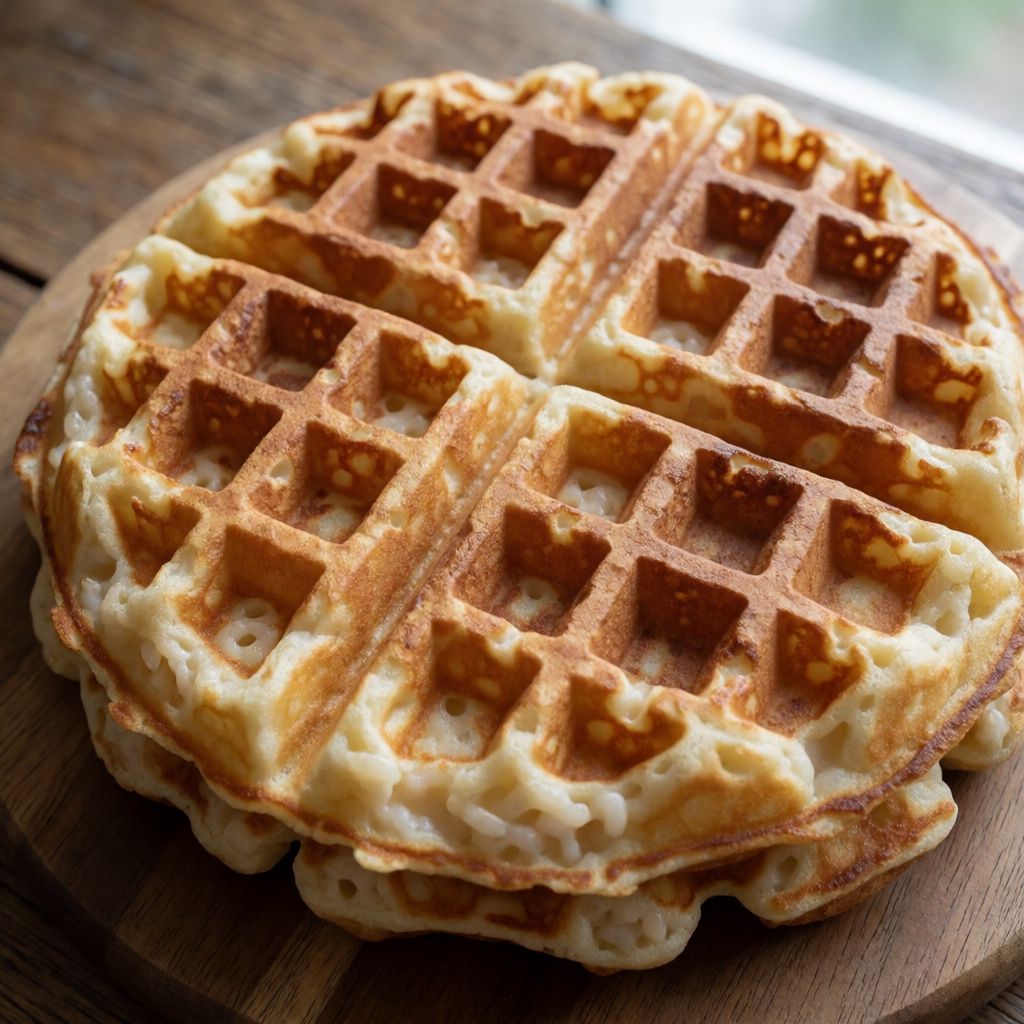
 AI photo
Rice Pudding Waffles
Fluffy waffles made from a creamy rice pudding base, served with Greek yoghurt, pomegranate, hazelnuts and pistachios.
Labels are worked out automatically from the ingredients and can be wrong. Check the packaging if it matters to you.
Ingredients
- 0.5 l Milk
- 25 ml Water
- 150 ml Pudding Rice for the pudding
- 1 pinch Salt
- 40 g Plain Flour
- 0.5 tsp Baking Powder
- 2 pcs Eggs
- 30 g Sugar
- 0.5 pinch Vanilla Powder
- 1 tsp Cinnamon
- 2 tbsp Butter for frying
- 100 ml Greek Yoghurt 10%
- 100 ml Pomegranate
- 40 g Hazelnuts finely chopped
- 20 g Pistachios finely chopped













Steps
Rinse the rice in cold water, put it in a small saucepan, add 25 ml of water and bring to the boil.
5 minPour in 500 ml of milk and bring to the boil, stirring constantly.
3 minLower the heat so the pudding barely simmers, cover and cook, stirring roughly every 10 minutes.
10 minWhen the pudding is ready (the rice is soft and the milk absorbed), season it with the salt.
Separate the eggs into whites and yolks in separate bowls. Let the rice pudding cool to room temperature, then stir the cooled pudding into the bowl with the yolks.
5 minMix 40 g of plain flour, the baking powder, 30 g of sugar, the vanilla and cinnamon, and stir this mixture into the rice pudding until smooth.
Whisk the egg whites to stiff peaks and gently fold 2 tbsp of the whisked whites into the batter, then carefully fold in the rest.
Heat the waffle maker, spoon in a few large spoonfuls of batter and bake for 3–4 minutes, until the waffles are golden brown on both sides.
4 min
This is rice pudding that got ambitious. You make a proper milk pudding first, stove and patience, then you fold it into a waffle batter and press it between hot plates until it turns into something with a crust. The result is custardy inside, crisp outside, with pomegranate and nuts on top cutting through the richness. It's a Sunday-morning dish, not a Tuesday one.
What decides whether it works is almost entirely in two places: how well you cook the rice down, and how you fold the egg whites in. Rush the rice and you get a thin, milky batter that never sets properly in the waffle iron — it'll steam rather than bake, and you'll be standing there for ten minutes wondering why nothing's browning. Bash the egg whites into the batter like you're annoyed at them and you lose the one thing that makes this different from a dense rice cake: air. The whites are there to make a heavy, starchy batter into something that can still be called a waffle.
Some say pudding rice is just "risotto rice but for dessert" — no, because the starch behaves differently. Pudding rice is a short-grain variety bred to release starch slowly into milk over a long simmer, giving you that thick, clingy texture rather than the bite-resistant centre you want in a risotto. Swap one for the other and your "pudding" either turns to soup or stays gritty.
Start with the rice itself. Pudding rice — sometimes sold as "short grain pudding rice" in UK shops — is chosen because its grains are short and starchy, built to break down and thicken a liquid rather than stay separate. If you've only got risotto rice (arborio, carnaroli), it'll work at a pinch because it shares that starchiness, but expect a slightly firmer bite and you may need a touch more milk and a few extra minutes to get the same creaminess. Long-grain rice is the wrong tool here — it resists breaking down, and you'll end up with rice floating in milk rather than rice pudding.
The milk does double duty: it's the cooking liquid for the rice and it's what gives the final batter its custard character. Don't substitute water for any of it — water has nothing to offer beyond heat, no fat, no proteins to set. If you want a lighter version, semi-skimmed will do; just know the pudding will be looser and the waffles slightly less rich.
Eggs are split for a reason that isn't decoration. The yolks go in with the rice because they carry fat and flavour and thicken on contact with the warm (not hot — you let the pudding cool first, or you'll scramble them) base. The whites are whipped separately and folded in last because that's the only way to trap air in a batter this heavy with rice and milk. Add the sugar straight into the whites if you've ever struggled to get a stiff peak — it stabilises the foam — but here the sugar's in the dry mix, so just make sure your bowl and whisk are properly clean and dry, any trace of yolk fat and the whites won't whip at all.
Flour and baking powder are a small amount for a reason: this isn't a flour-based waffle with rice stirred in, it's a rice pudding held together by a little flour. Too much flour and you mute the pudding character and end up with something closer to a rice scone cooked flat. The baking powder gives you a bit of lift to compensate for how little actual aeration a pudding-heavy batter can hold on its own.
Butter for frying — or rather, for brushing the waffle plates — needs to be a fat you don't mind tasting, since its job here is flavour as much as release. If your waffle maker is nonstick and well-seasoned, you can go lighter; a dry or elderly machine needs more, brushed on rather than dolloped, or you'll get patches that stick and tear when you try to lift the waffle.
Cinnamon and vanilla aren't just scent — cinnamon in particular has a mild antibacterial quality that older cooks leaned on when milk puddings sat around before fridges were common, though here it's purely for flavour against the sweetness of pomegranate. Pomegranate itself brings acidity that a custardy, buttery waffle badly needs; without something sharp on top this dish tips into one-note sweetness. If pomegranate's out of season or too fiddly, a spoon of tart berry compote does the same job — the point is acid, not the specific fruit. Greek yoghurt plays the same role in a creamier register — go for a thicker, higher-fat one if you can, since thin yoghurt just slides off rather than sitting on the waffle.
Hazelnuts and pistachios, finely chopped, aren't for crunch alone — they're there because a dish this soft and warm needs something with actual resistance when you bite it, or every mouthful feels the same. Any unsalted nut you like will do the job; just chop it fine enough that it doesn't fight the waffle's own texture.
A word on the waffle maker and patience. A domestic machine runs hotter and less evenly than you'd think, and a batter this dense will take longer to cook through than a thin, flour-based batter — the surface browns while the inside is still finishing. Don't chase a timer here; lift the lid gently once you smell a proper toasted-sugar note rather than a milky one, and look for colour, not minutes. If you open it too early expecting a quick waffle, you'll tear the top layer clean off and leave half the batter stuck to the plate — that's not a faulty machine, that's impatience meeting starch that hasn't set yet.