
 AI photo
Ricotta Fritters
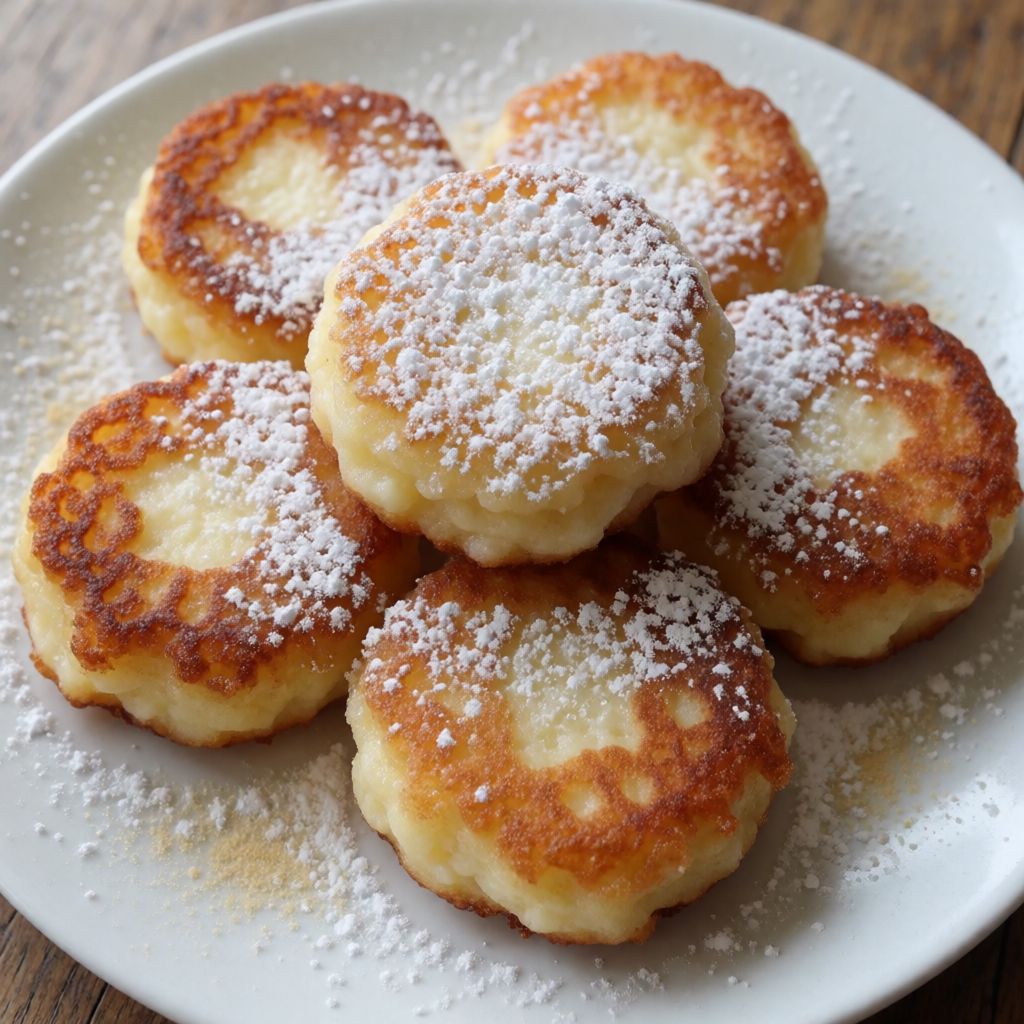
Soft ricotta fritters flavoured with lemon zest, deep-fried until golden and rolled in sugar.
Labels are worked out automatically from the ingredients and can be wrong. Check the packaging if it matters to you.
Ingredients
- 250 g Ricotta
- 100 g Caster Sugar
- 2 pcs Eggs
- 50 ml Milk
- 300 g Plain Flour sifted
- 8 g Baking Powder
- 1 pcs Lemon Zest
- Peanut Oil for frying








Steps
In a large bowl, whisk the ricotta and caster sugar together until smooth.
Add the eggs and mix well, then slowly pour in the milk, stirring as you go.
Gradually add the sifted plain flour together with the baking powder, and mix into a batter.
Stir in the lemon zest and mix thoroughly once more.
In a saucepan, heat the peanut oil to about 170°C.
Using two spoons, shape small walnut-sized fritters and carefully drop them into the hot oil.
Fry 2-3 fritters at a time so the oil doesn't cool down.
Once the fritters are golden brown on all sides, remove them from the oil, drain on paper towels to remove excess fat, then roll them in sugar.
These are not doughnuts and not pancakes — they sit in between, a spoonful of sweetened ricotta batter dropped into hot fat until it puffs and browns. The whole dish is decided twice: once when you mix the batter, once when the oil hits temperature. Get either wrong and you get something heavy and greasy instead of light and crisp.
The mixing matters because flour, once wet, starts building gluten the moment you stir it. A little gluten gives the fritter structure so it holds its shape in the oil. Too much, and you get something chewy and tight, closer to a bread roll than a fritter. So when the recipe says "mix into a batter," read that as: combine, don't knead. Stop as soon as the flour disappears.
The oil is the other half of the mechanism. At 170°C the surface of the batter sets into a crust fast enough to seal the fritter before the oil can soak in — that's the whole trick of deep frying, the crust is a gate, not a garnish. Drop the oil below that and the crust forms too slowly: oil gets in before it's sealed, and you end up with something dense and greasy that tastes of frying rather than of ricotta and lemon. Push it too hot, and the outside burns while the centre, thickened with egg and still raw, never catches up.
Some say you need a thermometer and a proper deep-fat fryer for this. You don't. A small ball of batter dropped in should sizzle hard and rise to the surface within a couple of seconds — if it sinks and sits, the oil isn't ready; if it's already dark before it floats, the oil's too hot. Your eyes and ears do the job a dial does.
Frying only two or three at a time isn't fussiness, it's physics. Each spoonful of cold, wet batter you drop in steals heat from the oil around it. Crowd the pan and the oil temperature collapses before it can recover, and every fritter after the first behaves as if the oil were 140°C instead of 170°C — soft, pale, greasy. Give the oil time to climb back between batches. That wait is the patience this recipe actually asks for; there's no proving, no resting, so this is where the impatience would otherwise sneak in and ruin things.
Use a saucepan with real depth rather than a wide shallow frying pan. A domestic hob struggles to hold a large surface of oil steady — more surface means more heat lost to the air and more splash. A narrow, taller pot holds its heat better and needs less oil to cover the fritters properly, which also means less to clean up and less risk of spitting oil over your hob.
Ricotta is the body of the whole thing — fresh whey cheese, mild, slightly grainy, with enough moisture to make a soft batter without extra liquid. Buy the kind that looks dry in the tub, not swimming in whey; if yours is wet, tip it into a sieve for ten minutes first; otherwise your batter runs thin and the fritters spread instead of holding a shape. No ricotta in the fridge — drained cottage cheese or quark, pushed through a sieve to break the curds, does the same job.
Caster sugar dissolves into the ricotta cleanly because the grains are small; granulated sugar would leave grit in the mix, so if that's all you have, give it a quick spin in a blender first. Eggs aren't just richness — the protein in them sets alongside the flour's gluten when it hits heat, giving the fritter enough structure to hold the air the baking powder pushes into it. That's the lift mechanism here: no yeast, no proving, just a chemical reaction between the powder and the wet batter the moment heat hits it, which is also why this batter goes straight from bowl to oil with no rest needed.
Milk is only there to loosen the batter to the right thickness — thick enough to hold a shape between two spoons, loose enough to drop rather than stick. Your usual whole milk, the same carton you use in tea, is exactly right; skimmed will do, it just makes a slightly less rich crumb.
Lemon zest — the zest, not the juice, because the flavour lives in the oil of the peel, and the white pith underneath is only bitterness with nothing to offer. Its job is to cut the richness of the ricotta and the oil the fritters carry out of the pan; without it, the whole thing reads flat and one-note.
Peanut oil is chosen for one reason: it has almost no flavour of its own and tolerates high heat without smoking or breaking down. The real criterion for a frying oil is exactly that — no smell, high smoke point — so sunflower, vegetable or rapeseed oil all do the job just as well if that's what's in your cupboard.