
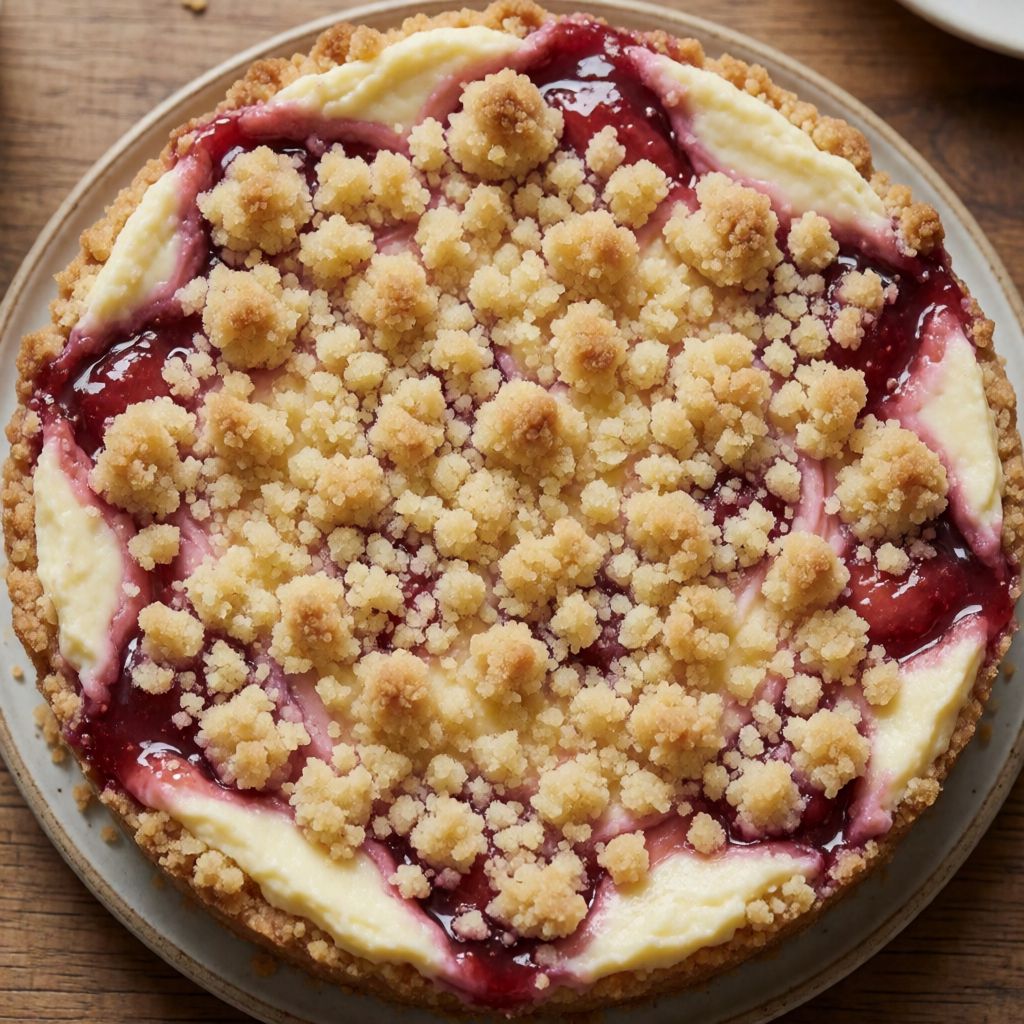
 AI photo
Crumble Pie with Ricotta and Strawberry Jam
A buttery crumble pie filled with creamy ricotta and sweet strawberry jam.
Labels are worked out automatically from the ingredients and can be wrong. Check the packaging if it matters to you.
Ingredients
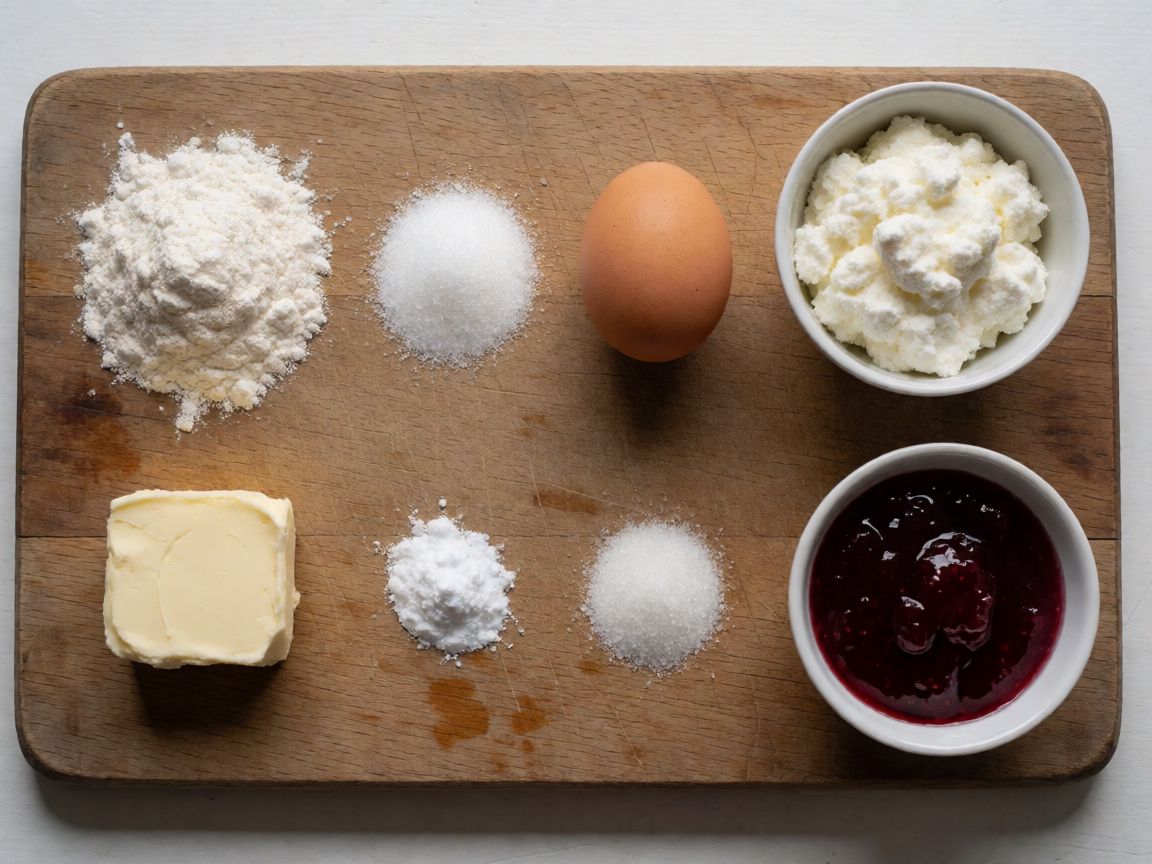
- 300 g Plain flour
- 100 g Caster sugar
- 100 g Butter cold, cubed
- 1 pcs Egg
- 8 g Baking powder
- 400 g Ricotta
- 20 g Caster sugar
- 250 g Strawberry jam







Steps
Sift the flour, add the sugar (100g), baking powder and egg. Add the cold butter, cut into cubes.
Rub the ingredients together with your fingertips until you get a crumbly texture.
Cover the bowl with cling film and chill in the fridge for at least 30 minutes.
30 minBeat the ricotta with a mixer to soften it, then add the sugar (20g).
Line a 24cm springform tin with baking parchment.
Take the dough out of the fridge and press about two-thirds of the crumble evenly into the bottom of the tin.
Spread over the ricotta cream, then top with the strawberry jam.
Cover with the remaining crumble.
Bake in a preheated fan oven at 180°C for about 30 minutes.
30 min
What you've got here isn't an English crumble and it isn't an Italian crostata — it's a cross-breed, and a sensible one. A crumble, strictly, has no base and no lid: it's rubbed butter and flour strewn loosely over fruit, open to the air, eaten with a spoon. A crostata is rolled pastry, not rubbed crumbs. This pie borrows the crumble's method — fat rubbed into flour until it falls apart in pieces — and uses it to build walls and a roof for a filling that's pure Italian habit: ricotta smoothed out, then jam. Nobody signed a treaty forbidding this. It works because the mechanism under both traditions is the same trick with butter and flour.
What decides whether it works is whether that butter stays in distinct cold lumps all the way to the oven, or softens and smears into a paste along the way. Cold, cubed butter rubbed quickly between fingertips coats each speck of flour in fat without gluing them together — that's what gives you crumbs instead of dough. Warm hands, warm kitchen, or too much dawdling at this stage, and the butter starts to melt into the flour rather than sitting inside it. What lands in the tin then isn't crumble, it's a dense, slightly greasy biscuit that forgot what it was supposed to be.
Look at what's actually in the crumble mix and you'll see it isn't a classic English one — there's egg and baking powder in there, which no self-respecting crumble topping would ever need. They're there because this crumble has a second job: holding its shape as a pie wall, not just scattering over stewed fruit. The egg gives it just enough binding to stay together when sliced; the baking powder keeps it from baking down into dense shortbread, so it stays light and genuinely crumbly rather than compacting into a biscuit brick.
The butter does the real work, and it only does it cold. Cubed, straight from the fridge, rubbed in fast — that's the whole method, and the thirty-minute rest afterwards isn't dead time, it's where the butter re-hardens after your hands have warmed it, and where the little gluten that formed from the egg and flour relaxes, so the crumble doesn't turn chewy. Patience here is an ingredient exactly like the flour is — skip the rest and you're baking a dough that's half-relaxed and half-tight, and it shows in the texture. Any firm fat that melts cleanly and has no flavour of its own will technically do the same job as butter — a flavourless hard margarine, say — but you lose the shortbread richness that butter alone gives, and that richness is most of the reason you're making this instead of toast and jam.
Ricotta is whey cheese — mild, slightly grainy, with almost no character of its own straight from the tub, which is exactly why it suits this filling. It's a surface for the jam's sweetness and colour to sit on, not a competitor to it. Beating it with the sugar isn't decorative either — it breaks down the curd and works a bit of air in, turning a grainy, watery cheese into something smooth enough to spread in an even layer. Skip that step and you bake a filling with dry, grainy patches and little pools of whey that never bound into the cheese around them. If you've no ricotta, anything soft, mild and low enough in moisture to beat smooth will stand in — quark, strained cottage cheese blitzed in a blender, even mascarpone if you don't mind it richer and less tangy.
The jam needs to be thick enough to sit still once spread, not run. If yours is on the thin side, warm it in a small pan for a few minutes to drive off water before it goes anywhere near the base — otherwise it soaks straight through the bottom crumble into the parchment and you get a soggy foot instead of a base. Any high-sugar fruit preserve that holds its shape on a spoon meets the criterion; what fruit it's made from matters far less than how set it is.
In the oven, a fan setting pushes hot air round the tin steadily, which is why 180°C fan does roughly the job a conventional oven would need nearer 200°C for — worth knowing if your oven only does one or the other. What you're watching for isn't a clock, it's colour and movement: the top crumble going from pale sandy to pale gold, and if any jam is peeking through at the edges, it should be just starting to bubble there. That bubbling is the sugar in the jam concentrating and the whole thing setting; thirty minutes is your starting point, not your finish line.
Splitting a crumble method across a filled pie rather than rolling pastry is pure domestic economics, by the way — no rolling pin, no resting a disc flat, no patching tears. You press crumbs with your hands instead, which forgives cold kitchens, hot hands, Sunday-roast-sized distraction, almost anything short of melted butter. At 24cm across this feeds six reasonably, less if your household treats pudding the way mine does.